Creator of Yoon-Suin and other materials. Propounding my half-baked ideas on role playing games. Jotting down and elaborating on ideas for campaigns, missions and adventures. Talking about general industry-related matters. Putting a new twist on gaming.
Saturday, 28 February 2015
Yoon-Suin Print Edition Update
Monday, 23 February 2015
Light Consequences, Combat Consequences, and Noise Consequences in the Dungeon
We all - those reading this blog at least - know that YOU CANNOT HAVE A MEANINGFUL CAMPAIGN WITHOUT CONSEQUENCES. A big part of the DM's job is this: thinking up likely (not punitive; not lenient) consequences of PC actions in the game, and executing them.
In the dungeon, this is largely composed of three things: the consequences of light, combat, and noise.
Noise consequences are well understood. Noise brings random encounters. But not just encounters; noise also tells the goblins waiting on the other side of the door to prepare an ambush. Noise tells the cave fisher to retreat into its hole. Noise tells the hobgoblins' prisoners help could be at hand. Noise tells the spider round the corner to get ready to pounce. PCs should hate and fear all noise.
Light consequences are similar. In the pitch black, light travels. It seeps under doorways. It reflects off damp walls. It gleams in puddles. It shines off eyes and door-handles and dropped coins to be spotted round corners. PCs carrying lights should never suprise a half-wary dungeon-dweller, and all dungeon-dwellers are wary.
Combat consequences are often thought of as damage: hit points, poison, lost equipment. Or as enemy reactions: retreats, ambushes, surrenders. What are less well represented are the environmental after-effects. Things down there in the dark can smell blood. They can smell the waste from a disembowelled orc. They can smell bile. Maybe they can even smell fear. But it doesn't take a good nose to notice bodies lying on the stony floor, or spent arrows, or broken swords, or dropped equipment, or a severed limb. After every fight, the PCs' most sensible and first thought should be: what do we do with the bodies? And what might pick up the trail we leave behind from the blood on our boots?
Thursday, 19 February 2015
Yoon-Suin is released on PDF
Yoon-Suin is a campaign toolbox for fantasy games, giving you the equipment necessary to run a sandbox campaign in your own Yoon-Suin - a region of high adventure shrouded in ancient mysteries, opium smoke, great luxury and opulent cruelty.
It contains:
- A bestiary of unique monsters, including self-mummified monks, liquid golems, tiger-beetle men, figments, and dozens more
- A new character class, the Crab-man
- A chapter for each of the major regions of Yoon-Suin, filled with random generators to brainstorm map contents, social groups, and more
- Extended rules for poisons, tea, opium, trade, deities and so on
- Extended rules for exploring the Old Town of the Yellow City, and the haunted jungles of Lahag
- Many encounter tables
- Well over 100 pre-written adventure locales
- 320+ pages of content
- Purple prose
The PDF can be bought and downloaded here: https://payhip.com/b/Utso
A print edition will be ready soon - within a week to 10 days of this blog post - for the price of £12.50, in 9" x 7" landscape format; details on this will follow.
Sunday, 15 February 2015
Storytelling and Immersion, or We Are Ahead of the Curve
He cites fan fiction communities, cosplay, Lost fandom, people tweeting as Mad Men characters, fantasy football, and so on as early examples of this. As somebody who basically only watches sport and old episodes of Frasier on TV, I generally have to take the word of people who talk about these things, but I am prepared to accept the general proposition that these phenomena are real. What amuses and intrigues me is that role playing games are completely ignored in the conversation. Indeed, when Rose said the following:
I think ultimately where it's going to go is some kind of fusion of story and game, which has not really been accomplished yet. I think that is, however, what's implied in this kind of immersive, participatory kind of story-telling...So, in any case, I think where it's going is some form that really hasn't been invented yet that very convincingly combines the very participatory aspect of games with the narrative absorption of storytelling.
It had me muttering to myself like a crazy person something along the lines of, "Duh, it was invented in nineteen fucking seventy four."
People who play D&D are ahead of the curve. We may have neckbeards and stink of cat piss but we have seen the future. We are the music makers and we are the dreamers of dreams. We've seen things they wouldn't believe: d20s rolling on the kitchen table, pencils glittering in the dark near piles of squared paper... Today is only one gaming session in all the gaming sessions that will ever be. But what will happen in all the other gaming sessions that ever come can depend on what you do today. It's been that way all this campaign. It's been that way so many times. All of games are that way.
The future is already here, in other words; it's just not very evenly distributed.
Thursday, 12 February 2015
Hit Points as Proxies for Character Traits, and the Genius of the Abstract
What isn't often remarked upon is that, because hit points are abstract, they're not really necessarily tied to health. This makes them actually fairly powerful tools for packaging information about an otherwise faceless character. Let's explain by taking three model fighters, Bill, Ben and Ted.
Bill
Bill is a 1st level fighting man with 18 STR and 1 hp. He is extremely healthy and robust, but also absurdly reckless and belligerent; in any fight he leaves himself highly vulnerable to attack through his sheer uncontrolled desire to crush his enemy. A clever opponent need only wait for an opening to deal a killing blow.
Ben
Ben is a 1st level fighting man with 18 STR and 1 hp. As a child, Ben was cursed by his father's witch lover, out of spite for his mother. Ever since, he has gone through life with a bleak fate hanging over him: he will meet an ignominous end. He does not know how or where or why, but only that some otherwise humdrum accident or mistake will bring about his death.
Ted
Ted is a 1st level fighting man with 18 STR and 1 hp. Ted was constructed by a mad archmage when a teenager, who removed every bone in his body and replaced them with glass. Ted possesses vast strength, but his skeleton is so brittle that one decent blow is enough to shatter it irrevocably.
The otherwise uninteresting and uninspiring stat, in other words, can be interpreted into something unique - because of D&D's unintentional genius for the abstract.
Wednesday, 11 February 2015
Monday, 9 February 2015
Dukes of er, Hazard, Revels & Rhymes, and Elizabethan D&D
"What would the world's first roleplaying game look like if it had been invented by a Shakespearean theater troupe instead of a wargaming club?"
Elizabethan England, or rather pseudo-fantasy Elizabethan England, is a great time frame and location to use as the setting for a D&D or D&D-esque campaign, for the following reasons:
1. It's culturally familiar for English-speakers. Obviously, it's most culturally familiar for English people and secondarily to non-English Brits, but anybody from an Anglo environment gets the language and basic cultural gist of things.
2. The geography already exists.
3. Many of the asssumptions D&D makes about the economy and society are more fitting for the Elizabethan age than the medieval.
4. The cultural artefacts are more readily accessible: Early Modern English sounds a bit weird sometimes, but it's understandable to the modern day ear. There are thus plenty of sources to plunder for ideas.
5. Shakespeare.
At the same time, the game Hazard, used as the basis for Revels & Rhymes' dice mechanic, is really interesting. It is a little complicated to understand at first, but if you play around with it a bit it's simply to pick up. It revolves around the following table:
Basically, there is a number between 5 and 9 called the Main. You then roll 2d6 against it. On a 'Nick' you win, on an 'Out' you lose, and on a 'Chance' (4, 10, or anything which isn't a Nick or an Out) you roll again: if you get that number again you win, if you get the Main you lose, and you keep rolling until one or the other happens.
The creator of Revels & Rhymes has aleteredthis slightly: rolling a 'Chance' simply indicates a draw or partial success - presumably because the author thinks rolling 2d6 again and again may get annoying at an RPG table.
He has also changed it by the use of modifiers. Essentially, you are able to use modifiers to either your own, or your opponent's, dice roll, to try to push it away from Nicks and towards Outs, and these arise from your PC's stats.
I played around with this a bit last night, and came to the conclusion that this is a nice idea, but may be missing something: Hazard is a game that was created for gambling, so what makes it interesting is really bidding on the results of the roll, just as an Elizabethan gambler would stake a bag of silver or whatever on the results. So I started wondering whether you could revamp it into a more rules-lite, namby-pamby, obscenely pretentious, new fangled high-falutin' story-gamish GHOST/ECHO or MAR Barker's Perfected Game Rules esque decision-making mechanism for negotiated results, based around bids or stakes.
Picture the scene:
The players are brought before the King. They need to pursuade him that they're not spies for a rival. The players announce what they're saying and what they aim to do. The Master of Revels then tells them to make their bid, and he will then make a bid in return.
The players discuss between themselves briefly and then announce that their bid is as follows: if they succeed, they manage to pursuade the King. If not, they get thrown in prison. The Master of Revels thinks this is acceptable, so he tells them to go for it.
The players roll a 6 initially to establish the Main. They then roll a 10, which is a Chance. (This means rolling again until they get the Main, indicating a failure, or the Chance - a succees.) They roll a 7, and then another 10, indicating they succeed and win their bid. They have persuaded the King they are not spies.
But now it is time for the Master of Revels to make his bid. He can't now directly alter what has been established, but he can tweak it. He announces that if he succeeds, the King is persuaded they are not spies, but remains suspicious they are thieves or ne'er-do-wells and will have them followed by a spy of his own. If he fails, he not only is persuaded they are not spies, but will attempt to recruit them to spy on his rival.
The Master of Revels rolls 11, discarding it, and then 9, establishing the Main. He rolls a 5, which is a Chance. He then rolls a 9 - failure! Not only is the King persuaded the PCs are not spies, he likes the cuts of their jibs and attempts to recruit them.
The structure is formalised as follows:
-Whenever a player wants to do something that requires adjudication, the MoR announces he has to make a bid and roll on it. The player must moot an outcome for success or failure amenable to the MoR.
-After the outcome has been established, the MoR then has an opportunity to make his own bid and roll on it, affecting the outcome but never outright reversing it.
-The MoR must endeavour to come up with outcomes that will move things along, rather than simply kibosh or detail things. Failure meaning the King attempts to recruit the players is a million times better than Failure simply being that the King decides he likes them, or whatever.
Thursday, 29 January 2015
The Importance of Shadowrun
I've written before about Shadowrun and considered view on it is this: Shadowrun is the most fundamentally awful and crass idea ever invented, a crime against gaming and literature and culture in general, and yet I love it. I love it because I love fantasy fiction and I love cyberpunk, and despite the fact that ice cream and steak really shouldn't, no really shouldn't, go together, in the case of Shadowrun they mysteriously do. Through some weird alchemy, a William Gibson novel which has elves and orcs running around in it works. Or rather, it doesn't work - it fails terribly - but in such a charming way that it doesn't matter even slightly.
The activities we engage in as teenagers have a great deal of value. I don't want to credit Shadowrun with much at all - in fact that era of my life was full of motivation-draining and very mildly malign influences of which that game was one. (I'm sure I could currently be the Dean of Jesus College, Cambridge or Harvard Law School or something if only I'd applied myself, rather than spending so much time pretending to be an elf, commanding Space Marines, drawing pictures of people killing each other with medieval weapons, or writing abortive attempts at fantasy novels.) Yet I will credit it with this: it filled my weekends at that age, that and playing cricket. And the importance of that shouldn't be underrated; being a 14 year old boy is pretty awful, even if you've been well brought-up and have friends - you are pestilent, uncoordinated, socially inept and just about old enough to know it - and hobbies are little rays of sunshine, little zones of self-expression and creativity and emotion amongst the general atmosphere of hangdog weirdness. They give you space to aspire, and dream beyond the dull grey skies and dull grey lifepaths of Northern English suburbs. So let me raise a glass to you, Shadowrun, and wish you good health. May you long provide solace to spotty teenagers everywhere, especially the ones who go to single-sex schools.
Wednesday, 28 January 2015
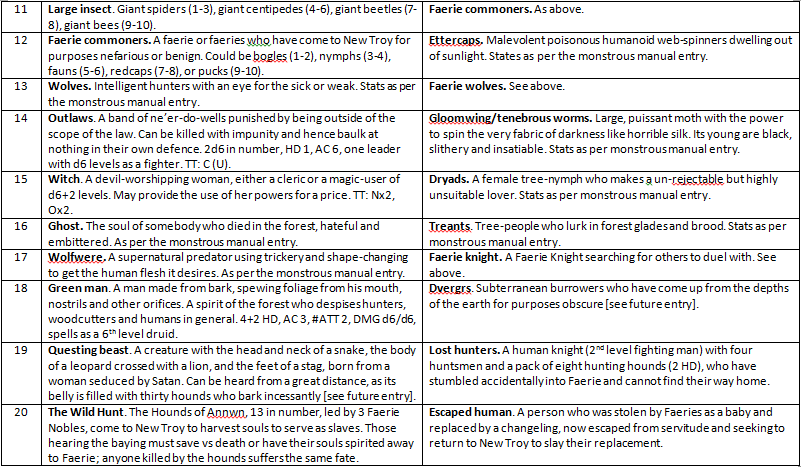
Random Encounters in New Troy: The Forest of Broceliande
I've only included stats were necessary; I intend to expand on methods for creating "generic faerie commoners", the Questing Beast, and the role of the Dvergrs in future entries.
Monday, 26 January 2015
Effusing About Writing
Bunny West grew up rich in Pasadena. She married a man named Robert Krauch in the late '50s and had four kids by him. Krach was a reporter for the LA Herald. His father was a big cheese with the paper.
Bunny West was beautiful. She was kindhearted and pathologically cheerful. Robert Krauch was possessive and ill-tempered. Everybody liked Bunny. Nobody liked Robert.
The Krauches moved to Playa del Rey in the early '60s. They bought a beautiful beachfront home. Robert developed a bad reputation. People considered him eccentric. He rode his bicycle around Playa del Rey and put out hostile vibes.
Marina del Rey was the new hip enclave. It was just a mile north of Playa. It featured boat slips and yachts and lots of groovy bars and restaurants.
Charlie Brown's opened up in '68. It was a freewheeling bar and steakhouse with a swinging clientele. The waitresses were all stone foxes. They wore lowcut tops and short dresses. The manager dug the LA Lakers. He sucked up to the players and got his girls dates with them. Charlie Brown's became a big sports hangout.
Bunny Krauch got a waitress job there. She worked the late shift and quit around midnight. She started living a separate life away from her family.
Charlie Brown's swung hard. The waitresses were always dodging passes. Bunny Krauch got pawed and groped every night.
This Don guy was the King of the Gropers. He worked as a bug exterminator. He was unattractive and well into his fifties. The waitresses loathed him. He became Bunny Krauch's lover. Nobody could figure them out.
Don was 20 years older than Bunny. Don was disgusting. Don was a flagrant ass-pincher and a drunk.
The affair went on for three years. Don and Bunny met at a motel on Admiralty Way. They met at Charlie Brown's and other restaurants in the Marina. They were not discreet. Bunny's friends knew the score. Robert Krauch did not.
Robert got a vasectomy. Bunny said she wanted to stay on the pill. The pill regulated her period.
Robert did not get the picture.
Imagine 351 pages of that and you get a good idea about how addictive reading James Ellroy can become.