After quite a hiatus of running games because of moving cities, I've recently got back in the driving seat via Google+, GMing what I've dubbed "Pendragon of Mars". It's a mashup of Pendragon and Mekton Zeta; if anybody is particularly interested in how this works mechanically I'll go into the details, but it's basically Pendragon except when the characters are in their mechs, we use Mekton Zeta. Duh.
As should be obvious: yes, Pendragon of Mars is Pendragon, but where the knights pilot mechs. We began with this initially cheesy premise in a moment of enthusiasm while puzzling over why Japanese mech-based manga is so boring; the setting sort of spiralled from there. My idea was as follows: it's Mars in the far, far future. In the ancient past - so many aeons ago it is now forgotten - the planet was terraformed by an Earth-based civilisation. The current inhabitants are unaware of this, and indeed do not really know anything beyond Mars itself - to them, Earth is just another shiny object in the sky. They have forgotten much of the ancient technology they once knew, and have regressed to a feudal state without the knowledge of how to operate the crumbling technological remains that still dot the Martian landscape. Just about the only technology of elder days which they still have available to them are their mechs - sad remnants of former times which are handed down from generation to generation of noble families like heirlooms. The knights (the only ones who are allowed to pilot or possess mechs) do not know how to make them, and do not comprehend their technology beyond making simple repairs. Other than the mechs, people live as they did in the Dark Ages on Earth.
(Conceptually, the whole thing is a bastardized mixture of The Once and Future King, Viriconium, Dune and the Dying Earth, but with mechs.)
Sessions 1 and 2 have followed the traditional Pendragon opening. I had the players create Pendragon quires in the normal way (they will be called Sir Xyre, Sir Elias, Sir Wiglaf, and Sir Owain once they are knighted) and four mechs each - a charger, two rouncies, and a sumpter. I then had them begin in an area of Mars called Salisbury, which is more-or-less a Martian version of that in the Pendragon 5th edition book.
In the first session play began with training in the region of Vagon, with each player in one of their rouncies. Sir Elad, the Castellan of Vagon and Marshall of Earl Roderick's forces, suggested they have a race, with the winner taking the position of their leader for the course of the day. Since Xyre had the faster rouncy, he modestly suggested they make the race more interesting by holding it on hilly terrain, which they did - running up and down hills in a chaotic fashion, having several falls and crashes, before Elias emerged victorious.
After the race, they returned to Vagon, and heard news that the people of the nearby village of Imber were reporting the existence of Geteit Chemosit in the area. The Geteit Chemosit are large automata made of a strange green-black stone, who attack people seemingly at random, slicing the top of their skulls off and stealing their brains - for reasons unknown - before disappearing into the wilderness. They are said to be creations of the Elders - the ancient civilisation of Mars.
The squires immediately volunteered to go off and destroy these Geteit Chemosit, which they did in a fierce melee after tracking the things for a day. But Wiglaf's mech lost the use of its left leg, and Xyre's the use of its right (and only) arm, in the fight. They therefore decided to head to the nearby city of Warminster after taking some ceramic swords and ceramic eyes from the Geteit.
In Warminster they sought refuge with the Bishop of Salisbury, at Warminster Cathedral. This is a triangular structure made out of wood, which surrounds a large hall made of pale stone, rumoured to be a creation of the Elders. While there they talked with Brother Roger, a deacon at the cathedral, who told them that there are rumours that the Elders did not die off or disappear, but buried themselves deep underground - where they remain still, in endless slumber. Because the Elders are so artful, where they hid themselves and where they are is a mystery that nobody alive could know.
They also tangled with Sir Belias and Sir Guy, two knights who form the Earl's garrison at Warminster. These two powerful knights bachelor were rather different characters - the former friendly, the other arrogant and dismissive of weakling squires. They told the squires that they had destroyed a group of Saxon raiders a week previously, and the Saxon mechs might be salvageable for parts to perform the necessary repairs on Wigla's mech's leg and Xyre's mech's arm. The next day the squires duly went to the site of the battle, where they found usable scrap but also the corpse of a Saxon mech pilot, decorated with silver and bronze and clearly a man of some repute. They decided to take him back to Sir Elad the next day. Back at Warminster Xyre and Sir Guy had an unpleasant conversation and Xyre seemed to have made himself an enemy. Asking around, he discovered that Sir Guy had an unrequited love for Lady Gwion, the attractive handmaid of Lady Ellen, the Earl's wife.
The squires returned to Sarum the following day and then went with Sir Elad to Sarum, the mighty fortress of Earl Roderick, built into a network of fortified craters. After being announced to the Earl, they told him what they had seen and done in the preceding days and were congratulated on their triumph in combat and their discovery of the Saxon. The Earl recognised the man as being a prince, the son of King Cnut of the East Saxons. He surmised that this prince and his raiders were the remnants of the Saxon horde who had been destroyed in battle two years ago at the Battle of Savernage. He ordered the squires to tell Sir Guy and Sir Belias as soon as they were able that they had achieved a great feat in killing this enemy prince.
The Earl then implied that the squires would be knighted after the evening meal. During this meal they attempted to socialise with the ladyfolk of Sarum. Xyre, mainly as a way of getting back at Sir Guy, decided he would try to seduce Lady Gwion, and invited her to go falconing with him the next day through one of her maids. Wiglaf, meanwhile, invited Lady Elaine - a beautiful adultress shunned by the rest of the court - to dance, and Elias attempted to make the most beautiful woman in the county, Lady Adwen, jealous by dancing with Lady Indeg, a 40-year old three-times widow who is always on the look out for handsome young knights. Thanks to the intervention of Xyre, who composed a ditty for the minstrels, both Wiglaf and Elias were able to dance most impressively. Later that night they are sure to be told by the Earl they will be knighted, whereupon they may be able to press their advantage with the ladyfolk further.
Monday, 1 April 2013


Monday, 18 March 2013
The Underlying Game and AD&D 2nd Edition
It's often said that the "gold standard" of XP for treasure (pun intended) is at the core of older editions of D&D. It's certainly the mechanism by which XP is awarded in most of the retro-clones. And a narrative has developed in which it is said that D&D almost requires this mechanism: it provides a driver for player action - they have to go out looking for treasure in order to advance - and also a fun challenge in its own right (the logistics of handling treasure is in itself interesting).
All the older editions of D&D, but OD&D in particular, did a very poor job of explaining this, but it seems indisputably correct. You might go so far as to say that XP for treasure is the underlying but unstated assumption on which D&D is founded.
AD&D 2nd edition did not have this mechanism. Reading through the DMG, indeed, it is rather striking that the only time XP is supposed to be awarded for treasure is as an individual class award for Rogues. XP, in general, is recommended to be given for the following reasons:
- Fun. XP is for rewarding player involvement and making the game enjoyable for others (including, implicitly, the DM). It is correspondingly to be withheld if the players are disruptive or inactive.
- Survival. Simply by the PC surviving from session to session, he or she should gain XP.
- Improvement. As players learn how to play the game better (the text states "players should also improve by trying to play more intelligently each session") their characters should be awarded XP. I'm reminded once again of Zeb Cook's exhortation to always try to improve as a player and DM.
It will be noted that two of these categories, 1 and 3, are totally external to the game world itself, and 2 is only partially connected to it. They are primarily meta-gaming awards. And they give the lie to the idea that the DM's job is to make the game fun for the players. Indeed, the "tyranny of fun", if anything, cuts in the other direction: it's up to the players to be the heart of things in that regard. It's their job to do interesting things and get involved, and it's their job to get better and better at playing D&D. I wholeheartedly approve.
There are also, of course, group awards (for defeating enemies and for "story goals" like rescuing the princess or whatever) and the aforementioned class awards. These latter are as follows:
- In general, XP is awarded when a player has a clever idea, role plays well, or encourages others to participate
- Warriors gain XP for individually defeating monsters
- Wizards gain XP for using spells intelligently, researching spells, making magic items, and so on
- Priests gain XP for using granted powers and "furthering [their] ethos"
- Rogues gain XP for using their special abilities (i.e. thief skills and bard abilities) and getting treasure
What is the underlying game for AD&D 2nd edition, then? Surprisingly, given the reputation the edition has for a) focusing on plot/story rather than strategy/tactics; and b) softening the approach of older editions, you might say that, if anything, the XP mechanism for 2e is primarily concerned with player skill.
In that sense, it is not so far removed from the approach of the past, given that gaining treasure was, to a large degree, a clear measure of success and, hence, player skill. But the 2nd edition mechanism is more holistic; it aims to reward not just in-games success but also the more intangible elements of gaming success - doing stuff, getting involved, making the experience worthwhile for all concerned. That seems to be nested in a set of assumptions about players, and would also perhaps be seen as incentivising paternalism in the DM. But nonetheless, it is of interest to me as somebody who grew up playing 2nd edition but piledrivered XP for gold and monster kills. Lying between the two stools of New and Old Schools, 2nd edition remains almost totally ignored and very much under-theorized, which I don't doubt does it something of a disservice.
Monday, 11 March 2013
Noisms' Theorem of Character Generation Length and Player Cautiousness
I am running a Pendragon game (set on Mars...it's a long story), and got to thinking about the lengthy process of character generation in that system. It takes ages to make a character, certainly in comparison to D&D. There are a lot of choices, a lot of numbers to think about, and a lot of rolls to make. It can easily take an hour.
I don't mind this process. There are horses for courses. Short, speedy character generation works for D&D and similar, because characters are commensurately throwaway and individualistic. D&D characters tend to be men with no names, who appear from the aether as a set of dice rolls. They develop personalities through play, but they are not really part of any social milieu. When they die, it's no biggie. You roll up a new one. The system supports, and implicitly expects, this.
Lengthy, involved character generation works for Pendragon, because the expectations of the game are different. Characters are part of extended social networks. They have families, homes, roles to play in the community. They are not aimless Cugel-esque rogues. They have to do things like looking for wives and punishing criminals.
It's not something that I've particularly considered before, although it's obvious when you think about it, but the longer and more detailed the character generation process for a game is, the more you would expect players to try to avoid character death in the early game. Partly this is because a long, detailed progress involves you in the character more. But mostly I think it's just a function of length. If it takes you an hour to sit down and make up a character, you are going to be much more careful about what happens to the character than if it only takes you 5 minutes - again, with the qualification that it is in the early stages of a game. (Of course, the death of a level 15 D&D character who you've been playing for over a year is going to be a horrible prospect for other reasons.)
It's hard to separate tone from length, of course, and there are so many other variables. Does starting off play with a main character and backup make you less cautious - almost like a moral hazard? What about the role of hit points (perhaps the most important variable)? And what about how enjoyable character generation is? Where the process is more enjoyable, do people mind their character dying less, and thus act more incautiously on a subconscious level?
Monday, 4 March 2013
GM as Auteur and The It's My Party And I'll Cry If I Want To Rule
Generally speaking, I favour a loose approach to GMing. I like creating detailed settings, but I usually allow the players quite a lot of leeway in the process (I might have them each say one thing about the setting, or I might let them create a handful of NPCs who they know, for example) and permit them to do what they want with their character within reason.
I think this is more-or-less standard amongst GMs, at least among those who blog regularly or post on Google+. We tend to avoid being too draconian. I wouldn't describe it as a fear of saying no, but there is a sense in which being a stickler about your setting - in which being precious about it - is seen as petty and old-fashioned. It's unusual (I think) for a GM to tell a player directly, "No, you mustn't do what you want to do in developing this character - I don't want that type of character in my game".
It is even rarer to imagine a GM saying to a player, "No, your character mustn't do what you intend him to do" once play has begun. That goes strongly against what has now become established orthodoxy wherever you look, be it on story-games.org (where players are supposed to have narrative control), within the OSR (players have complete freedom within the sandbox) or at rpg.net (where you must never judge anybody for anything or tell anybody how to behave - unless of course they have the wrong opinions, but why would you game with such a person in the first place?). It is the most arbitrary and obvious form of railroading.
Which is all well and good - generally speaking I don't want to run games in which I am constantly telling players, "No, you mustn't do that". (And here I have to stress the distinction between "No, you can't do that", as in "No, you can't understand dragon if it is not on your character sheet", as opposed to "No, you mustn't do that", as in "No, you mustn't torture that orc".) In the vast majority of cases, that way leads adolescent authoritarian bossy madness.
I do wonder whether this avoidance of "mustn't" prevents the GM from acting like an auteur, however. This, you may think, is no bad thing - indeed, there is little more horrendous than a GM who thinks he is a novelist, as we all know. But let's try a thought experiment: imagine that your GM was actually Tolkien, or Mieville, or George R R Martin, or Mervyn Peake, or RE Howard, or H P Lovecraft, or [insert your favourite fantasy author here]. Wouldn't you want to allow them to auteur things to a certain degree? Wouldn't you be interested in having [your favourite fantasy author] have complete control over the tone of the game, within reason? From time to time, wouldn't you want him to tell you "No, your character mustn't do that, because it is not in keeping with the type of game I am running"?
I don't for a second mean to suggest that if Tolkien was my GM I would want him to boss me around to such an extent that I had no control over my character. I am not making an argument for turning RPGs into interactive fiction - God knows Dragonlance was bad enough. But I would certainly want his guidance to a certain extent - I would want him, from time to time, to tell me, "No, what you are proposing just is not appropriate for my game".
Nor am I suggesting that sensible, decent people with an average level of social skills can't just sort out misunderstandings around tone between themselves in the vast, overwhelming majority of cases. But "vast, overwhelming majority" is not the same as all.
Is there anything to be gained from allowing a GM a greater level of auteurship than orthodoxy suggests? Should a GM be permitted opportunities to say, "It's my party and I'll cry if I want to"? "This is my game and I just don't think what you are suggesting is something I am comfortable with"? "Trust me that things will be better for us all if you just don't do that"?
Friday, 22 February 2013
Were-Moray Eel
It's been a while since I've posted any Yoon-Suin stuff. It's ticking away.

Were-Moray Eels are a type of Lycanthrope encountered in the coastal regions of Yoon-Suin, particularly in and around the Topaz Isles. They often live alone or in small groups, and shun other human contact, but their strength and power occasionally leads them to dominion over brigands and sea raiders. They typically have three forms: human, giant moray eel, and a hybrid form in which the facial features and torso take on the appearance of the eel but arms and legs are retained. At the top of the food chain, they accumulate toxins from reef creatures, so their bite is cripplingly poisonous: if the victim does not succumb to Lycanthropy, he may well die from catastrophic diarrhea.
Were-Moray Eel
HD: 5+3*
AC: 5
Move: 120 (60'), Swim 150' (50') in eel form
No. Att: 1 in human form; 2 in hybrid form; 1 in eel form
DMG: As weapon +2; As weapon +2, bite 1d6; Bite 1d8+1
Special: Hit only by silver or magical weapons
Save As: Fighter 5
Morale: 8
Poisonous Bite: Anyone bitten by a were-moray, in addition to his Lycanthropy check, must save versus poison. Failure results in sickness and continuous diarrhea; he can only move at half rate, and loses 1 point of CON per day for 2d6 days. If he runs out of CON, he dies. If the 2d6 days expire and he still has a CON score, he survives and regains his CON at the rate of 1 point per day.
Monday, 18 February 2013
The Authentic Local Experience
I'm not sure about in other areas of the world, but localism is becoming A Thing in Britain. For a long time home grown British things were despised, through a combination of fascination with the world outside and all its exoticism (The Empire was a bad thing, but it certainly made Britain a place that was interested primarily in foreign climes); a fascination with immigrant cultures (particularly from India and Pakistan) which replaced the old suspicion people held for them; and the legacy of industrialisation, which had taken a mostly rural population and transformed it into a mostly urban one over the course of 100 years, replacing local traditions, culture and knowledge with bland uniformity. (Any mainland European visitor to Britain will be amazed at how everybody eats the same things, all city centres have exactly the same shops, and everybody dresses exactly the same way.)
In the past 10 years or so, though, I have noticed a significant trend towards localism, particularly favouring local produce. British people have always been extremely proud of their regional allegiances, but this switch to appreciating locally-made foods and drinks is significantly new. You really notice it when visiting the countryside. Everywhere you go you find micro-breweries making local beers, local dairy farms producing local cheeses, local fisheries producing local seafood, local restaurants selling locally-sourced meats. Part of this is, I think, because of consciousness about the environment (people want to buy local because they think it means less of a carbon footprint from transportation), part of it is wanting to support British producers (I think Britain is generally a more patriotic place than it has been for probably 30 years), and partly it is lead by the BBC, which for whatever reason has been producing series upon series about British history, geography and culture in recent years.
Generally speaking I like this trend. I think the economic and environmental arguments supporting it are probably utterly bogus, but it doesn't matter: Britain is a very interesting country, with interesting local traditions and dialects and music, and with a delicious and varied cuisine which is not well represented by the shit most people actually eat.
I got to thinking about this recently because the local supermarket sells smoked Northumberland cheese, locally sourced, which is probably the most heavenly thing I have ever eaten. As I was stuffing my face with this last night, I started to ponder: is there, or could there be, a local trend in gaming? Might gamers, like foodies, become more interested in setting games in their local areas - whether fantasy-inflected or otherwise?
The advantage of the move towards the local is that knowledge is extremely high. Not to get all Hayekian on a Monday evening, but knowledge in society is dispersed and decentralised: the closer you are to something, the better you know it. I noticed that, when I ran a Cyberpunk 2020 campaign about a year ago set in the area I grew up (Merseyside), I felt a level of comfort with the setting which I don't normally have. Whenever a player asked me something, I was able to respond with the familiarity and detail which only a local person could have (and the players, also being locals, were able to flesh out their characters and the setting very easily too). It's standard for a DM to know his own setting, and nothing less should be expected. But you can't know a fictional place you've made up as well as, and in anything like the same level of detail as, you know a real-world place you know intimately.
Localism in gaming does not have to be modern. Because I grew up in the North West of England, I know the climate and geography of the place very well. I know the landscape, I know the weather, I know the way the sky looks, I know how green the grass is. It would be very easy for me to simply remove what currently exists in terms of human habitation, and replace it with a complete fantasy culture/cultures and society/societies, while retaining the geography and all of those things I know about the physical space as a wilderness. This would give a game I ran in that environment a level of authenticity I could not give a completely created fantasy setting (in, say a desert or a jungle), because of all the extra knowledge I have about how the place feels.
Of course, part of the fun of role playing is using your imagination, so I would hardly advocate only ever running locally-based games. But isn't it a notion worth considering?
Wednesday, 13 February 2013
Hexology II [Travel]
Some more thoughts on hex crawling and wilderness adventures today; this time, focusing on actual travel itself. It's my submission that a DM running a game involving wilderness travel should know and love wilderness travel; it is important in running such a game to consider not just random encounters tables and pre-positioned adventure locales, but also the more subtle issues - how does it actually feel to be out in the wild? How would wilderness encounters actually play out in practice? How does the geography itself act as both threat and tool? Of particular interest to me is the question of distance (at what distance do wilderness encounters occur?) and surprise (how is it that a party of adventurers becomes surprised?). While hiking around Craster on Monday I started thinking about those questions.


This is a field of cabbages. The plants are a probably two feet high and visibility is low; it would be extremely difficult to spot an enemy in those fields who wanted to be invisible - they could simply drop down amongst the plants and submerge themselves. Moving around on your belly to stay out of sight would pose its own difficulties, however. The plant life is thick and difficult even to walk through. And, as we shall see, this being England...

...the ground is as muddy as fuck. You would be breathing in dirt lying in amongst that. It's also demoralizing merely to walk through, and I'd imagine nigh-impossible to run over, least of all in full armour. An important consideration if a band of orcs suddenly appear from the undergrowth to the left where they've lain in hiding. They're unlikely to be hidden there, though. Look also where the path leads. The choke-point in the path between the copse of trees and the line of shrub is a more-or-less perfect ambush spot. Surprise distance here could be a matter of a couple of yards.

This is the other direction for the path above. It shows the importance of the high ground. Somebody on top of that escarpment (known as a 'heugh' locally, and the site of an iron age hill fort) could see anybody moving along that path from literally miles away. Surprise distance in this scene could be half a mile at the very least.

A close-up of the above escarpment. Difficult to climb, though not impossible (I did). Those green bushes are gorse, though - it's prickly and painful and blocks movement. And if an enemy appears while you're half way up, you may as well just drop your pants and bend over.

And the view from the top. It shows how exposed anybody would be moving in the open ground below - but also shows how difficult it would be to see somebody on the hilltop from down below. There would be almost no need for a surprise roll out here. Somebody on top of this hill would easily see anybody approaching, and could just as easily hide amongst the rocks up at the top.

A typical muddy English field - the same comments about running through that mud apply: you couldn't. If I was a band of orcs, I know where I'd be - in the copse to the left. But it's important to consider the role of animal life...

...because, although you can't see them in this photo, the woods here on the right are packed with jackdaws and wood pigeons. As soon as you approach they scatter, crying out with loud abrasive voices. Again, think about an encounter here: what would a failed surprise roll mean? It might not be that you've been spotted. It might just be that somebody has spotted the birds which you have disturbed. A nice way to build tension - the players notice a few wood pigeons suddenly scattering up ahead. They know something has flushed those pigeons. But what?

Dunstanburgh castle. People who built castles knew what they were doing: imagine trying to assault that. The House of York apparently did it during the Wars of the Roses - the solution was to blast it with cannons. Notwithstanding that, you might want to give it a wide berth - but it would have to be very wide, because it is surrounded by open ground.

A view up the beach to the castle. Beaches aren't always sandy. Those rocks are slippery and take ages to clamber over. Again, forget running. And if you're in armour heavier than leather, roll a d6 per turn: get a 1 and you fall over.

A sheep trail. Game trails are an important way to move around, because they are usually more clear than the surroundings, but they have a bad habit of leading nowhere, or going round in circles. A bigger concern is the sheep themselves: sheep are easily disturbed, and they tend to baa the alarm when a stranger appears. Again, the surprise roll might just mean the local troll has heard the sheep warning of your arrival.

Another heugh. Plenty of places to wait in ambush for anybody walking along that boggy path.

An old limestone kiln set in the trees. There could easily be something hiding in there: and it would most definitely see you before you saw it, hidden away in the dark like that. Sneaking up on that structure would be a challenge in itself. You might be able to skirt around from behind, but the chances of being heard are still high.

The long hard slog of a journey. Imagine walking through that. Now imagine doing that for a week. No wonder people didn't get about much in the medieval era.
Tuesday, 12 February 2013
Hexology I [Contents]: Lindisfarne Case Study
A while ago I put up a few posts regarding the contents of 1 mile and 6-mile hexes, mostly using Google maps to show aerial views. In light of my most recent post and the comments it generated (to do with wilderness mapping and hex crawling in general) I thought it might be illuminative to do some work on the contents of hexes from the ground up: how much might a hex contain? But also - when you stop to examine the geography of a 6-mile hex, what sort of things might be encountered? What challenges would the landscape provide?
The first of these posts is a case study of Lindisfarne, or Holy Island, a tidal island off the Northumberland coast, near the Scottish border - for no better reason other than that I happened to be there on Saturday (I've spent the last four days driving and hiking around the far North East of England). My aim here is to answer the most simple of the questions posed: what might a 6-mile hex contain?
Lindisfarne is about 2.5 miles East-West and 1.5 miles North-South - easily enough to fit into a 6 mile hex, together with the surrounding coast and smaller islands:

This makes it ideal for our purposes of investigating how many interesting locales there might be for an 'adventurer' (or law lecturer on holiday) to interact with.
Let's take a look at what's on Lindisfarne (while entering the necessary caveat: I was taking photos on my BlackBerry, which is shit, and I'm also a shit photographer, so don't expect anything decent).

This is a view across lush pastures to Lindisfarne castle, a small fortification on the only real promontory on the island. Note the flooded areas in the middle ground. These are extremely difficult to cross and would have to be worked around. Note also how big this area is. It's only a small part of the island, but it's still a large area of ground. To the right is a narrow road and a collection of houses which, today, house the local branch of Her Majesty's Coastguard.

A typical farming cottage with a wide expanse of pastures for sheep grazing around it. One of several on the island. It may just be a farmhouse, but who lives in it? What's his or her story?

The village of Lindisfarne itself. The population is around 150. As well as houses, there is a distillery for brewing mead, a few churches, a graveyard, a quayside, and a ruined priory which we shall re-examine later.

A flooded pasture, which harbours about three dozen geese. Or, if you prefer, a monster of some kind. Or, both.

An old lime kiln to the rear of the castle. This is a warren of tunnels, about 100 yards square, where people used to fire lime stone to make bricks.

The view to the rear of Lindisfarne castle. Again, a wide area of open ground, and plenty of sheep. What you can't see is that this area is boggy underfoot and difficult to walk over, and criss-crossed with rivulets which have to be jumped over.

More flooding - the pool is well over a foot deep. At the brow of the hill is a walled garden area which is strangely pristine and fertile given the bleakness of the surroundings; it could easily be imagined to be magical, or owned by a witch, or similar.

Pebbly beach stretches around much of the Northern and Eastern coasts of the island. It is covered with flotsam and jetsam - broken crockery, sheep bones, crab shells, etc.
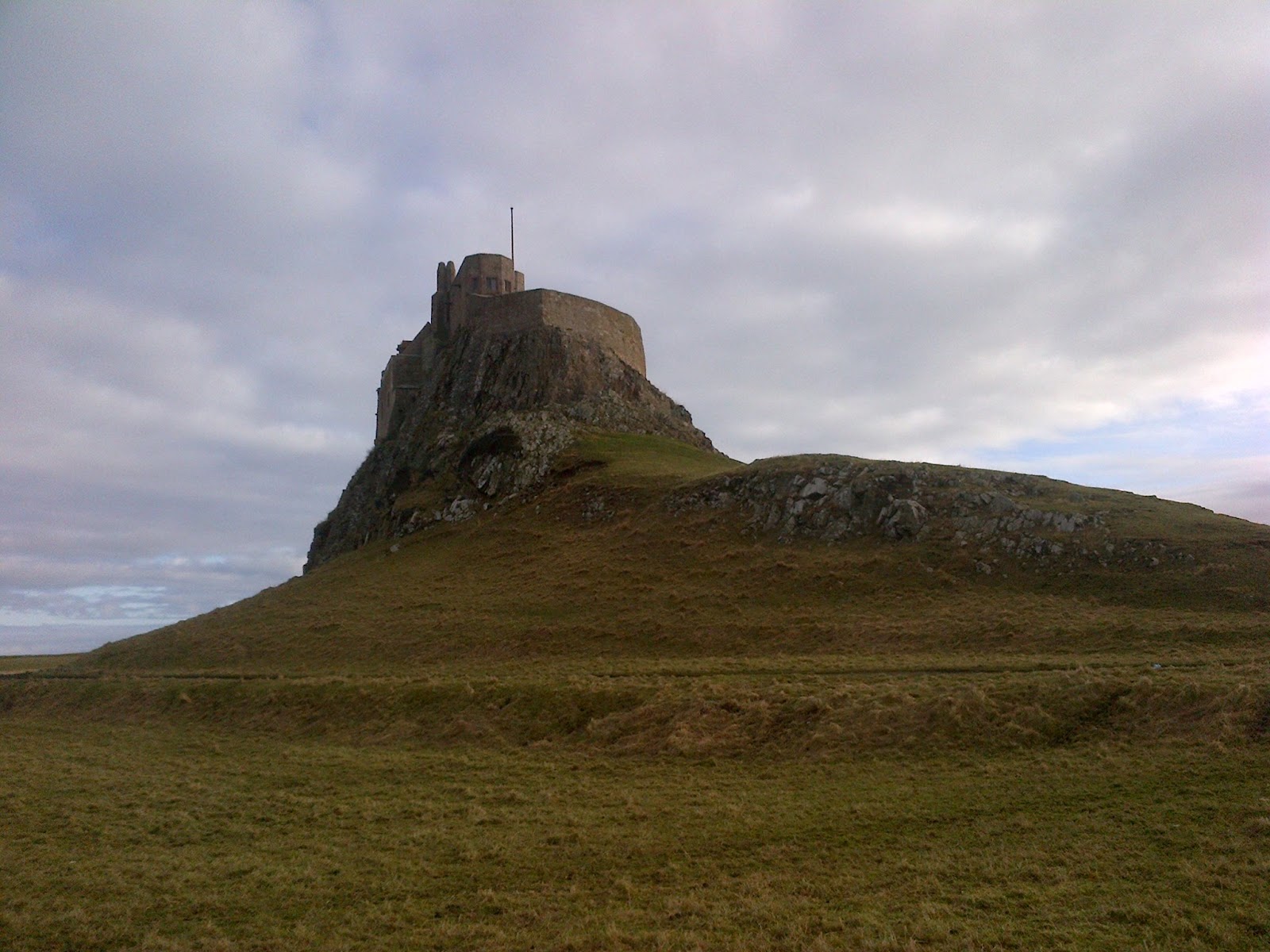
Looking up at the castle.

Looking over the sea towards the mainland. All of that area is included within the 6-mile hex: the islet in the middle of the channel, and the coast beyond, dotted with farmsteads and small hamlets.

A cemetery overlooking the sea, complete with creepy mausoleum.

Coming up a steep hillside to a church and cemetery. A spooky and evocative location, even on a sunny winter's day.

A view over the channel to the smaller island to Lindisfarne's south. I have no idea what those two towers are, but studying them was my obsession the day I was on the island. They look pretty much exactly where I would expect a pair of squabbling arch-mages to live. Again, they are within the bounds of a 6 mile hex centred on Lindisfarne.

A better view of the small islet. There is a low building of some description on it, as well as a shrine (you might just be able to make out the crucifix there).

I don't know if this is actually a well, or just a flooded dungeon or basement. There is clearly something down there worth exploring, though, don't you think?

The old priory. An extensive ruin, full of dark arch ways and unexpected corners.

A ruined watch tower overlooking the entrance to the harbour.

Another view of the ruined watch tower. Is it haunted? Is something buried underneath it? Does it harbour a hermit, a group of brigands, an evil spirit?

Boats turned upside-down and converted into huts - apparently a tradition from the Viking days. Probably housing suspicious fishermen, but I bet you can think of a dozen interesting things you could put here as a DM.

Detail of the doorway to an abandoned farm building down by the beach. Peeking through a gap I found a lot of hay and some abandoned farm machinery, but again, I bet you can think of a dozen more interesting things you could put inside as a DM.
These potentially important locales are only a taste of what is on Lindisfarne - let alone the surrounding area of coast which would potentially be covered in a 6-mile hex hex here. Put simply, there is a huge amount of game-able material just in this very tiny piece of land.
As a DM, of course, coming up with a list of 15 interesting locations for each 6-mile hex before the start of a campaign would be overkill, but there is certainly an argument to be made that at the very least each 6-mile hex in a campaign setting, particularly in a settled area, should have a handful of adventure locales within it, with more arising through improvisation during play and through random encounters. One locale per hex, or even blank hexes, simply aren't good enough.
Tomorrow: thinking about actual wilderness travel.
Wednesday, 6 February 2013
Fetishizing the Dungeon
The kids over at the rpg site are discussing whether or not the collective output of the "OSR" has been better, or could be better, than that of TSR.
My own feeling is that, whatever the answer, the OSR certainly creates better dungeoneering materials than TSR did, but the opposite side of that coin is that The Dungeon, and particularly The Megadungeon, are fetishized within the OSR to a far greater degree than they ever were during the TSR era. This is especially true of the 2nd edition period, when many of the major campaign setting materials created - Al Qadim, Dark Sun, Planescape, Spelljammer, and so on - specifically and deliberately eschewed The Dungeon as the locus of play.
The obsession with The Dungeon is a source of some mystery to me, as somebody too young to have played 1st edition. Although, equally, it's clear that it comes from a preference for that play style among the early OSR heavyweights, and that this has, in turn, influenced the development of the movement (such as it is). I like dungeons, but it's far from my favourite method of play, which would revolve around city-based and/or wilderness exploration. What excites me most is not the insular dungeon layout, but an open hex map full of interesting areas to explore and range over, and interesting locales to interact with.
In that area it's very hard to say that the OSR has produced much good at all. I could be wrong, but the only products that spring to mind in that regard are Carcosa and Isle of the Unknown, both of which I find pretty uninspired, and the Sin Nomine and Land of Nod stuff - which is good, but nowhere near extensive enough to say that it is in any way challenging of the grand TSR setting creation machine that was at work in the 1990s.
Monday, 4 February 2013
Thoughts on Buying White Dwarf
I was in my local Anonymous Supermarket the other day and saw the latest issue of White Dwarf winking seductively at me from behind a copy of Woman's Weekly in the magazine section; I couldn't resist the urge to buy it. I think it may be the first time I have bought it since around issue 195 or so - although I do vaguely remember the celebrations for issue 200. In any event, not since around 1996, when I was 15 years old. And because I haven't played Warhammer or 40k since I was about 16 or 17, I've been out of the loop for quite some time. (I was astonished to discover, for instance, a few years ago, that Chaos Dwarfs are no longer an army list.)
White Dwarf has changed a lot since the old days. I noticed that:
I enjoyed reading the magazine and found myself getting genuinely excited about the thought of buying some of the new models and maybe even collecting an army. Then I looked at the prices. £30 for 10 plastic chaos warriors? Fuck me.
White Dwarf has changed a lot since the old days. I noticed that:
- Although they still have battle reports, they are breathless, chaotic affairs where you don't have a clue what the fuck is going on - except that everybody is dying. In my day the battle reports were quite drawn out and considered. The players would describe their tactics in some detail, and although the reports were written with verve, they were relatively easy to follow and contained detailed maps showing the locations of the units each turn with their movements. Apparently they don't do that any more. The battle in the February issue is Chaos versus Night Goblins and a "slaughterbeast" was involved, but I couldn't tell you a great deal more than that.
- There is actually more than I expected on how to paint and customise the models and rules. Far more than in the old editions, at least as I remember them. I was surprised by this, because in my conception of things Games Workshop had gone down the route of Wizards of the Coast and increasingly frowned upon people doing anything remotely resembling DIY. Not so: it seems actively encouraged. (There is even an editorial from the still-active [and still alive!] Jervis Johnson explicitly telling you to do whatever the hell you want with the rules, the models, and everything else.) The how-to-paint articles are detailed, useful and extensive.
- In the same vein, they've freed up Space Marines. In the old days everybody made up their own Space Marine Chapters, but that seemed not to be encouraged by GW: I remember all the codices and articles in WD being about the Space Wolves, Ultramarines, Blood Angels, Dark Angels or nothing. Now it appears having and designing Your Own Chapter is positively encouraged.
- Far more ads - but I could just be misremembering the extent of ads in 'the old days' because I never paid attention to them.
- I was surprised to discover a lengthy section detailing the model conversions carried out by the great John Blanche and his friends. One of their creations is called "Deposed Planetary Governor Daven Kel-Rosber, penitent and executioner". I love 40k sometimes.
- There is oodles more model porn. Particularly Space Marine porn. There are metric shit-tons of photos of people's Space Marine designs, conversions, kit-bashes and paint jobs. A lot of it is incredibly impressive.
- It's amazing that I was surprised to discover there is no longer a catalogue to order models from at the back of the magazine. Of course there isn't. In the years since I was reading White Dwarf, this thing called 'the internet' has come along.
- Warhammer, and 40k, remain brilliant, compelling, dark fantasy creations - among the greatest in the history of the genre, without question, despite their ruthless pilfering of ideas from elsewhere. This issue details a 40k chaos warrior called "Vilitch the Curseling" who is a weak, stunted child who forged a pact with the chaos gods: he now controls his big, strong older brother while attached to his shoulder, from which he sprouts like a hideous growth, and he has become a mighty chaos wizard. The dark creativity of Games Workshop is as strong as ever.
- They have a girl working for them now, and she's actually kind of cute.
I enjoyed reading the magazine and found myself getting genuinely excited about the thought of buying some of the new models and maybe even collecting an army. Then I looked at the prices. £30 for 10 plastic chaos warriors? Fuck me.
Subscribe to:
Posts (Atom)