Creator of Yoon-Suin and other materials. Propounding my half-baked ideas on role playing games. Jotting down and elaborating on ideas for campaigns, missions and adventures. Talking about general industry-related matters. Putting a new twist on gaming.
Thursday, 17 January 2019
Yoon-Suin is Not an Analogy for Anything or Anywhere
Wednesday, 16 January 2019
Revisiting 40k: Orks
The first observation (apart from fucking hell things got expensive) is that something seems to have happened to the Orks: they haven't gone away exactly, but their role - I am judging this by the number of other factions, the number of models available in shops, and other external paraphernalia like White Dwarf and the novels and codices - seems very much diminished. When I wur a lad, Warhammer 40k was basically Space Marines, Imperial Guard, Eldar, Orks, and Chaos. Tyranids had, I think, just begun to become a "thing". Now, from what I can tell, there are three types of Eldar, three types of Chaos army (more if you include separate codices for Death Guard and Thousand Sons), all manner of different Space Marine armies, something like eight (eight!) different non-Space Marine human armies broadly conceived, new factions like the Necrons and Tau... and then, somewhere lost in the middle of all this, Orks.
I wonder if this observation is accurate. Regardless, I will idly speculate that is partly because:
a) Orks have been around for so long and the Games Workshop version of the "orc" - markedly different to that given us by Tolkien - is so influential in popular culture that they are almost now part of the furniture and hence can't escape being thought of as old hat;
b) There is too strong a humourous (at least, attempted humourous) streak in the orks for modern Games Workshop and especially modern 40k, which now gives off a vibe of being relentlessly and oppressively humourless which it never used to;
c) There was always too much of a conceptual overlap between Orks (a hostile external force which unwaveringly seeks to destroy and dominate mankind through force) and Chaos (a hostile external force which unwaveringly seeks to destroy and dominate mankind through force and other more interesting insidious means), and this may finally be causing Orks to be eclipsed: they just aren't quite as compelling as enemies as heretical and corrupted humans and grotesque daemons, and the only thing they had going for them (a sense of anarchic fun) doesn't have the traction it once did (see point b) above).
Tuesday, 15 January 2019
Billy Liar and Tolkien's Sub-Creation
There are certain hobbies - D&D, certainly; model railways and model village-making, definitely; arguably also military-modelling - for which the creation of miniature worlds is a chief component. Whether it's a DM creating his own campaign setting (which could be literally an entire world or just a small region of one), a model railway enthusiast setting up a rail network complete with villages and mountains in his attic (like, weirdly, Jools Holland), or a military history enthusiast setting up a diorama of a battle in his study, these people are united by an interest in a peculiar activity: the making up of imaginary places for its own sake.
There is a certain armchair psychological view that would have it that this sort of hobby is the exclusive preserve of socially-inept neckbeards who live in their mothers' basements and compensate for their complete lack of real-world success and influence by playing God with made-up places where the shackles which currently bind them do not apply.
The best statement of this view is probably Billy Liar, the novel/play/film about Billy Fisher, a young man still living with his parents, with a dead-end job, who fantasises about becoming a comedy writer, compulsively lies to make his life sound much more interesting than it really is, and spends much of his free time dreaming about a made-up place he calls "Ambrosia", of which he is the ruler. It's a kind of tragicomedy about a character who is endearing but also sort of monstrous: a warning about the perils of daydreaming.
Tolkien would take a different view. For him, God was the creator par excellence, and because we are made in his image we have a desire to create, too (to "subcreate"). This manifests itself in different ways, and can be good or bad (for Tolkien, staunch Catholic that he was, acts of subcreation which echo God's creation honour Him and are therefore good; those which mock it are bad) but all our creative (subcreative) activities are inescapably done in that context.
I think, though, that there is a perfectly credible non-religious interpretation of Tolkien's thesis, though, which is simply that human beings clearly have an urge to make places of their own. It's in D&D and model railways, but it's also in fiction writing, in gardening, in DIY, and in any sort of painting that isn't strictly representative. There is an impulse in all of us to take joy in, broadly speaking, imposing a desired sense of place in either physical reality or figurative-imaginative space. The socially inept nerd down in the basement drawing up his never-to-be-played D&D campaign setting is doing something deeply and wonderfully human, and should be congratulated for it.
Monday, 14 January 2019
Good Non-Fantasy/SF Novels for Fantasy/SF Fans
- We Have Always Lived in the Castle by Shirley Jackson. Could possibly be categorised as horror, but isn't really. I don't think it is the work of genius it is sometimes cracked up to be, but it's a very effective little novel you can read in one sitting.
- The Magus by John Fowles. You can't read this one in one sitting. You might want to, though. Possibly the best literary thriller ever written? I can't think of a rival candidate that comes close. Again, it could be categorised as horror, or fantasy, but isn't really either.
- Sophie's World by Jostein Gaarder. One of the rare huge bestsellers that I think deserves it.
- The Name of the Rose by Umberto Eco. I mean, come on.
- Azincourt by Bernard Cornwell. You all know who Cornwell is and you have all read some of his books, of course. This is a lesser known one, but one of his better efforts (I think).
- Miss Smilla's Feeling for Snow by Peter Hoeg. Kind of feels like a technoir/cyberpunk novel, even though it isn't.
- The Mysterious Mr Quin by Agatha Christie. Okay, it isn't a novel, but it has that character. It's Christie's strangest and, I think, best work: not fantasy, but almost like proto-slipstream fiction - stories about what happens when the real world touches something that isn't quite real itself.
Friday, 11 January 2019
The Silence Around a Predator
There were no little birds around, though, of course. Normally my neighbourhood, if you stop to listen for it, is a riot of background bird noise, and there are constant comings and goings of feathered life - from wrens all the way up to herring gulls. When the sparrowhawk is around, they scarper. God knows where. Eerie silence descends. (You really notice the constant noise birds make when it isn't there any more.) The exception is crows and magpies - they'll try to chase off the intruder, and are apparently the only ones with the balls to pull this off.
It got me wondering: what kind of effect would a griffon, dragon, manticore, etc. have on the animal life around it? How far would the radius of silence around such a creature be? What would the local fauna do if they saw a griffon, no matter how apparently-blissfully high in the sky it might be? Would a herd of deer squirrel themselves away in a wooded hideout like birds reacting to a sparrowhawk, or would they do what gazelles do on the Serengeti and start prancing?
To operationalise this phenomenon, a random encounter with a predator when the PCs are not surprised should probably be preceded by clear activity on the part of other animals in the area - perhaps in quite a big area in the case of a big (flying) predator. When the PCs are surprised, it indicates that the predator has successfully camouflaged or hidden itself - or simply that they've badly blundered.
Thursday, 10 January 2019
My Tin Ears
- Dr Who. The BBC does documentaries well, but is almost incapable of producing drama that doesn't make me want to cringe myself into a ball and then roll into the nearest bin. (I make an exception for the old 1990s Pride & Prejudice series - catch it now on Netflix.) Dr Who is horrendous. Like watching somebody scratch their nails down a blackboard for an hour. Have you ever bitten into a sheet of tin foil? Try it now. Nasty, isn't it? That's what watching Dr Who is like for me.
- Superheroes. Hearing about some superhero comics, I am often intrigued. They seem to be full of interesting characters and ideas. I get why intelligent people like them. But, fundamentally, I just don't like looking at the pictures. For me, the thrill of fiction has always come from picturing things for myself, in my own imagination. Comics thrust the artist's vision into my head, and it is never as interesting as what I would have come up with myself just by reading words on a page.
- Vampires. Even without having been done to death in recent years, and transformed into annoying emo-teens in the process, vampires never interested me particularly. Ooh, a guy in a suit who is going to suck your blood and doesn't like garlic. Scary.
- While we're at it, gothic horror in general. I like my horror to be of the more prosaic variety: the humdrum rendered terrifying by incongruity or skillful manipulation by the author. Gothic horror is, in essence, about scary things self-consciously visually representing themselves as scary; I have no interest in it as a consequence.
- Dark elves. It is easy to take pot shots at D&D drow and RA Salvatore. But my complaint is broader than that, and runs as follows: elves are most interesting when presented as morally ambivalent, capricious, inscrutable and fey - basically, in the manner in which Tolkien gives us the Noldor in The Silmarillion. Dividing elves into "good" and "bad" is the ultimate banalifying impulse. Elves are better when they're neither.
Wednesday, 9 January 2019
2nd Edition: The Friendship Edition
All that said, I have a big soft spot for 2nd edition and its aesthetic. One of the strongest themes running through that era of D&D - it is all over the art, the fiction, the way the rules are presented - is friendship. 1st edition AD&D PCs are rogues and ruffians who are thrown together through pure self-interest. 2nd edition AD&D PCs, on the other hand, are buddies. They get along well together. They are Tanis and Flint - Legolas and Gimli. They have each other's backs. They make jokes about each other. This is what 2nd edition AD&D PCs look like:
The utter ludicrousness of this painting (who are they supposed to be posing for? Are there cameras in Faerun now - or are they standing for a painter with an easel?) shouldn't detract from its charm. This is a group of people saying yes, we are not alike, but we are comrades and friends who achieved something together. We are more than the sum of our parts.
It is a short step from there, of course, to PCs having plot immunity and fudging dice rolls to keep them alive, and so one should certainly tread with caution, but I think the central message is an interesting one. It is not just making the superficial point: people of different races and backgrounds can get along. When one thinks of what is undoubtedly the beating heart of 2nd edition, the Dragonlance novels- if you'll forgive me for bringing up that topic - it is actually saying something a bit deeper: people who have fundamentally different views (Raistlin, Flint, Tas, Sturm) can also get along. Friendship and loyalty to the group trump personal differences of opinion. There are bonds of comradeship which are stronger than arguments about points of principle. (The entire thrust of Planescape seems to be a statement of this position writ large.) I am sympathetic to that idea, and I think it is what genuine community (more about that in a future post, maybe) is all about. It is a good tenor to adopt, I think, with the kind of audience 2nd edition was aimed at - i.e. older children and adolescents.
Tuesday, 8 January 2019
The Lost Moon of Mercury
Naturally enough, my first thought was: let's imagine there was a moon of Mercury in the mid 70s, but it disappeared. This is because:
a) Aliens took it
b) It is the ghost of a destroyed moon which only appears at certain times or in certain circumstances
c) It is a demigod
d) "That's no moon - it's a space station" (but possibly long dormant and only recently reactivated?)
e) It's a moon which has been turned into a spacecraft a la The Sparrow
Either way, room I think for an interesting scenario combining near-future hard-SF and horror in the vein of Event Horizon or Sunshine?
Monday, 7 January 2019
A Small Experiment
Many others came before him. Many other came after. This history begins with him because it must begin, and it must begin somewhere.
He came to the Brothers' island on a boat he hired from the fisherwoman Malavin, a widow of forty summers with forearms as hard as varnished oak, who lived off the silver-green tench of the inner lake. He told her his name was Pyotr, and that he had also made a living from the water. This was a half-truth. He had been a river pirate, once. Sailing up and down the mighty waters of the steppe lands in a longboat, sleek, quick and deadly, with his greedy crew. Preying on fat merchant boats gorged on treasure like an otter catching roe-filled salmon swimming upstream to breed.
His work, as he called it, had eventually taken him south to distant Trapzon, where he fought in the pay of the Kastrioti, raiding the ports of the Circassian coast. He read of the Ring Lakes on a scroll in the library of a monastery in Epidamnos as he sat recuperating from a dagger-thrust to the ribs, given to him by a whore in the throes of love-making in a bungled attempt to kill and rob him. Strong again, he left the warm south, where he no longer felt the people could be trusted, and made the long journey to the damp and misty north. He wanted to see what fortune he could find in the caves which the unknown author of that scroll had described.
Malavin delivered him to the muddy, pebbled shore of the Brothers' island and did not herself get off her boat. They nodded to each other as she slowly rowed her way back through the drizzling mist towards the other shore. He had given her two gold coins embossed with the image of the Autokrat of the Kastrioti. They would be spent in Arinagour on mead and goat meat, and examined with great curiosity and suspicion by Malavin's friends and acquaintances there.
The island in the middle of the inner lake is as the scroll had described it: a small hillock, with twelve rowan trees around its skirts and a chunk of granite as big as a house on its top. The rock loomed above him in the dank morning light, implacable like the haunch of an ox hunched against the wind and rain. The scroll had said there was a mighty crack in that lump of stone, wide and tall enough for a horse to enter if it could, and that it could be found on boulder's north face in winter, east face in spring, south face in summer, and west face in autumn. Now it was autumn. And Pyotr, sure enough, found the crack facing west.
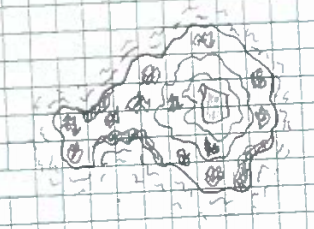
He slipped into the blackness inside, out of the rain. Underfoot the soil was soggy from the weather, but within two paces it became dry. The ground thereafter rapidly inclined downwards, creating a steeply descending tunnel, a yard or so wide; the weak gleam of grey light from outside did not illuminate it. Pyotr crouched to the ground and listened for a while, breathed in the stale scent, put his attention to the skin of his face to feel if there was any movement in the air. There was nothing: stillness, silence, emptiness.
He had with him flint, a little kindling, a torch and some oil. In seconds he had a flame. Light and warmth filled the space around him. Below his feet, the tunnel floor: rocks and stone. On either side and overhead, rough granite. Beyond the glow - blackness.
He was still for a long time before he started to edge his way downwards. Eventually he crept forward, his torch in his right hand, the fingertips of his left touching the wall of the tunnel as if to comfort himself with its solidity. The incline was steep. He trod carefully. Step by step. For ten, then twenty, then thirty yards. As he descended, the air grew warmer - the heat of the torch held close by the blanket of rock around him. Every short while, he would pause, and listen. There was no sound except for his own breath and the faint crackle and snap of the flame. Eventually, he would continue.
Finally, the ground beneath his feet levelled off and the tunnel ended, and seemed to open up into a wider space before him - a room, a cavern, or a wider tunnel - just visible in the faint glow of the furthest reaches of the light of his torch. He stood still and listened for long minutes. And then, achingly slowly, he began to edge forward. The fingers of his left hand no longer touched the wall of the tunnel. They went to his side, where he kept a knife.
It was not long before the light of the torch revealed that what lay at the end of the tunnel was no cavern. The floor was, quite clearly, tiled. Black and white squares, each about a square foot, were slowly and delicately revealed by the torch's glow. He gently slid his knife from its sheath and held it like a dagger, its blade close to his wrist.
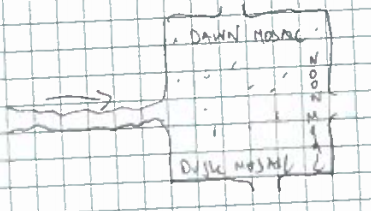
When finally he reached the end of the tunnel, he could see out into a square chamber, illuminated flickeringly and dully copper-orange by the torch light.
He was standing in an entrance in the middle of one wall. In the middle of each of the other three walls was, likewise, a doorway - a black gulf, a hole, big enough for a man to enter. On each of the walls were smaller tiles, arranged in detailed mosaics. And above, the ceiling was low, and black. It alone was not tiled.
He did not yet step into the room. He counted the floor tiles and measured the chamber as 6 yards square. Then, he looked up at the ceiling. It was a single slab of stone, painted in the deepest, darkest and purest black, but flecked all over with tiny specks of white that seemed to shimmer iridescently even in the dim torchlight. The firmament.
Then, he studied the wall to the left. The entire wall was a single mosaic, the only gap being the entranceway itself, a block of absolute darkness. The image was of the sun, an orange globe covering the left hand side of the wall, with rays of orange spreading from it from left to right. The dawn.
In the wall to the centre, the image was of the sun, but this time in the middle of the wall, and yellow, with yellow rays spreading out in all directions. Noon.
In the wall to the right, the image was again of the sun, but now to the right hand side, and red, with red rays spreading from right to left. Dusk.
Pyotr stepped into it, and turned round to regard the wall from which he had just emerged. It was grey, unadorned, solid rock. He leaned his back against it and looked at the other three entranceways before him.
Saturday, 5 January 2019
A Slight Return; Or, Back from the Flounce
Fuck it. I will be blogging again shortly. Having dwelt on things for a while, I have realised that: a) Giving up something I enjoy just because of annoying culture warriors is pretty silly; and b) Now that I am more or less totally divorced from social media I don't notice all the nonsense anymore and the world seems much more normal and sensible.
I leave you with the Bluetones. Not a great song but one I had not heard in probably 20 years and which suddenly popped into my head when thinking up a post title.