Monday, 23 November 2020

Lares

Patron demigods were brought to the Great North in their thousands by the Emperor’s servants during his reign, each being given purview over a tiny sliver of public or private life - a road, a house, a family, a field, even a single room. Many have faded into nothingness now that their cults have disappeared and the places which they inhabited have fallen into ruin. But there are those which remain, often in the most unlikely places: a forgotten cellar on an urban street; a small shrine hidden in a  barn; a toppled statue in a copse of oak in a hidden fold of land; a narrow lane running from nowhere in particular to nowhere special. Some of them are sorrowful, some are imbued with rage, while others have long gone mad; a few, though, retain the devotion to protective care which they were originally given, and exercise it still. 

Each lar has a type, a character, and an archetype. The type gives some core stats and abilities. The archetype adds others. The character provides hooks.


Dice

Type*

Character

Archetype

1

Lar praestitis

Lost - longs for its cult and has become mournful; it may be befriended if given new worshippers

Youthful hero

2

3

Lar vialis

Angry - rages against mankind for its abandonment; it may be being placated by locals with sacrifices

Beatific female

4

5

Lar militaris

Benevolent - continues to bestow blessings in return for offerings

Wolf

6

7

Lar ruralis

Insane - capricious and destructive, or bewildered and distant; it may have come under the sway of a grindylow, barghest or other similar force

Eagle

8

Lar domesticus

9

Lar compitalicus

Megalomaniac - determined to become a god in the truest sense; it schemes to amass power

Snake

10

Lar augustus

*Only roll in this column if the type has not yet been determined or is not obvious from the lar's location.


Types


Lar praestitis - a guardian or sentinel over a significant location or item, such as a temple, fortress, buried treasure, imperial artefact, etc.


HD 9+3, AC 2, ML 12, Save as C10, TT [?]

*Can cast holy word, animate object, conjure animals and flame strike 1/day

*Can cast sticks to snakes, continual light, glyph of warding, bestow curse, prayer, hold person, silence 15’ radius and cause fear 3/day

*Casts all spells as a 12th level cleric


Lar vialis - a protector of a single road, and those travelling on it. 


HD 7+1, AC 3, ML 12, Save as C8, TT [?]

*Can cast control weather, earthquake, wind walk, quest 1/day

*Can cast control winds, find the path, prayer, cause blindness 3/day

*Casts all spells as a 10th level cleric


Lar militaris - a patron of soldiers and those bearing arms.


HD 9+3, AC 0, ML 12, Save as F12, TT [?]

*Can cast blade barrier, flame strike, 

*Can cast spiritual hammer, call lightning, prayer, cure critical wounds, cure serious wounds, protection from evil, protection from evil 10’ radius 3/day

*Casts all spells as a 12th level cleric


Lar ruralis - a protector of a single field or group of fields.


HD 8+3, AC 2, ML 12, Save as C8, TT [?]

*Can cast control weather, conjure animals, animal summoning III, fire seeds, control winds, creeping doom, commune with nature 1/day

*Can cast insect plague, plant growth, summon insects, sticks to snakes, entangle, prayer, animal summoning I and animal summoning II 3/day

*Casts all spells as an 11th level cleric


Lar domesticus - a protector of a single building or room.


HD 7+1, AC 3, ML 12, Save as C8, TT [?]

*Can cast symbol, finger of death, feeblemind, dispel evil, flamestrike and quest 1/day

*Can cast protection from evil 10’ radius, continual light, prayer, remove/bestow curse, hold person, silence 15’ radius, spiritual hammer and darkness 15’ radius 3/day

*Casts all spells as a 10th level cleric


Lar compitalicus - the patron or warden of a village or neighbourhood.


HD 9+3, AC 2, ML 12, Save as C10, TT [?]

*Can cast regenerate, resurrection, cure critical wounds, heal, weather summoning, control weather, fire storm and control winds 1/day

*Can cast dispel evil, cure disease, prayer, remove/bestow curse, cure serious wounds, purify food & drink, and flame strike 3/day

*Casts all spells as a 12th level cleric


Lar augustus - a lar of the Emperor’s own cult. 


HD 12, AC -2, ML 12, Save as C14, TT [?]

*Can cast animate rock, fire storm, conjure animals, divination, dispel evil, holy word, quest and conjure fire elemental 1/day

*Can cast command, prayer, dispel magic, remove/bestow curse, protection from evil 10’ radius, animate dead and hold person 3/day

*Casts all spells as a 15th level cleric


Archetypes


Youthful hero - the lar appears as an adolescent boy of haughty demeanour, fierce-eyed but solemn, and often bearing a drinking horn. 

#ATT 3, DMG By weapon (sword, spear)+4, Move 150


Beatific female - the lar appears as a woman with an expression and bearing of endless patience and kindness. 

#ATT 2, DMG By weapon (staff, dagger)+2, Move 150

*Can cast charm person 3/day


Wolf

#ATT 3, DMG 1d8+2/1d8+2/1d8+2, Move 180

*Can cast animal summoning I 1/day in addition to other spells, only summoning wolves


Eagle 

#ATT 2, DMG 1d8+2/1d6, Move 60 (Fly 360)

*Can cast lightning bolt 3/day in addition to other spells


Snake

#ATT 1, DMG 1d8*

*Bite causes death within 1d3 minutes on a failed save vs poison, with a -4 penalty


Thursday, 19 November 2020

The Love of Mapping and the Beauty of Hexographer


I love Hexographer, and I love Hexographer maps. More than that, though, I love the exercise of map-making. 

I would like to say that this is because making maps spurs me to imagine far off places, fills my heart with the romance of travel and adventure, and makes me long to get on a boat and sail to some far-flung location filled with bizarre animals and alien cultures. 

It does do those things. But, the truth is, more than that, it makes me feel like a god. Watch, as I raise mountains and fill oceans! Watch, as I send rivers slicing through hitherto barren landscapes! Behold, as I cause mighty jungles to grow with a mere sweep of my pen! See me build entire civilizations with my mind - and then destroy them!!!!

How much of the average RPG gamer comprises wide-eyed, imaginative love of wonder, and how much comprises frustrated megalomania and control freakery? Answers on a postcard...

Tuesday, 17 November 2020

The Imagination in Times of Lockdown

The UK is currently in a 'second lockdown'. What this means in practice is: you can still go out freely and meet people outdoors (the rules on this are complex; nobody really follows them) but most of the shops are shut. You can go to a supermarket, or to a garden centre, or to a kitchen fitter. But you can't go to a bookshop. For some reason the local dog grooming salon down the road from my house is open and doing a roaring trade; the hair salons and barbers are all closed. (One aspect of British culture has not changed: dogs are still more important than people.) Parks and beaches are thronged with families enjoying the fresh air, even in the frigidity of November, because there's fuck all else to do. What has been achieved by the government can be summarised as: few of the purported public health benefits of 'locking down', but most of the economic costs. 

Richard Condon once said it was useless to try to understand the motives of the kind of people who seek and attain high public office. You might as well try to understand the motives of reptiles or space aliens. They want power. That is all you need to know. 

Walking to work through the centre of town each morning, I see people queuing at banks or at coffee shops, or simply wandering aimlessly about in the desolate ruin of what was once a society. This puts one in mind of running a post-apocalyptic game. Not Gamma World exactly; maybe more like something along the lines of Escape from New York but you can still go to Pret or Starbucks. 

My walk takes me through the main shopping street and then over a motorway bridge to my office - a deserted wasteland of empty cathedrals of commerce. Technically I'm supposed to be 'working from home' and can only go in with special permission; there are about a dozen of us, myself and some colleagues, who worked out back in October that nobody bothers to verify this and our keycards still get us in the building. We prefer to go in physically rather than 'live at work'. These are my band of brothers and sisters; these are the kind of person you would want beside you in the trenches. Now, one feels like running Cyberpunk 2020.

When the day is done, after hours sitting in the eerie peace that descends on an office building when there are about three occupants per floor, I know instead that what I really want is to run a game of Traveller, or Stars Without Number, or a Thousand Suns. To imagine what it was like to be free, to travel, to explore; how it was to live my life on my own terms, to take responsibility for my own conduct and my own goals, and to accept death and risk as the consequences of life truly lived. To imagine liberty. 

Sunday, 15 November 2020

In Praise of Formula

'Formulaic' is a four-letter word in criticism of books, films, music. We all know how dispiriting it is to encounter a work of art which holds no surprises because we've seen it done a thousand times before.

But there is nothing wrong with a winning formula. I was struck by this yesterday after finishing The Book of Dreams, the last in Vance's Demon Princes series. Each of these books is, in essence, the same. Once you've read the first two, you know roughly how things will turn out. The joy comes not from being surprised by the basic structure of the plot - rather, the opposite. It comes from knowing how things will turn out and being gratified in watching it unfold. As our hero triumphs - the outcome never in doubt - we, the readers, bask in reflected glory. We feel as though we are in on things. When Gersen gets the girl and kills the bad guy, we feel pleasure because we're on his team and we're watching the universe unfold as it should.

This is the secret of Columbo's success. Alone among big name police procedurals, Columbo is a about inversion. You know who did it. You're just waiting to discover how Columbo works it out. The pleasure comes from already knowing the truth and then having your knowledge confirmed. It seems to take advantage of some flaw in our psyche, allowing our lizard brains to take satisfaction from having correctly predicted the course of events even though our conscious minds know that we cheated and had the facts in advance. 

Formula here is reassuring, comforting, gratifying. There are only five volumes in the Demon Princes, but I could happily have read 50.  

The question rightly will be raised: how does one draw a distinction between good formula as I have identified it here, and bad 'formulaic' things which the critics justifiably pooh-pooh? I think it is straightforward. An established format deriving from the repetition of a certain plot structure in a particular series of books, TV shows, films, etc., can be good. The repetition of themes in unrelated works of art is usually bad. It's the difference between Columbo, which set up a formula in its first episode and followed it for the 68 that followed, and Diagnosis: Murder, which added nothing to the hundred thousand detective series that went before it.  

Tuesday, 3 November 2020

A Map

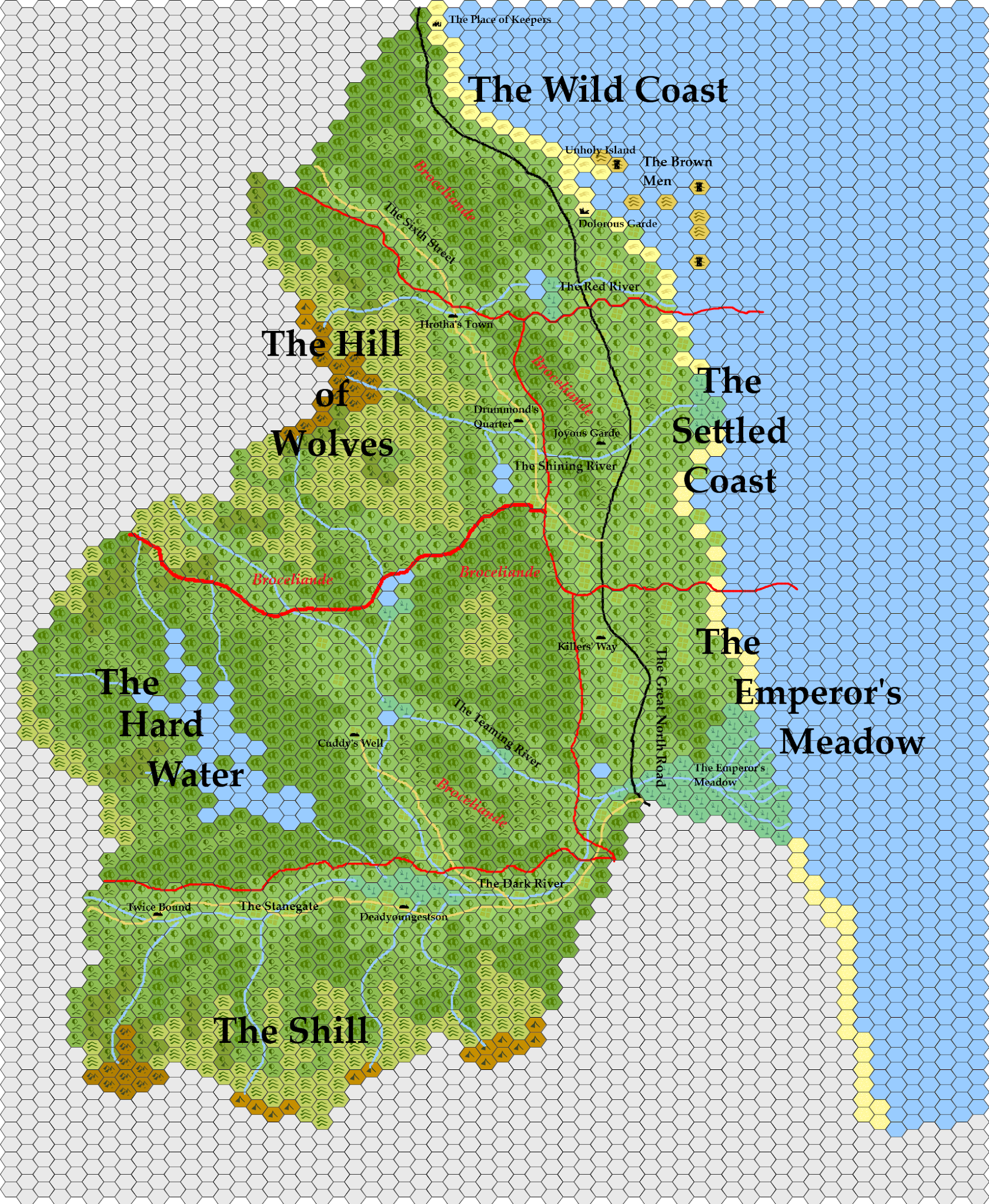
Not a finished product but a draft to show to the person who will be drawing the real thing. The red borders are the regions of the Great North, each with its own chapter in the book. There is provision within for every one-mile hex to have at least one thing of interest in it, arranged to taste.


Wednesday, 28 October 2020

We Need Long Campaigns

Pay close attention to what has happened to your mind. You are beset, besieged, bewildered by notifications from your phone, your social media accounts, your emails. You are unable to sit at a computer for longer than 10 minutes without giving in to the relentless need to check, something, anything, nothing. You switch on the TV but can only tolerate a minute or two of what you're watching before the urge to fiddle with some electronic device becomes overwhelming. You open up YouTube or Netflix and flick between short videos, chopped up segments of longer ones, that can hold your attention only for a moment before you move on to something else. You spend hours each day, if you tot up all the fragments of time here, there and everywhere, scrolling Twitter or Facebook feeds, or scanning over news websites, or swiping right on Tinder. You are not really living, and you know it. You can picture yourself on your death bed, looking back at your life and regretting how much time you spent on passive time-wasting bullshit, but you still can't shake your bad habits - and anyway, there's always another tweet, text message, email or TikTok to salve the ennui for another second or two. 

Cultivating the capacity to concentrate, think, and plan for deep, long, rich periods of time has never been more urgent than now. We slide toward dystopia. What we do with our inner lives has always mattered, but now it matters more. 

We need long campaigns. We need to sit down with the same group of people on a regular basis over the course of years, telling the kind of stories which require concentration and thought and, above all, loyalty; stories which gain their own momentum through peaks and troughs, ebbs and flows, ups and downs and ins and outs; stories in which the events which happen matter because they have a context and a background and an unknown future waiting to be discovered. We don't need the inconsequential frippery of the one-shot; we need time.

When Rachmaninoff wrote his 18th variation of his Rhapsody on a Theme of Paganini, he knew that he had a hit. "This one is for my agent," he said. It was a flip remark, but he was hitting on something that mattered. The 18th variation is justly famous, but taken on its own it is candyfloss. It is pop music. It is 3 minutes that make you feel a bit of a warm fuzz before you skip onto the next thing. It is mass market. But take it in its context, somewhere in the middle of a difficult and complicated 23 minutes of virtuoso concertante playing (not the crescendo, not the culmination, but almost shyly hidden), it is something else altogether: a moment of dizzying transcendent beauty in the midst of something moody and intellectual and strange. Like a gap between dark clouds through which a ray of golden light gleams for a moment before being once more concealed. A taste of some vast ocean of feeling the content of which can be communicated only in the smallest of wordless doses, lest it overwhelm you and the player herself. You have to work to get this feeling - you have to put in the time. But which is best: to sit with eyes closed and really listen for the payoff, or to gorge yourself on a YouTube clip (the modern day equivalent of a Best Classical Music EVER! CD album) before moving on to the next treat?


Rachmaninoff knew this about music. Listening to Stravinsky's The Firebird, whose moment of climax is one of the great eucatastrophes in all of Western art, he was moved to remark, "Great God! What a work of genius this is!" You can only identify it as a such when you have been on the long, difficult, sometimes dissonant, always challenging journey with Prince Ivan, Kaschei the Immortal, and the Firebird herself; when you have put in the hours (the minutes, anyway). The music repays your effort, your focus, your loyalty. If you don't, all you get is a cheap and meaningless thrill - a triumph of thought and feeling and taste reduced to a bit of ASMR-inducing fluff. 


Almost everything worth doing, knowing, reading, hearing, feeling or saying in life has the character of being unobtainable via shortcuts except in a form which diminishes both you and it. Why would you expect RPGs to be any different? 

Saturday, 24 October 2020

An Introduction

What does one do when it is a Saturday night (the worst time for blog traffic)? Certainly not post a content-only post (the worst type of post for blog traffic) on one's blog. Right? Wrong. Here is the introduction to The Great North, which is the final title for 'Northumberland Yoon-Suin'/'The Meeting of the Waters'. 

Once, there was an Emperor, who had already made half of the known world his own, yet grasped endlessly for the rest. At the zenith of his strength, when he was perhaps already sensing its impending failure, he reached out, straining in defiance of age and time, to clutch once more at conquests. The touch of his fingertips in one of those final desperate grabbings brushed against the shores of a distant, wild land of heather-moored hills and deep narrow valleys, wind-seared beaches and damp-cold forests, where magic was strong and there were powers that were old, and strange, and rooted in the ancient earth and rock on which they stood. The Emperor ruled parts of that land, here and there, but he could never fully tame it, and as he grew old and feeble and his Empire shrivelled back upon itself, it was the first of his provinces that he abandoned to its fate. 

The Great North has since lain free for long eons. None rule it. It was wild once, and so it remains. A frontier land where the tide of civilisation once washed before retreating, leaving fragments of flotsam behind it to lie where they may be found. A cold land. A fierce land. A debatable land. And a land of opportunity for those willing to grasp for it, much as the Emperor once tried in the faded past.

Monday, 19 October 2020

I Want to Break Free


God knows I want to break free...from Drive Thru RPG.

Yes, I said it. I hate that site. I hate publishing through it: the eye-watering royalties (30% as opposed to the 3% you might get with a non-RPG-related competitor), the fact that it doesn't provide instant access to those royalties but forces you to wait, and - perhaps, irrationally, the thing I hate about it most - the fact that it seems to think I am a Spanish-speaker and doesn't apparently have a setting to switch my display language back to English.

It's not that I object to any of the political decisions or non-decisions that it has made. It's that it takes us for a ride in terms of pricing - for both consumers and publishers - because it is a quasi-monopoly. And the only reason that I can think of as to why this should be the case is that we have a misplaced loyalty to it: a species of geek social fallacy that says, "Because this website unashamedly and unabashedly makes clear that it relates to my weird hobby, there is a rebuttable presumption that I like and will use it."

Well, it's time to stop liking and using it. There are better options. I've always been satisfied with payhip; there are plenty of others. Use them instead. 

Wednesday, 14 October 2020

What Did Medieval Battles Look Like, Really?

Today marks the something-and-somethingth anniversary of the Battle of Hastings. No, before you start, I don't have the date memorised as the point at which England began its long slide to the dogs; wikipedia told me - and in any case, England only started going to the dogs in 1832. 

Anyway, according to wikipedia, about 6,000 men are thought to have been killed in the battle - roughly 2,000 Normans and 4,000 Anglo-Saxons. That took place between 9am and 'dusk', which in Kent at this time of year must be, what, about 6pm? Let's say 9 hours of fighting, then. That's 540 minutes. Assuming the 6,000 deaths figure is accurate, 11 people were therefore killed each minute on average during the battle. Not a great deal, when you think about it - certainly nothing like what a Hollywood depiction of a battle tends to look like. 

Now, obviously, this didn't all happen at a continual rate from start to finish. We can assume most of the deaths, certainly on the Angle-Saxon side, took place in the final crescendo. Since the deaths almost all presumably happened in relatively condensed clumps, it's probably the case that an awful lot of time was spent just waiting around, jostling, manoeuvring, hurling insults, ineffectually taking potshots, the odd tussle between particularly aggressive individuals (maybe even conversations), and so on. 

You can get a bit of a sense of this from watching footage of two rival sets of football hooligans getting ready for a brawl. There is a huge amount of bluster, chanting and histrionics (not really much different to what you get to see at the chimpanzee enclosure on a visit to the zoo), and not a great deal of fighting; the kind of thing my dad, who had been to many an Old Firm game in his time, used to call "handbags at 12 paces" or "handbags at dawn". Gradually, the tension builds and builds, though, throughout the course of the day, as more and more alcohol is consumed (how many of the combatants at the Battle of Hastings were off their tits on mead?), and then, at a certain indefinable point there might be the noise of something snapping and you can sometimes get actual violence.


This is all mostly harmless hijinks for a lot of football fans, and probably almost nothing like what a medieval battle was like (as it has none of the discipline, none of the real threat of death, none of the unbelievable adrenaline rush that it must have been for the men involved), but is maybe the closest we can get to at least imagining something of the atmosphere surrounding one before it, so to speak, kicked off. It is also, not incidentally, the closest we can get to understanding how hard it must have been to train men to stand firm when charged by a large group of cavalry. 

Thursday, 8 October 2020

The Books You Liked Best, 2000-2020

You know what? Let's cheer ourselves up. What are your favourite 20 books of the last 20 years? Not by date of publication - I mean the book you liked best from those you read in each of the last 20 years. This does not have to be, and probably cannot be, accurate. Just do your best - try to remember what you were reading in 2000, and what your favourite book of that year was. Then go from there. The point is to try to build a picture of what your tastes were like 20 years ago, what they are like now, and how they have changed. But it is also an enjoyable exercise in itself to try to remember in what year you read a particular book, what you were doing at the time, and why the book mattered to you.

I have tried to do this by year. This will not be entirely accurate, but I think it mostly is:

2000 - It is very hard to remember what one was reading 20 years ago, but I do remember that I read Viriconium, by M. John Harrison, in omnibus form, in the first year I was at university - which would have put it in either 1999 or 2000. Assuming it was 2000, it was almost certainly my favourite book that year, as it would probably have been in almost any year you care to name.

2001 - Yes, I am going to have A Game of Thrones in this list, and I am going to say it was 2001 that I read it, although again I may be late by a year or two. GRRM has disappointed us all on so many occasions. He may well never finish ASoIaF. But I will have no truck with people who pooh-pooh A Game of Thrones. It is an absolutely bravura performance which revolutionised the way we think of fantasy book series. Having got used to reading bog-standard fantasy fare for so long, I couldn't believe how high the bar had been raised when I first read it. 

2002 - I was introduced by my father to Raymond Carver when I was in my late teens, but I don't think I read Elephant until I was in my early 20s. It's my favourite collection of his - one in which you can see him really begin to hit his stride before his untimely death. For a time, it made me want to be a short story writer in precisely his mould. You won't get much discussion of how to 'Carverise' your OSR games out there in the blogosphere; indeed, this may be the first and last time his name ever gets a mention in an OSR blog, so I claim that mantle. 

2003 - High Fidelity by Nick Hornby. I know this was in 2003, for sure, because I read it practically in one sitting shortly after new year, before leaving the UK for foreign climes for what I felt was for good. This is very much one of those books that you have to read at the right time, and, what can I say? It was the right time (I was 21, sensitive, romantic, indecisive in matters of the heart, very much into music and books, not sure what to do with my life), and I read it. 

2004 - I read Shogun, by James Clavell, when living in Japan, and I was riveted by it, despite being horribly let down - as anyone must be - by the ending, in which Clavell gives every impression of simply having become bored by his complex plot and wraps everything up in the space of about 10 pages. I don't make a point of re-reading books and I'm glad I've not re-read this one, because I suspect now I would find it cringeworthy; I loved Clavell's Noble House, but I've tried some of his other books more recently and I find them almost literally unreadable. 

2005 - Mieville is a frustrating writer: he has phenomenal imaginative and creative gifts and is a master storyteller, but I find I just don't really like any of his characters. Iron Council has stood the test of time, in that it feels as though he was really trying to stretch his craft while writing it; I think it's the only book he's written in which he seems to be trying to create beautiful prose. This makes a difference. I remember reading this on work breaks in a tiny staff room, not much bigger than a cupboard, in 10 minute bursts between lessons at the school where I was working, like a smoker getting his hit to last him through the next hour. 

2006 - The Guns of August by Barbara Tuchman. I have now read a large number of WWI histories which criticise The Guns of August for its apparent inaccuracies and looseness with the truth, and I've since read Max Hastings' Catastrophe, which has a much superior breadth and depth. But this remains one of the best books to have been written about war, and one of the most breathlessly entertaining non-fiction works that I have read. I loved it. 

2007 - Funnily enough, you could probably say the same about Guns, Germs and Steel as you could about The Guns of August. Perhaps it has an oversimplistic narrative that is now thought of as outmoded, and it has become something of a cliche because of its popularity and influence, but I find it hard to think of a more thought-provoking book that I have read. I am fairly sure I read this one in 2007, as I was back in the UK that summer and have memories of paging through it, ensconsed on my father's sofa on lazy days with nothing much else to do forever for all that I cared.

2008 - For all of his naffness and mainstream appeal, Bill Bryson's works have been a guilty pleasure of mine going back to The Lost Continent, which I read on a family holiday in Portugal when I was about 14 and which I still sometimes re-read as a literary equivalent of comfort food; I can still vividly remember lying on the beach with that book and almost weeping with laughter at some scene while my parents and older sister watched me with concern on their part, disgust on hers. A Short History of Nearly Everything is his best book.

2009 - The Whisperers: Private Life in Stalin's Russia, by Orlando Figes. This I definitely read in 2009, and I know that, because I wrote a blog post about it. Not one of my finest efforts, I'll admit, but I was still relatively knew to it. (It's amazing to think that Yoon-Suin was actually a thing then; I was writing that damn book 11 years ago.) 

2010 - Economic Sophisms & 'What is Seen and What is Not Seen', Volume II in the Complete Works of Frederic Bastiat. I read this on a Kindle when I first got one, and that would have been late in 2010. It made a lasting impression on me; that Frenchman from the early 19th century spoke to me in ways that very few political theorists have before or since. 

2011 - Wonder Boys by Michael Chabon. An underrated film, and a fabulously funny, moving and insightful book, with quotable lines on almost every page. (One remains a favourite: "There is nothing more embarrassing than to have earned the disfavour of a perceptive animal.") Again, here I am clear on the dates, because I had almost literally just finished reading this book on one of the worst days of my life, March 11th, 2011 - one of those before/after events that come along from nowhere and just change your and your loved ones' lives irrevocably, and without giving you the tiniest say in the matter. 

2012 - Dark Companions by Ramsay Campbell. I can't say that this is a great work of literature, but what I can say is that it scared the bejeezus out of me and also really bummed me out with its spectacularly bleak approach to the horror genre; these stories don't just have unhappy endings - they have terribly sad, nasty, unredemptive endings which leave you with the certain impression that nothing will ever be well again, and that takes some serious doing.

2013 - TH White's The Once and Future King; I had read the first volume as a child, but not the others, until that year, and if you were forcing me to pick one of those, it would have to be The Ill-Made Knight, whose moment of apotheosis may be my favourite passage in all of English literature. 

2014 - Mythago Wood by Robert Holdstock. It is possible I read this in 2015, but I really can't now remember; what I can remember is how good it is - beautiful and epic, but also moving in the way that great literature can be, but fantasy so rarely is. 

2015 - This would probably be My Dark Places by James Ellroy, a book that confirms him in my view as one of the greatest living prose stylists, and which provides a slice of 1950s low-life so real you can practically smell it. 

[We enter now the 'Goodreads era', when I started cataloguing the books I read and have much more certain records of when I read what.]

2016 - I read a huge number of stellar books in 2016. How do you pick one from The Neverending Story, Meadowland, Cutter and Bone, The Goshawk, Lavondyss, and American Tabloid, to name but a few? I suppose really it has to be The Neverending Story, which blew me away - one of those books that you can't believe you have never read, that you can't fathom that nobody has ever sat you down and forced you to read because of how good it is. But because it is less well-known, let's go for Cutter and Bone. A haunting and wonderfully-written book, and possibly the finest mystery story I've ever read. 

2017 - This, on the other hand, was a bad year for books, if I recall, and I spent much of it re-reading Tolkien, which feels like cheating. It probably has to be Bix's Hirohito and the Making of Modern Japan, which is big, important and fascinating, although lacking I think the narrative verve that a truly riveting non-fiction book needs.

2018 - Iain McGilchrist's The Master and His Emissary. I read some fabulous books in 2018, looking back at my Goodreads bookshelf - Everybody Loves Our Town, Soldier of the Mist, Soldier of Arete, Trial By Battle... But The Master and His Emissary may be the most important book to have been written in the past 50 years; I can't put any book I read that year, or most years, above it. 

2019 - Jack Vance's The Dirdir, the third volume in his 'Planet of Adventure' series. Beautiful, funny, sad and moving - it showcases Vance at the absolute pinnacle of his talent, combining sardonic wit with emotional heft and demonstrating an unrivalled imaginative palette. 

2020 - It will almost certainly be Master of the Senate, the third volume of Robert Caro's epic biography of Lyndon Johnson. I have small misgivings about it - it is not quite up to the standard of the first two volumes - but it is still a phenomenal work of literature, not to mention history or biography. It is very hard for me to imagine reading anything better this year, that's for sure, and I am hoping beyond hope that Caro doesn't 'pull a GRRM' and leave this series unfinished.