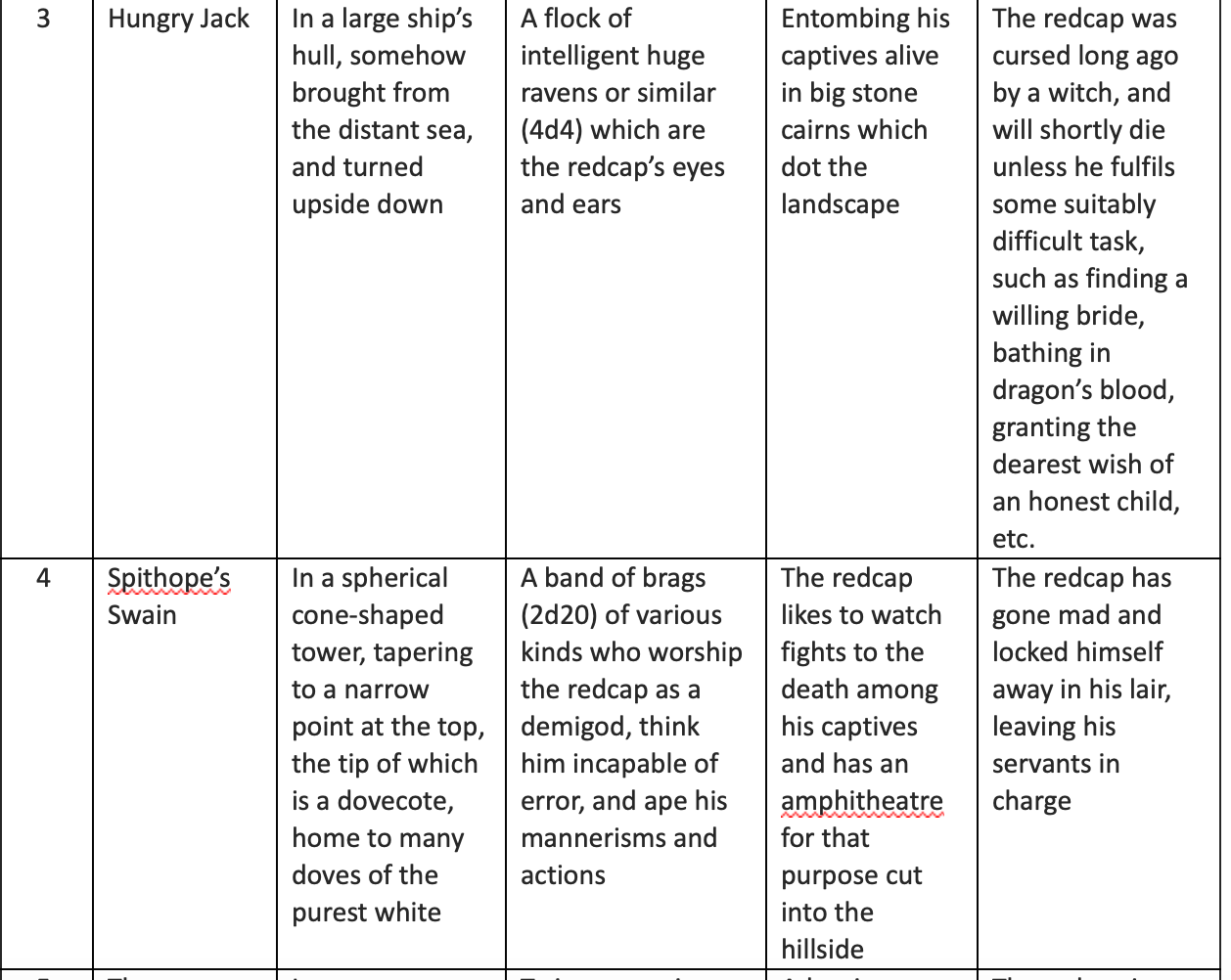
A table I am working on for the Meeting of the Waters/"Northumberland Yoon-Suin" project. Also serves as Exhibit A for those who complain about the landscape format of the Yoon-Suin book. This is what all those tables looked like when printed in portrait.
Creator of Yoon-Suin and other materials. Propounding my half-baked ideas on role playing games. Jotting down and elaborating on ideas for campaigns, missions and adventures. Talking about general industry-related matters. Putting a new twist on gaming.
Monday, 30 March 2020
Wednesday, 25 March 2020
The End of the World As We Know It
With the world in meltdown about a disease that may kill about 0.5-1% of the people who catch it, to use a commonly cited figure, it is worth reflecting that European diseases killed somewhere in the region of 60-90% of the pre-Columbian population of the Americas. Can you imagine what it must have been like to be an Andean native during the smallpox epidemic that struck shortly before Pizarro's arrival? Think of the generalised anxiety among the population now about COVID-19, give it a liberal dose of ignorance about the very concept of infectious diseases that can spread through breath or touch, and then multiply it by 50 or so.
And they still managed to have the wherewithal to fight a civil war - what's your excuse for sitting around all day watching Netflix?
This is not the apocalypse, or anything like it, but it does at least put one in mind of the concept. We are familiar with games set in post-apocalyptic settings, and we are familar with both post-apocalyptic and apocalyptic fiction. But I'm not sure I know of many game settings or games proper that take place during the end of the world or an apocalypse event - All Flesh Must Be Eaten, I suppose, but zombies have never really interested me very much. I prefer my apocalypses to be Dionysian in tone. Although I am also intrigued by what you might call the Nyarlathotepian Apocalypse, in which a travelling scientist/philosopher drives everybody insane by inflicting them with nightmares which mean they can never sleep again, with this in turn meaning that society very quickly declines into fatal insomnia. And I also have a deep, abiding love for the Donald Sutherland Invasian of the Body Snatchers - which, by a form of free association between late 70s/early 80s SF/horror flicks, then gives me the idea for the "Apocalypse of The Thing", in which the eponymous Thing somehow gets off Antarctica and is suddenly all over humanity like a cheap suit.
What is your favourite flavour of the apocalypse?
And they still managed to have the wherewithal to fight a civil war - what's your excuse for sitting around all day watching Netflix?
This is not the apocalypse, or anything like it, but it does at least put one in mind of the concept. We are familiar with games set in post-apocalyptic settings, and we are familar with both post-apocalyptic and apocalyptic fiction. But I'm not sure I know of many game settings or games proper that take place during the end of the world or an apocalypse event - All Flesh Must Be Eaten, I suppose, but zombies have never really interested me very much. I prefer my apocalypses to be Dionysian in tone. Although I am also intrigued by what you might call the Nyarlathotepian Apocalypse, in which a travelling scientist/philosopher drives everybody insane by inflicting them with nightmares which mean they can never sleep again, with this in turn meaning that society very quickly declines into fatal insomnia. And I also have a deep, abiding love for the Donald Sutherland Invasian of the Body Snatchers - which, by a form of free association between late 70s/early 80s SF/horror flicks, then gives me the idea for the "Apocalypse of The Thing", in which the eponymous Thing somehow gets off Antarctica and is suddenly all over humanity like a cheap suit.
What is your favourite flavour of the apocalypse?
Tuesday, 24 March 2020
Hrotha's Town
Everyone knows that Hrotha’s Town exists. They see its people - the women bright-eyed, intelligent, gregarious, quick to laugh; the men laconic and somehow ponderous and bland - coming to their markets to trade, and they are real enough. And everyone knows that the Town lies somewhere to the north of Drummond’s Quarter, up the Sixthstreet. But few could take one to the spot, nor tell one how to get there, and its people will never say, no matter what the inducement.
To get into Hrotha’s Town, one must know that its entrance lies between two trees in a glade not far from the bridge over the Red River, and that, when drizzle falls on a bright day such that one could expect to see a rainbow, if one looks through the rain falling between those two trees where the sunlight strikes it, one will see the faintest outline of a wrought-iron gate. One must then step forward, making as though as to grasp the bars - convincing oneself that, despite the fact that they are as delicately translucent and as pale as gossamer, one can feel the hard cold metal as one presses one’s palms against them - and at that moment one will realise that it is in fact a real gate, and that it is as strong and heavy as iron can be, and that behind it is a track leading to what is clearly a large village with fields and orchards and people laughing in the distance.
Hrotha is a wizard with a thick black beard that bristles almost to his feet, and hair to match it. His violet eyes twinkle from a tanned face creased by laughter lines and his nose and cheeks are red with humour and the flush of wine. He is the image of avuncular affection. But he carries an iron rod, and rules with it both literally and figuratively. None of the populace dares to cross him, and his vengeance when he feels himself slighted is terrible.
It is their terror of his wrath that ensures the people of the Town continue to abide by Hrotha's rules for the most part even after his long and unexplained absence, which has now stretched to three years and thirty-three days with no sign of ending. One morning the people awoke to find he was gone, and his servants - the bands of unruly goat-men who serve as his eyes and ears - would not say where, nor even reveal if they knew that destination. Life has continued as before because the expectation is that one day he will come back, and none of the people of the Town wishes to be found in violation of his rules at that moment - the consequences of that far outweighing whatever benefit might have been gained from breaking them. For their part, the satyrs could not care less whether anybody abides by the rules, and in principle there is nothing stopping anybody flouting them at will if they were of a mind to do so.
The rules themselves are simple. First, it is forbidden to tell any outsider how to get into Hrotha’s Town, unless they are being brought there directly. Second, an outsider must not be brought to Hrotha’s Town without having agreed to Hrotha’s terms of residence. Third, once one has agreed to the terms of residence and come into the town, one may come and go as one chooses on the proviso that one never spends a night elsewhere again. And fourth, one must take part in the bacchanals, held each equinox and solstice. In return, one is guaranteed the safety and comforts which life in the Town provides.
Were a stranger to visit Hrotha’s Town one would be struck by the happiness and fulfilment of its women and the demoralised bitterness of the men. This is for the simple reason that, over time, being exposed to the vigour, virility and joyous abandon of the satyrs, the women of the town usually become dissatisfied with their menfolk, who come to strike them as unimpressive and weak-willed - not least because they have sacrificed all courage and zest for life by seeking craven comfort in this hidden place of safety. They readily take on lovers among the goat-men, and scorn their erstwhile human husbands. The men as a consequence grow almost visibly pale and wilted. The consequence is that Hrotha’s Town is largely barren of children, and the population only sustains itself by bringing in outsiders. A slow trickle of these flows in, perhaps in the order of a dozen people a year all told - a family with young children seeking protection; a runaway; an outlaw - brought by promises of safety and of plenty given in whispered conversation. The women of Hrotha’s Town’s desire to bring in others of their sex is evangelical in nature. For the men, it is more accurately described with the old saw that misery loves company.
To get into Hrotha’s Town, one must know that its entrance lies between two trees in a glade not far from the bridge over the Red River, and that, when drizzle falls on a bright day such that one could expect to see a rainbow, if one looks through the rain falling between those two trees where the sunlight strikes it, one will see the faintest outline of a wrought-iron gate. One must then step forward, making as though as to grasp the bars - convincing oneself that, despite the fact that they are as delicately translucent and as pale as gossamer, one can feel the hard cold metal as one presses one’s palms against them - and at that moment one will realise that it is in fact a real gate, and that it is as strong and heavy as iron can be, and that behind it is a track leading to what is clearly a large village with fields and orchards and people laughing in the distance.
Hrotha is a wizard with a thick black beard that bristles almost to his feet, and hair to match it. His violet eyes twinkle from a tanned face creased by laughter lines and his nose and cheeks are red with humour and the flush of wine. He is the image of avuncular affection. But he carries an iron rod, and rules with it both literally and figuratively. None of the populace dares to cross him, and his vengeance when he feels himself slighted is terrible.
It is their terror of his wrath that ensures the people of the Town continue to abide by Hrotha's rules for the most part even after his long and unexplained absence, which has now stretched to three years and thirty-three days with no sign of ending. One morning the people awoke to find he was gone, and his servants - the bands of unruly goat-men who serve as his eyes and ears - would not say where, nor even reveal if they knew that destination. Life has continued as before because the expectation is that one day he will come back, and none of the people of the Town wishes to be found in violation of his rules at that moment - the consequences of that far outweighing whatever benefit might have been gained from breaking them. For their part, the satyrs could not care less whether anybody abides by the rules, and in principle there is nothing stopping anybody flouting them at will if they were of a mind to do so.
The rules themselves are simple. First, it is forbidden to tell any outsider how to get into Hrotha’s Town, unless they are being brought there directly. Second, an outsider must not be brought to Hrotha’s Town without having agreed to Hrotha’s terms of residence. Third, once one has agreed to the terms of residence and come into the town, one may come and go as one chooses on the proviso that one never spends a night elsewhere again. And fourth, one must take part in the bacchanals, held each equinox and solstice. In return, one is guaranteed the safety and comforts which life in the Town provides.
Were a stranger to visit Hrotha’s Town one would be struck by the happiness and fulfilment of its women and the demoralised bitterness of the men. This is for the simple reason that, over time, being exposed to the vigour, virility and joyous abandon of the satyrs, the women of the town usually become dissatisfied with their menfolk, who come to strike them as unimpressive and weak-willed - not least because they have sacrificed all courage and zest for life by seeking craven comfort in this hidden place of safety. They readily take on lovers among the goat-men, and scorn their erstwhile human husbands. The men as a consequence grow almost visibly pale and wilted. The consequence is that Hrotha’s Town is largely barren of children, and the population only sustains itself by bringing in outsiders. A slow trickle of these flows in, perhaps in the order of a dozen people a year all told - a family with young children seeking protection; a runaway; an outlaw - brought by promises of safety and of plenty given in whispered conversation. The women of Hrotha’s Town’s desire to bring in others of their sex is evangelical in nature. For the men, it is more accurately described with the old saw that misery loves company.
Monday, 23 March 2020
He Achieved Most of What He Wanted Through Charm - the Karajan Effect
From a comment on this post last week comes this interesting observation:
This is true of many, many activities that involve social interaction - teaching, sales, management and public speaking among them. Some people are either naturally good at it, or have become conditioned to be really good at it by circumstance, and this puts them at a huge advantage in comparison to others.
I would like to christen this the Karajan Effect, after the conductor Herbert von Karajan. Karajan was one of the greatest classical conductors of the recorded era. He is probably the only classical conductor apart from Leonard Bernstein who you have a fighting chance of having heard of if you're not into classical music, and was by many measures one of the highest-selling recording artists of the 20th century. If you want to hear him in action, listen to this performance of Beethoven's Sixth Symphony and compare it with the one you may remember from the Fantasia of your childhood:
But by all accounts he did very little of what one is "supposed to do" as a conductor. He usually conducted with his eyes closed, which is considered to be precisely the opposite of what you would learn in conducting 101, because there is purportedly no way to properly communicate with the musicians if you don't do it, and he didn't particular care if his players played the wrong notes as long as they kept perfectly in time. One of his musicians said of him that "He achieved most of what he wanted through charm", rather than any sort of technique - he just made people want to play better.
You may see where I'm going with this, which is that when one thinks that somebody is a really good DM, it's often (not always!) simply the Karajan Effect in action - they're good at public speaking, performance, bluster, clarity of expression, and simply being fun to be around. This then rubs off on the players, who feel as though they are having a good time and get on board accordingly. It might superficially seem the right thing to do to copy a DM's technique if the players seem to be enjoying themselves, in other words, but you may not be able to replicate it if you don't have the requisite charm.
Another way of putting this is that figuring out what works well is not really something that you can learn from what a purportedly great DM writes about in his blog, talks about in his YouTube videos, or even demonstrates in actual play streams. Even if it is true that what he is telling you about or showing you apparently "works" for him (which I sometimes have my doubts about, especially with bloggers), that might just be because he happens to be charming - which is highly likely if, for instance, he has a very watchable and popular YouTube channel.
A simpler way of putting it even that this is: practice makes perfect, and not necessarily aping others or learning tricks and techniques.
[T]he issue is that you have a lot of people who are very poor at basic speaking-to-audience skills who don't realize that the number one reason the DMs they see on youtube are effective is that they are comfortable speaking *as a general matter*. A good teacher or salesman or improv actor is going to need a completely different type and degree of instruction to become a good DM because they don't have to first figure out how to be engaging in front of a crowd. People who don't have that background have a real challenge ahead of them.
This is true of many, many activities that involve social interaction - teaching, sales, management and public speaking among them. Some people are either naturally good at it, or have become conditioned to be really good at it by circumstance, and this puts them at a huge advantage in comparison to others.
I would like to christen this the Karajan Effect, after the conductor Herbert von Karajan. Karajan was one of the greatest classical conductors of the recorded era. He is probably the only classical conductor apart from Leonard Bernstein who you have a fighting chance of having heard of if you're not into classical music, and was by many measures one of the highest-selling recording artists of the 20th century. If you want to hear him in action, listen to this performance of Beethoven's Sixth Symphony and compare it with the one you may remember from the Fantasia of your childhood:
But by all accounts he did very little of what one is "supposed to do" as a conductor. He usually conducted with his eyes closed, which is considered to be precisely the opposite of what you would learn in conducting 101, because there is purportedly no way to properly communicate with the musicians if you don't do it, and he didn't particular care if his players played the wrong notes as long as they kept perfectly in time. One of his musicians said of him that "He achieved most of what he wanted through charm", rather than any sort of technique - he just made people want to play better.
You may see where I'm going with this, which is that when one thinks that somebody is a really good DM, it's often (not always!) simply the Karajan Effect in action - they're good at public speaking, performance, bluster, clarity of expression, and simply being fun to be around. This then rubs off on the players, who feel as though they are having a good time and get on board accordingly. It might superficially seem the right thing to do to copy a DM's technique if the players seem to be enjoying themselves, in other words, but you may not be able to replicate it if you don't have the requisite charm.
Another way of putting this is that figuring out what works well is not really something that you can learn from what a purportedly great DM writes about in his blog, talks about in his YouTube videos, or even demonstrates in actual play streams. Even if it is true that what he is telling you about or showing you apparently "works" for him (which I sometimes have my doubts about, especially with bloggers), that might just be because he happens to be charming - which is highly likely if, for instance, he has a very watchable and popular YouTube channel.
A simpler way of putting it even that this is: practice makes perfect, and not necessarily aping others or learning tricks and techniques.
Sunday, 22 March 2020
20 Rumours Overhead in Drummond's Quarter
1/In a glade called Scrabby Wood a parliament of rooks gathers each evening at twilight; if one goes there in the gloaming, one can hear in the rooks’ cries their gossip about what they have seen while going about their business in the course of the day
2/A tiny hamlet called Burradon Mains survives the predations of reivers by its population retreating into a network of tunnels underground, which they say goes all the way down to the centre of the earth
3/In a forested cleugh called Greenlish Wood there are the remains of a large village, now long overgrown, whose people were all eaten by ettins - except for a few children left in hiding who starved; their ghosts haunt the wood still and crave revenge on the giants' descendants
4/A band of robbers called Lanternside’s Boys used to operate from a cave at the top of Turnberry Cleugh; Laternside was always rumoured to have a hidden stash of treasure somewhere, and it has never been found
5/A big raid by the reivers from the hill known as the Swire recently returned from the settled coast, bringing with it several prominent captive ladies
6/A deep pool lies at the top of Dove Crag; in its waters their swims the Lady of Dove Crag, a great witch who was transformed by her sisters into a pike
7/A redcap who calls himself the Master of Fleehope Manor lives in a ramshackle half-ruined castle in a narrow cleft on the side of the hill known as the Curr; he keeps his captives alive and forces them to take part in frenzied bacchanals each full moon, and to practice their entertainments in between
8/An ancient road, called the Quickening Street, runs through the hills between High Bleakhope and the Nag’s Head; it was built in the days of the Emperor and people say that it leads to a great temple hidden beyond the fastness of the hills, where the descendants of an imperial cult still practice the old ways
9/Huge wild hogs roam the woods of Kidland Forest; they were bred by ettins long ago and let loose for hunting, and ever since it has been impossible for local people to access the woods for firewood, timber, mushrooms, and so on
10/Three waterfalls called the Rushy Linns follow in quick succession through Red Cleugh; diving into the pools of each in turn will cure any illness, but the water will turn one's skin red forever thereafter
11/A spring wells up in the woods by the hamlet of Nettlehope to form Drummer’s Pool; bathing in its waters is said to cure infertility, but the people of Nettlehope only allow their own to go near it
12/The reivers of Sneer Hill are said to have been tasked with guarding a place which the elves of the Hardwater hold secret and sacred
13/The ruin of a former imperial fort lies at Kinch Knowe, a remnant of an abandoned attempt to subdue the Hill of Wolves; its Prefect had a powerful magic sword that is hidden somewhere at the site
14/The redcap known as Father Moneylaws lives in a peel tower in the middle of Marl Bog; he is renowned for ‘adopting’ children, who are shortly after drowned in the bog when they inevitably disappoint him
15/The ettins of the Hethpool lair on an island in the middle of a dark, cold lake on Laddie’s Knowe, where they are said to have held captive an elf prince for a hundred years
16/A red dragon called Dreams-Coldly-Sleeping lies dormant under the Shank, a heather-covered hilltop; she is the daughter of Yehud-Shining-in-the-Twilight and inherited his wealth on his death
17/In the woods a waterfall, called Black Linn, plunges into a deep pool filled with dark green loaches; these are the spirits of 33 bastard children who were drowned as a sacrifice by an imperial cult long ago, and legend has it they will bestow great blessings on anybody able to release them
18/Down in the Hepplewoods there is an old gallows; a troll lives in a hut nearby and hangs anybody he finds out in the woods at night
19/A cave known as Darden Parlour lies hidden in the woods between Drummond’s Quarter and Hrotha’s Town - it goes deep under the earth
20/On the moor known as Ottercops Moss there is a large, single standing stone which is said to mark the burial site of a king of the people who lived in these lands before the days of the Emperor
2/A tiny hamlet called Burradon Mains survives the predations of reivers by its population retreating into a network of tunnels underground, which they say goes all the way down to the centre of the earth
3/In a forested cleugh called Greenlish Wood there are the remains of a large village, now long overgrown, whose people were all eaten by ettins - except for a few children left in hiding who starved; their ghosts haunt the wood still and crave revenge on the giants' descendants
4/A band of robbers called Lanternside’s Boys used to operate from a cave at the top of Turnberry Cleugh; Laternside was always rumoured to have a hidden stash of treasure somewhere, and it has never been found
5/A big raid by the reivers from the hill known as the Swire recently returned from the settled coast, bringing with it several prominent captive ladies
6/A deep pool lies at the top of Dove Crag; in its waters their swims the Lady of Dove Crag, a great witch who was transformed by her sisters into a pike
7/A redcap who calls himself the Master of Fleehope Manor lives in a ramshackle half-ruined castle in a narrow cleft on the side of the hill known as the Curr; he keeps his captives alive and forces them to take part in frenzied bacchanals each full moon, and to practice their entertainments in between
8/An ancient road, called the Quickening Street, runs through the hills between High Bleakhope and the Nag’s Head; it was built in the days of the Emperor and people say that it leads to a great temple hidden beyond the fastness of the hills, where the descendants of an imperial cult still practice the old ways
9/Huge wild hogs roam the woods of Kidland Forest; they were bred by ettins long ago and let loose for hunting, and ever since it has been impossible for local people to access the woods for firewood, timber, mushrooms, and so on
10/Three waterfalls called the Rushy Linns follow in quick succession through Red Cleugh; diving into the pools of each in turn will cure any illness, but the water will turn one's skin red forever thereafter
11/A spring wells up in the woods by the hamlet of Nettlehope to form Drummer’s Pool; bathing in its waters is said to cure infertility, but the people of Nettlehope only allow their own to go near it
12/The reivers of Sneer Hill are said to have been tasked with guarding a place which the elves of the Hardwater hold secret and sacred
13/The ruin of a former imperial fort lies at Kinch Knowe, a remnant of an abandoned attempt to subdue the Hill of Wolves; its Prefect had a powerful magic sword that is hidden somewhere at the site
14/The redcap known as Father Moneylaws lives in a peel tower in the middle of Marl Bog; he is renowned for ‘adopting’ children, who are shortly after drowned in the bog when they inevitably disappoint him
15/The ettins of the Hethpool lair on an island in the middle of a dark, cold lake on Laddie’s Knowe, where they are said to have held captive an elf prince for a hundred years
16/A red dragon called Dreams-Coldly-Sleeping lies dormant under the Shank, a heather-covered hilltop; she is the daughter of Yehud-Shining-in-the-Twilight and inherited his wealth on his death
17/In the woods a waterfall, called Black Linn, plunges into a deep pool filled with dark green loaches; these are the spirits of 33 bastard children who were drowned as a sacrifice by an imperial cult long ago, and legend has it they will bestow great blessings on anybody able to release them
18/Down in the Hepplewoods there is an old gallows; a troll lives in a hut nearby and hangs anybody he finds out in the woods at night
19/A cave known as Darden Parlour lies hidden in the woods between Drummond’s Quarter and Hrotha’s Town - it goes deep under the earth
20/On the moor known as Ottercops Moss there is a large, single standing stone which is said to mark the burial site of a king of the people who lived in these lands before the days of the Emperor
Thursday, 19 March 2020
D&D and Mental Health
Let's try talk in a sensitive and entirely non-judgmental way about something which I feel like is a bit of an elephant in the room: a lot of people involved in OSR blogging and self-publishing have (self-declared) mental health problems - much more so, I would say, than in the general population. I used to notice this a lot even back in the early days, and with a high level of frequency in the G+ era. I see it all over Twitter, too, on the occasions when I look at RPG related tweets.
I have my worries, like anybody, but I thankfully (to my knowledge) don't have any mental health problems particularly. (Although severe psychotic disorders and rare degenerative brain conditions both appear to run in the family, so this may not last forever.) But I am interested in why this apparent correlation between an interest in RPGs and mental health arises, partly because I'm just curious, as a disinterested lay person, in the ways in which the conditions of modern life appear to be producing a crisis of spirituality of a kind, and partly because I like D&D nerds and I want to know what makes them tick.
Maybe you have noticed something similar to what I have described. If so, do you think it is:
-A function of the fact that 'extremely online' people who spend large portions of time each day on the internet discussing anything are more likely to have mental health problems than average, and I'm just noticing the ones who happen to be discussing old school D&D?
-A function of the fact that D&D players, particularly those who are really into it, and so immersed in it indeed that they would discover OSR games, tend to be quite creative people, and creative people have a tendency towards neurosis, anxiety and depression?
-A function of the fact that this is a relatively small corner of the internet that has the feel of a community and which therefore has a comfortable atmosphere that encourages openness about these things?
-A function of D&D having some kind of therapeutic benefit, whether intended or otherwise?
-Something else?
Or do you disagree with the initial premise?
I have my worries, like anybody, but I thankfully (to my knowledge) don't have any mental health problems particularly. (Although severe psychotic disorders and rare degenerative brain conditions both appear to run in the family, so this may not last forever.) But I am interested in why this apparent correlation between an interest in RPGs and mental health arises, partly because I'm just curious, as a disinterested lay person, in the ways in which the conditions of modern life appear to be producing a crisis of spirituality of a kind, and partly because I like D&D nerds and I want to know what makes them tick.
Maybe you have noticed something similar to what I have described. If so, do you think it is:
-A function of the fact that 'extremely online' people who spend large portions of time each day on the internet discussing anything are more likely to have mental health problems than average, and I'm just noticing the ones who happen to be discussing old school D&D?
-A function of the fact that D&D players, particularly those who are really into it, and so immersed in it indeed that they would discover OSR games, tend to be quite creative people, and creative people have a tendency towards neurosis, anxiety and depression?
-A function of the fact that this is a relatively small corner of the internet that has the feel of a community and which therefore has a comfortable atmosphere that encourages openness about these things?
-A function of D&D having some kind of therapeutic benefit, whether intended or otherwise?
-Something else?
Or do you disagree with the initial premise?
Wednesday, 18 March 2020
Useful Advice about Narrating and Describing
The topic of how to narrate and describe things as a DM came up in the comments to a recent post. It put me in mind of a topic that I have written about before - namely, the difference between skills which are primarily learned through explanation (reading and writing, speaking a new language as an adult learner, driving, most sport) and those which are primarily learned through introduction (law, philosophy, teaching, acting, creative writing).
In a nutshell, learning how to drive is a skill which you can for the large part learn from being directly taught a series of techniques such as how to change gears, how to do a three-point turn, how to parallel park, etc., combined with practice. This is what makes it mostly an explained skill.
Learning how to write fiction is a skill which you can only really learn by reading good fiction, combined with practice. You can't become a good writer by learning technical tricks. This is what makes it mostly an introduced skill.
For both types of skill you need a lot of practice to get good, and you need intuition and experience to do whatever it is well. But the former category is the type of thing that is amenable to being taught through a course and/or textbook, while the latter is the type of thing that can only really be taught by consistent informal exposure for a period of years. This is why there are useful textbooks on how to learn Romanian, but there are no useful textbooks on how to write fiction well. Romanian, like any other language, is mostly learned from putting into practice rules and techniques. Writing fiction well cannot be learned through a similar process (which is why 'how to write fiction that sells' type books are full of useless crap like, 'Write what you know' or 'Don't use adverbs', which no great novelist, or even bog-standard novelist, has ever actually followed).
Learning how to DM is in my view quite clearly much more like learning to write novels than it is like learning to drive. Yes, there are rules of thumb, and you will need to learn the rules of whatever game you're running, but what makes a good DM is mostly learned from watching others and from practice rather than from following technical guidelines or lists of 'best practices' or anything of that nature.
I am willing to be proved wrong, but I think in particular that the elements of DMing which concern describing and narrative events can't really be learned other than through watching good DMs and through practice. How to describe a fight scene in an exciting way? How to make wilderness travel interesting? How to make a scene, or a particular NPC, really 'come alive' in the players' minds? You have to do it a lot, reflect on what works and what doesn't, and watch other people who you think are good at DMing and reflect on that, too.
In a nutshell, learning how to drive is a skill which you can for the large part learn from being directly taught a series of techniques such as how to change gears, how to do a three-point turn, how to parallel park, etc., combined with practice. This is what makes it mostly an explained skill.
Learning how to write fiction is a skill which you can only really learn by reading good fiction, combined with practice. You can't become a good writer by learning technical tricks. This is what makes it mostly an introduced skill.
For both types of skill you need a lot of practice to get good, and you need intuition and experience to do whatever it is well. But the former category is the type of thing that is amenable to being taught through a course and/or textbook, while the latter is the type of thing that can only really be taught by consistent informal exposure for a period of years. This is why there are useful textbooks on how to learn Romanian, but there are no useful textbooks on how to write fiction well. Romanian, like any other language, is mostly learned from putting into practice rules and techniques. Writing fiction well cannot be learned through a similar process (which is why 'how to write fiction that sells' type books are full of useless crap like, 'Write what you know' or 'Don't use adverbs', which no great novelist, or even bog-standard novelist, has ever actually followed).
Learning how to DM is in my view quite clearly much more like learning to write novels than it is like learning to drive. Yes, there are rules of thumb, and you will need to learn the rules of whatever game you're running, but what makes a good DM is mostly learned from watching others and from practice rather than from following technical guidelines or lists of 'best practices' or anything of that nature.
I am willing to be proved wrong, but I think in particular that the elements of DMing which concern describing and narrative events can't really be learned other than through watching good DMs and through practice. How to describe a fight scene in an exciting way? How to make wilderness travel interesting? How to make a scene, or a particular NPC, really 'come alive' in the players' minds? You have to do it a lot, reflect on what works and what doesn't, and watch other people who you think are good at DMing and reflect on that, too.
Tuesday, 17 March 2020
"Because God Loves Wondrous Variety"
Spot the difference:
Fantasy and SF settings need more of a 'Mos Eisley Cantina' vibe than less, I think.
Foreign observers never failed to be impressed by the exotic regiments of the Tsar - Don, Turkistan and Ural Cossacks, the latter 'big, red-bearded, wild-looking men'. Officers carried their maps in their high hats; many enemies were killed with the lance...As for the men, correspondent Alexei Kayunin wrote: 'The yellow and purple robes of the Turkmens appeared blindingly brilliant against the background of village houses. They wore enormous sheepskin hats, above dark features and wild hair which made them seem picturesque and majestic. Galloping on their horses they caused no less panic than armoured vehicles. I offered cigarettes and tried to talk to them. It was useless, for they didn't speak any Russian...
An American correspondent described a squadron of Kubanski Cossacks: 'a hundred half-savage giants, dressed in the ancient panoply of that curious Slavic people whose main business is war, and who serve the Tsar in battle from their fifteenth to their sixtieth years; high fur hats, long caftans laced at the waist and coloured dull pink or blue or green with slanting cartridge pockets on each breast, curved yataghans inlaid with gold and silver, daggers hilted with uncut gems, and boots with sharp toes turned up...They were like overgrown children.' First Army's cavalry were commanded by the old Khan of Nakhichevan, who was found weeping in his tent one morning because he was too crippled by haemorrhoids to mount his horse.
-From M. Hastings, Catastrophe, pp. 260-261*
[W]e began to saunter along the embankment, while the Professor gossiped about the holiday-makers around us. He showed us some peasants from the villages down on the Greek border, who could neither read nor write, but got the silly fellows who had gone to the bother of learning such stuff to tell them the commodity prices on the foreign exchanges, and on that information they very cunningly calculated what crops to sow. He showed us also a superb being, like a Cossack in a Russian ballet, who went strutting by in a wide-skirted coat made from the wool of a brown sheep. This, he told us, was a wealth Tsintsar, a true nomad, who moved with his herds between summer and winter and hoarded all his wealth, according to the classic nomadic fashion, in the form of necklaces and bracelets worn by his womenfolk. And he hurried us across the road to see a family of gipsies who were clearly natives of fairyland. Only there could a father and mother still shapely as gazelles and bloomed with youth have eight children; only there could they have arrayed their coffee-brown beauty, which fastidious nostrils, secretive lips, and eyes like prune-whip made refined and romantic, in garments of chrome yellow, cinnabar, emerald, royal blue, and vermilion, which were so clean that they made the very sunlight seem a little tarnished. 'They are Gunpowder gipsies,' said the Professor; 'we call them that because they used to find saltpetre for the Turkish Army, and they are renowned for their cleanliness and their beauty.' 'But they are like Hindus!' I exclaimed. 'They might be from the Mogul court.' 'They are something of that sort,' said the Professor; 'when Gandhi's private secretary came here he could make himself understood to our gipsies in Tamil. We think that they are descendants of some conquered Indian people who fled out of Asia after some unrecorded catastrophe in the Middle Ages, and certainly these Gunpowder gipsies represent the ruling castes.' [...] 'All, all is in Yugoslavia,' said Constantine, glowing happily...
-From R. West, Black Lamb and Grey Falcon, p. 657*
All sorts of people hung about the stations, men turbaned and fezzed and capped with conical hats of brown fur, men in Turkish trousers, or in long shirts and tights of creamy homespun linen, their leather vests richly worked in coloured wheels and flowers, or in suits of heavy brown wool ornamented with patterns of black braid, high red sashes wound round and round their waists, leather sandals sewed to a circular spout on the toe and bound to the calf with leather ribbons wound to the knees; women with the Turkish yashmak and bloomers, or in leather and woollen jackets embroidered in bright colours, waists of the rare silk they weave in the village, embroidered linen underskirts, black aprons worked in flowers, heavy overskirts woven in vivid bars of colour and caught up behind, and yellow or white silk kerchiefs on their heads.
-From J. Reed, The War in Eastern Europe, p. 3*
Coad was a busy town. Along the crooked streets, in and out of the ale-coloured sunlight, moved men and women of many castes and colours: Yellow Islanders and Black Islanders, Horasin bark-merchants muffled in grey robes; Caucasoids such as Traz from the Aman Steppe; Dirdirmen and Dirdir-men hybrids; dwarfish Sieps from the eastern slopes of the Ojzanalai who played music in the streets; a few flat-faced white men from the far south of Kislovan. The natives, the Tans, were an affable fox-faced people, with wide polished cheek bones, pointed chins, russet or dark brown hair cut in a ledge across the ears and foreheads. Their usual garments were knee-length breeches, embroidered vest, a round black pie-plate hat. Palanquins were numerous, carried by short gnarled men with oddly long noses and stringy black hair: apparently a race to themselves; Reith saw them in no other occupation. Later he learned them to be natives of Grenie at the head of the Dwan Zher.... Once Traz grabbed his elbow and pointed to a pair of thin men in loose black trousers, black capes with tall collars all but enveloping their faces, soft cylindrical black hats with wide brims: caricatures of mystery and intrigue. 'Pnumekin!' hissed Traz in something between shock and outrage. 'Look at them! They walk among other men without a look aside, and their minds full of strange thinking!'
-From J. Vance, Servants of the Wankh
Fantasy and SF settings need more of a 'Mos Eisley Cantina' vibe than less, I think.
Monday, 16 March 2020
PCs From the Deep
A long time ago, I speculated that Werewolf: the Apocalypse was secretly a game in which the PCs were terrorists.
Today during my lunch break I went down a weird rabbit hole of watching XCOM 2: Terror from the Deep play throughs on youtube. Perhaps it is just the use of the word 'terror' that forced a connection between these two things in my mind. But I got to thinking about the following high concept for a campaign:
The problem with turning a game like XCOM or Terror from the Deep into an RPG is that it falls prey to the old samurai sandbox problem. Having the players act like policemen or alien hunters forces them into a reactive mode which is repetitive and deprives them of agency. A campaign in which the PCs are elite soldiers or superheroes staving off alien attack is one in which they are basically at the beck and call of the DM, either directly because they are generally carrying out missions on behalf of some higher authority, or indirectly because their job is to wait for something bad to happen and then ride to the rescue like cavalry. You can possibly have a fun game that way, of course, but it won't be a sandbox and the players won't have much choice about what to do. It'll be more like a wargame with acting. It'll also be hard on the DM, who has to constantly come up with interesting scenarios rather than following the players' lead, which is one of the main virtues of a traditional sandbox campaign.
(This is the same problem in a nutshell as a "the PCs are cops" campaign: following orders and waiting for bad stuff to happen before acting is not as interesting as its opposite.)
But spin Terror from the Deep on its head and you have something very different. The basic idea behind TftD, for those who haven't played it, is that aliens who have been slumbering on the ocean floor for millennia have suddenly been awakened and are rising up from the oceans to attack human cities, spreading fear, panic, destruction, blah blah, and a special international agency has been set up to stop them. The parallel universe version is that the aliens have taken over the world, and the humans, rather than stopping alien terror, are engaged in a terrorist campaign against the alien overlords.
Rather than casting the PCs as guardians of humanity, in a reactive/defensive role, it makes them purposive actors - planning activities (bombs, raids, assassinations, whatever) - with the whole world as their oyster. Each session they're not looking to the DM to discover what their mission is; they're deciding for themselves how they are going to further their terrorist campaign.
A concluding observation is that players love this sort of thing. I find that the best moments in RPGs, the times when things really seem to sing the most, come when the PCs are coming up with some dastardly plot or scheme; that's when the players come to inhabit their PCs the most, and the point at which distinction between player and character begins to break down. When players are cooking up a plan, they start to truly think 'in character', and they do it collectively into the bargain. A terrorist campaign is one which maximises the opportunities for precisely that kind of mood to develop.
Today during my lunch break I went down a weird rabbit hole of watching XCOM 2: Terror from the Deep play throughs on youtube. Perhaps it is just the use of the word 'terror' that forced a connection between these two things in my mind. But I got to thinking about the following high concept for a campaign:
Aliens have taken over the world, and the PCs are freedom fighters in underwater submarine bases engaged in a futile campaign of disruption and defiant violence against them.
The problem with turning a game like XCOM or Terror from the Deep into an RPG is that it falls prey to the old samurai sandbox problem. Having the players act like policemen or alien hunters forces them into a reactive mode which is repetitive and deprives them of agency. A campaign in which the PCs are elite soldiers or superheroes staving off alien attack is one in which they are basically at the beck and call of the DM, either directly because they are generally carrying out missions on behalf of some higher authority, or indirectly because their job is to wait for something bad to happen and then ride to the rescue like cavalry. You can possibly have a fun game that way, of course, but it won't be a sandbox and the players won't have much choice about what to do. It'll be more like a wargame with acting. It'll also be hard on the DM, who has to constantly come up with interesting scenarios rather than following the players' lead, which is one of the main virtues of a traditional sandbox campaign.
(This is the same problem in a nutshell as a "the PCs are cops" campaign: following orders and waiting for bad stuff to happen before acting is not as interesting as its opposite.)
But spin Terror from the Deep on its head and you have something very different. The basic idea behind TftD, for those who haven't played it, is that aliens who have been slumbering on the ocean floor for millennia have suddenly been awakened and are rising up from the oceans to attack human cities, spreading fear, panic, destruction, blah blah, and a special international agency has been set up to stop them. The parallel universe version is that the aliens have taken over the world, and the humans, rather than stopping alien terror, are engaged in a terrorist campaign against the alien overlords.
Rather than casting the PCs as guardians of humanity, in a reactive/defensive role, it makes them purposive actors - planning activities (bombs, raids, assassinations, whatever) - with the whole world as their oyster. Each session they're not looking to the DM to discover what their mission is; they're deciding for themselves how they are going to further their terrorist campaign.
A concluding observation is that players love this sort of thing. I find that the best moments in RPGs, the times when things really seem to sing the most, come when the PCs are coming up with some dastardly plot or scheme; that's when the players come to inhabit their PCs the most, and the point at which distinction between player and character begins to break down. When players are cooking up a plan, they start to truly think 'in character', and they do it collectively into the bargain. A terrorist campaign is one which maximises the opportunities for precisely that kind of mood to develop.
Friday, 13 March 2020
To Be Alone Amongst Friends
George Mallory, explaining the attraction of mountaineering, said: "Why do we travel to remote locations? To prove our adventurous spirit or to tell stories about incredible things? We do it to be alone amongst friends and to find ourselves in a land without man."
Most fantasy RPGs are about what Mallory puts under the umbrella of "proving [one's] adventurous spirit or telling stories about incredible things". That is what I think you would describe as the main motivation for D&D PCs (along with gaining wealth and power), for example, and the game models that well enough.
Fantasy RPGs model the pleasure of "being alone among friends in a land without man" much less successfully. The struggle of man in the wilderness and the pleasures and hardships of travel and exploration have largely escaped our focus.
This may replicate an imbalance at the heart of fantasy literature, which I think has tended to draw from the more bombastic, saving-the-world and derring-do elements of The Lord of the Rings while neglecting the (huge) parts of the story which concern travel and exploration as interesting activities in their own right. You don't get many fantasy epics which are mainly about the experience of a journey, although Vance's books can have this quality.
Eventually I will get around to buying Ryuutama, which promises to be able to produce that type of play experience. Some elements of the game (the "players and GM create the world together" and the idea of nudging PCs to help each other through the mechanics) are a turn off. But it seems worth putting up with that - by which I mean cutting out those bits - for "Hayao Miyazaki’s Oregon Trail". As long as I can transpose the contents into Lower Druk Yul or Lamarakh or whatever, we're golden.
Most fantasy RPGs are about what Mallory puts under the umbrella of "proving [one's] adventurous spirit or telling stories about incredible things". That is what I think you would describe as the main motivation for D&D PCs (along with gaining wealth and power), for example, and the game models that well enough.
Fantasy RPGs model the pleasure of "being alone among friends in a land without man" much less successfully. The struggle of man in the wilderness and the pleasures and hardships of travel and exploration have largely escaped our focus.
This may replicate an imbalance at the heart of fantasy literature, which I think has tended to draw from the more bombastic, saving-the-world and derring-do elements of The Lord of the Rings while neglecting the (huge) parts of the story which concern travel and exploration as interesting activities in their own right. You don't get many fantasy epics which are mainly about the experience of a journey, although Vance's books can have this quality.
Eventually I will get around to buying Ryuutama, which promises to be able to produce that type of play experience. Some elements of the game (the "players and GM create the world together" and the idea of nudging PCs to help each other through the mechanics) are a turn off. But it seems worth putting up with that - by which I mean cutting out those bits - for "Hayao Miyazaki’s Oregon Trail". As long as I can transpose the contents into Lower Druk Yul or Lamarakh or whatever, we're golden.
Subscribe to:
Posts (Atom)


