I have a bad cold today so I'm not going out. I told my wife that it was probably a particularly virulent strain of swine flu and she should stay at home and nurse me from death's door by catering to my every whim, but the heartless woman went to work instead. So instead I'm sitting alone listening to the cricket on the BBC and thinking more about feudal management.
I have a longstanding interest in using playing cards in games. Here's my latest idea for that.
You play your feudal management game - something like Pendragon, Dragon Warriors or AD&D 2e is preferable for the mechanics of the adventuring portion, and you use your own rules or crib those from Pendragon Book of the Manor (thanks to sirlarkins for that), Houses of the Blooded, Birthright or LUG Dune or whatever for the actual resource management bit.
In my mind it would run something like this: the game is divided into "game years" and each year has four seasons. In each season one traditional adventure can be freely undertaken, and a number of management tasks can be completed (though these have a role playing component rather than a boring "I build a new castle" affair). But each season you also randomly determine weather (is the season ordinary, severe or mild?) and a Big Event.
For the big event you could simply roll a d1000 and consult a gargantuan chart, but the thought struck me: wouldn't it be both weird and fun and also rather in keeping with the medieval feel to use randomly drawn Tarot cards to determine these events? (I feel compelled to say I think Tarot as a means of divination is utter bunkum but I find the concept interesting.)

Here's an example: It's winter. The player draws a Major Arcana and comes up with The Heirophant. This means that the table concerning education, knowledge, conservatism and tradition is to be consulted. The player then draws a Minor Arcana and gets the 10 of Wands. The DM consults the Heirophant table, and finds that the 10 of Wands taken with the Heirophant means that the clergy are up in arms pestering the player to build a new library (or whatever).
The problem with this is that it would require a shitload of tables: 22 tables for each Major Arcana, each with 56 entries means...1232 separate possibilities. Repetition is therefore unlikely, but coming up with 1232 different events is a task that I frankly balk at. Maybe many of the entries could be blank, representing the fact that something doesn't happen every single season?
A duel example, following on from yesterday's post:
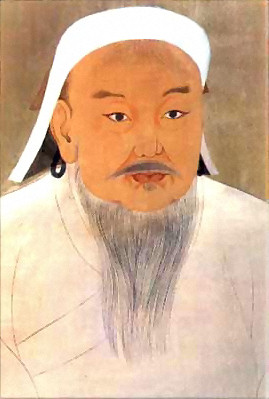
Genghis Khan and Michael Jackson sit down for a good, old-fashioned arm-wrestle. The loser will lose his head. It's a five-hand game, with the DM ruling that Genghis gets first pick at the trump.
Round 1
Genghis: JD, 10C, 6C, 5C, 5S
Michael Jackson: KC, 7C, 4C, 2C, 2S
Genghis picks Clubs as the trump.
Genghis plays 5C. Michael beats it with his 7C.
Michael plays KC. Genghis plays 6C, loses.
Michael plays 2C. Genghis plays 10C, wins.
Genghis plays JD. Michael plays 4C, wins.
Michael plays 2S, Genghis plays 5S, wins.
Michael won three tricks to Genghis' two, so Michael gets the pick of the next trump.
Round 2
Genghis: QD, 10D, 7S, 6C
Michael: JH, 9H, 5C, 3S
Michael picks hearts as the trump.
M's JH beats Genghis' 6C.
M's 9H beats Genghis' 7S.
M's 5C beats Genghis' 10D.
M's 3S beats Genghis' QD.
Michael Jackson wins. Genghis loses his head, and Michael is now the Great Khan of the Mongol Horde.
I like this. Admittedly it's rather unrealistic for Michael Jackson to beat Genghis Khan in an arm-wrestle, but not outside the realms of possibility if Michael is exceptionally lucky - as he was with the cards he was dealt and the fact that he won the trump in the second round. Maybe Genghis was distracted by a passing young mare.
What is needed now is a way of using the cards when there is only a very slim chance of one side prevailing. Like if Genghis challenged me to a beard-grooming competition.

Let's talk about duels.
I've been thinking about this in re: my Sir Gawain and the Green Knight game (see posts here and here). One of the best and most interesting aspects of the kind of storytelling I want to base the thing around is the Duel - whether it be two knights jousting, an extended sword-fight as in that between Errol Flynn and Basil Rathbone at the end of The Adventures of Robin Hood, or a battle of wills as with Nimue's tricking of Merlin. What I want is a mechanic that deals with such one-on-one struggles in a simple and intuitive way, and which will work whether it's two people with quarterstaffs trying to knock each other off a log bridge, or a woman trying to seduce a chaste knight in order to steal his secrets.
For some reason, my mind keeps going back to a game we used to play for 20p pieces back in school, which we called knock-out whist. Knock-out whist is deceptively simple. Seven cards are dealt out to each player. Then the deck is cut to decide which suit is the 'trump'. After that, the player on the dealer's left plays a card and the other players put a card down in turn; players must follow suit if they can, but if they can't they can play any card. The highest 'trump' card wins the trick - or if there isn't a trump card played, the highest card of the suit which led. The player who wins the trick then leads the next.
Once seven tricks have been played and nobody has any cards left, the cards are re-dealt - but this time only six are given to each player. The one who won the most tricks in the previous round chooses the trump suit. The process continues until seven rounds have been played, with the number of cards in a hand reducing each time down to one.
If any player fails to win any tricks in a given hand, he is knocked out of the game.
I feel like something can be done with this. Knock-out whist has the back-and-forth, unpredictable nature of a duel; it is possible for a player to survive by the skin of his teeth for six rounds and then win the seventh and the game, purely by luck of the draw - but it also incorporates a fair amount of skill and strategy when it comes to choosing which cards to play (it is rather like the game Hearts in that respect).
There are problems, though. Knock-out whist can be played by two people, but it works better with four or more. Also, success comes down purely to two things - luck and player skill. It wouldn't be a test of character skill if it was used as a mechanic to determine success in a duel in a role playing game. Finally, some 'Duels' are more serious than others; is it really appropriate to use the same method to work out who wins an arm wrestling match and who wins a life-or-death fight by hitting each other in the face with axes? How best to get around these problems? It strikes me that there are two ways:
- The length of the whist-game can be altered, so that a minor, unimportant struggle would use three or even two hands, whereas an epic sword fight like the Robin Hood/Guy of Gisborne one could be nine or ten hands long.
- Bonuses could be given to the stronger of the two characters in the given skill being tested by allowing them to start off by choosing the trump, giving them a one-trick head-start, or something else.
Let's try out an example to see if what I'm talking about makes sense:
Bert the Turnipeater and Fred Hogfatbreath are going to have a competition to see who can draw their sword fast enough, with the loser having to drink a pitcher of ale from the dregs of the barrel. The DM judges that this is a very minor incident, and it relies on speed, so it will only be one hand of three tricks in length. Bert is a trained swordsman, but Fred is an upstart journeyman, so the DM lets Bert decide on the trump. Then he deals out three cards:
Bert gets an Ace of Hearts, a Six of Clubs, and a Four of Clubs. He chooses clubs as the trump.
Fred gets a King of Diamonds, a Seven of Clubs, and an Ace of Spades.
Thinking strategically, Bert plays his Four of Clubs first, in order to 'flush out' any Clubs his opponent might have. Fred has to follow suit and plays his Seven of Clubs. He wins the trick. The DM says, "Fred gets his hand to his sword hilt a fraction earlier and begins to draw..."
Fred won the last trick so he leads. He has no trumps left so he decides he might as well play his Ace of Spades. Bert doesn't have a Spade so he can play either of his cards; seizing his chance he plays his remaining trump, the Six of Clubs, and wins the trick. The DM says, "Bert has a better grip on his sword hilt, allowing him to draw more quickly and match Fred's speed..."
The final hand. Bert won the last trick so he leads and plays his Ace of Hearts. All Fred can play is his King of Diamonds, so he loses. The DM says, "Bert swings his sword from his scabbard a fraction earlier than Fred. He wins." Fred has to drink the flat ale, while Bert wins the affection of the barmaid.
I think I'm going to go and play through a few scenarios and see how the whole thing works. More tomorrow, maybe; any advice appreciated.