Sunday, 30 June 2024

The Sunday Seven: 30th June 2024

Each Sunday (hiatuses notwithstanding) I share seven links to items of interest that have crossed my eye across the preceding week. Here are this week's:

  • Roger G-S posted a useful response to a recent post of mine, providing his own method for generating evocative wilderness travel descriptions.
  • Somebody good at maths did some maths to systematise success rates for repeated rolls - he mathed the maths, and it is useful.
  • The same person also did a nice, useful little precis on the properties of randomisers.
  • Jimmy Chamberlin is one of my favourite musicians of all time and was recently given an extended interview by Rick Beato. The whole thing is worth listening to, but in particular he had some interesting sceptical comments to make about AI and music that may be relevant to your interests (starting here).
  • And here is a lengthy interview with none other than Jack Vance, from 1976. Early on, he says something about his philosophy that I found interesting, and strongly counter-cultural - his mission as an author, he says, is to try to avoid inserting himself between the reader and the imaginative world being created, and this is one of the reasons why he was keen for people to know as little as possible about his personal life and opinions. What I think is interesting about this is that despite this avowed intention, it is often quite difficult to avoid Vance in his fiction - his personality comes across so forcefully. This goes to prove a point of some kind that is perhaps worth expanding on in a full blog post. 
  • The Lebombo Mountains, in the far south of Mozambique, are thought to be a chunk of what is now Antarctica, left behind in the break up of the super-continent Gondwana millions of years ago. If you can't use that in a game, there is something wrong with you!
  • I really got a lot out of this discussion of 'The Medieval Cosmos as Permanent Apocalypse' - you might, too. 

Thursday, 27 June 2024

Wilderness Exploration Design Approaches: Tight and Loose

Never dispute that the commenters on this blog are deep thinkers who possess profound insights into the True Nature of Things.

In my last post, I suggested that we need to do better in developing the principles guiding wilderness exploration and travel in the same way that we have for dungeoneering. From the comments emerged two suggestions, which I have not made up my mind are in absolute opposition or else McGilchristian productive, harmonied opposition; I will call them 'tight' and 'loose' approaches. 

Tight

Here, first, then is a comment by John:

I'll make the general assertion, that a 'true' wilderness hex crawl should be designed with as much love, care and attention as any tentpole dungeon in any underworld exploration game, and for the same reasons - it's the framework and fabric to which everything else is just an adjunct. It's not simply (rather, it doesn't have to be) an interstitial space between dungeons or a rote navigational exercise. Almost all published wilderness adventures have this thinness to them; those that don't tend to blur the line between wilderness adventure and above-ground "dungeon" in a way I find unsatisfying. The proof of the pudding is that it should produce enjoyable long-term play without any dungeons in it whatsoever, and without constant reinvention or new material added by the DM. I don't believe that's achievable with good intentions and excellent writing skills, it requires methodical design.

The idea here as I see it is that published wilderness adventures should carefully catalogue and describe contents of a region in exactly the same way as one would with a published megadungeon - perhaps not down to the last blade of grass (I suddenly have an image in my mind of the life-sized 1:1 map in Borges's On Exactitude in Science) but certainly in much more depth and with much more in the way of loving care than is done currently. I am taken with this idea and I especially like the implicit challenge behind the assertion that the map should 'produce enjoyable long-term play without any dungeons in it whatsoever' - this is a lofty goal (because I have always thought of even wilderness maps as needing caves, holdfasts, towers, etc. to break things up a bit), and one which gives me creative urges.

Loose

Second is a comment by Brian:

Traditional systems have you roll each day for weather, probably 3 encounter checks, and navigation. That forces the DM into narrating "you travel through the woods for a day", "you travel through the woods for another day". If you have an alternate system where you make one or more rolls that tell you how much time passes between encounters, (could be anything between an hour and a week), how much time passes until the weather changes, etc. now you can actually narrate the travel like Tolkien, who can spend a single sentence on a boring week's worth, or pages on a single day.

This is one of those 'Your ideas are intriguing to me and I wish to subscribe to your newsletter' moments. It is much more impressionistic, and would I think imply different rolls for different terrain types, so that in very hilly, broken up, densely forested country your 2d6 roll (or whatever) would give a gap between encounters read in hours, whereas in an open, sparsely populated desert it might be read in days. It would also need to be done - as Brian himself suggests - across different axes: weather change, actual creature encounters, 'ambient' events (like earthquakes or whatever), landscape featuers (chasms, rivers, lakes, bogs, etc.).... 

It reminds me in some vague way of what I was trying to achieve with the Zonal Combat System, not in the sense of arriving at the same result, but at the level of principle in abstracting distance for game-related purposes from actual distance in the fictional reality. 

What is for sure is that talking about such matters in this broad and air-fairy way can be interesting and inspiring but what is really needed are proper test cases in which we can see the way things work in action and critique and comment upon them.

Tuesday, 25 June 2024

Far, Vast and Lonely: Describing and Confronting the World

Cloud and mist abode ever in the south, and only the foot-hills showed of the great ranges beyond Bhavinan. But on the evening of the sixth day before Yule, it being the nineteenth of December when Betelgeuze stands at midnight on the meridian, a wind blew out of the north-west with changing fits of sleet and sunshine. Day was fading as they stood above the cliff. All the forest land was blue with shades of approaching night: the river was dull silver: the wooded heights afar mingled their outlines with the towers and banks of turbulent deep blue vapour that hurtled in ceaseless passage through the upper air. 
Suddenly a window opened in the clouds to a space of clean wan wind-swept sky high above the shaggy hills. Surely Juss caught his breath in that moment, to see those deathless ones where they shone pavilioned in the pellucid air, far, vast, and lonely, most like to creatures of unascended heaven, of wind and of fire all compact, too pure to have aught of the gross elements of earth or water. It was as if the rose-red light of sun-down had been frozen to crystal and these hewn from it to abide to everlasting, strong and unchangeable amid the welter of earthborn mists below and tumultuous sky above them. The rift ran wider, eastward and westward, opening on more peaks and sunset-kindled snows. And a rainbow leaning to the south was like a sword of glory across the vision.

- ER Eddison, The Worm Ouroboros

I have long been interested in the subject of how wilderness exploration can be perfected as an aspect of 'old school' play in the manner in which I think dungeoneering has been (almost) perfected as a playstyle conceptually by the OSR. I do not think we have achieved anything like as much in this regard despite our desperate graspings, gropings and gesticulations in that direction. And I think this is a failing. If we can think of old school D&D as an attempt to make fantasy literature gameable, then we neglect wilderness exploration only by doing great damage to this goal, since the making of epic journeys across mighty and wondrous landscapes goes so deep into the genre's blood. It is in Tolkien, it is in Eddison, it is in Howard, it is in Moorcock; it is in Vance; it is everywhere. Fantasy is impossible to conceive of as we understand it today without this emphasis on the mythopoeic world as something that exists to be explored and also grappled with as an entity in its own right. 

We ought then to think seriously about wilderness travel as a fundamental feature of what D&D should be about - and not only mechanically, but imaginatively or (dare I say it) spiritually. The landscape is something against which the PCs should be contending, and which should do justice to the attempt to engage with it in its own right, at the level precisely of landscape. It should not be something that is merely crossed to get between points A and B, or traversed so as to uncover pre-arranged or randomly generated contents (although both of those things will inevitably happen in a D&D campaign and are obviously important). It should have an independent existence that interests, entertains and entices the players as much as would the exploration of a dungeon.

We can mechanise this, of course, and there are systems that can be used for doing so (many of which are available online), but in the end there is only so much that mechanics can achieve. Fundamentally, what makes a landscape come alive is more intangible than that; it is how the physical space is described. To read the Eddison passage that begins this post is to be transported - one can not only see but feel oneself on that place on the cliff-top, looking out over the 'far, vast and lonely' mountains with the 'sword of glory' of a rainbow in the distance.

Not all of us (well, let's call a spade a spade, none of us) is capable of coming up with prose like that on the fly, let alone simply rattling it off such perfectly realised imagery in a description to the players of what the PCs happen to see at a given moment as they survey the landscape. But there are two practical things that we can do - whether as DMs or as game designers - to facilitate the creation of more immersive worlds.

The first is to actually go out and travel, explore and hike, and to pay careful attention to the landscape as one does so and what the actual 'lived experience' of overland travel is like - what what one can see, what one can hear and smell, what one can imagine happening there. A few years ago I wrote a post in which I put this into practice, describing a hike I had recently been on in rural Northumberland, and shared some photos. Here is just one of them, chosen deliberately because it is so ostensibly undramatic:


Look at it carefully and notice the way the landscape unfolds itself before the eye: the rough track that runs across the tussocky grass; the boggy pool that lines right across its path about a third of the way up the length of the photo; the patch of gorse to the right that might conceal a hidden predator; the higher grasses in the middle distance in which enemies might be lying flat against the ground; then the way the ground suddenly falls away so as to conceal a cleft in the landscape cutting across the image - there is obviously a body of water down there but what is it? how deep and sheer is the valley? - and beyond it the low rise to a clump of hillocks beyond; the semi-woodland of leafless trees that half-conceal the bracken around their feet; and behind a glimpse of buildings and of lush green farmland that hints at the closeness of something more civilised. This is an almost studiedly ordinary rural image, but it is not difficult to look at it, and think about it, in an engaged way so as to understand between the scale of natural landscapes and what can lie within them - and what the eye can actually take in (or not take in) during an overland journey.

Doing this will not provide you with an instantly accessible mental library of images that you can simply regurgitate to the players at the table but it will give you the stuff of mental conjuring - you will be better equipped to picture landscapes of your own and put them into words so as to better communicate to players a sense of place.

The second thing that can be done is that people who are writing adventure modules and campaign settings can get good at writing descriptions of landscapes themselves. People may already have done this, but providing DMs with handy, accessible and beautiful three-line descriptors of what the players can see as they traverse one hex or another, or go from one point to another on a pointcrawl, would I think be a very useful addition to wilderness campaigning. We have plenty of models for what good descriptive prose looks like with respect to fantasy landscapes in the form of Tolkien, Lewis, Eddison, et al - not to mention the great travel and nature writers: the Apsley Cherry-Garrards, Barry Lopezes, JA Bakers, and so on, who have tried their hardest to give accounts in prose (or poetry) of how the world looks and what is in it. Good writing can achieve great things - and can be put to useful purpose.

Sunday, 23 June 2024

The Sunday Seven: 23rd June 2024

I have been juggling too many different balls lately to keep them all in the air at once, and the Sunday Seven was one of the ones I let drop. But never fear. Like an ageing acrobat suddenly reinvigorated by memories of former glory, I find the old muscles still work. Expertly, I dart down to grab the Sunday Seven, somehow managing to keep all the other balls alive, and reintroduce it into my routine.

  • At Worldbuilding and Woolgathering, Edmund penned a response to my thoughts about Gene Wolfe and 40K, suggesting that 40K can be understood as a saturnine setting - I commend the post most highly for its depth and insight. And it even has a competition in it. (True story: I once did some peer reviewing work for Oxford University Press and they paid me in books. One of the books I requested was Michael Ward's Planet Narnia, but they never sent it to me on the basis that it was a quasi-POD book and they would need a few more orders to come in before they did another print run. That was in 2013. I'm still waiting.) 
  • I enjoyed this old post that I came across about Ursula Le Guin's worldbuilding. Le Guin is hit-and-miss for me, but this post made me wonder if I ought to do a reassessment. 
  • Patrick Stuart has decided to pivot towards quality over quantity. I see what your strategy is, Patrick. In any case, he doesn't always post nowadays, but when he does, he posts things like this and this.
  • I post this more out of curiosity than anything: a 2010 Cato Institute event on Robert Heinlein 'In Dialogue with His Century'.
  • I can't remember if I have mentioned this on the blog before, but I recently re-encountered CJ Cherryh's writing advice page, and thought it might be of interest. 
  • John Howe's illustrations of Tolkien's work were absolutely foundational in attracting me to fantasy literature, so I enjoyed this interview I found with him on YouTube
  • On a similar note, here is an interview with Tony Diterlizzi, whose illustrations were also, well, foundational in attracting me to fantasy gaming.

Thursday, 13 June 2024

Space Paladins in the Demonic Future

Here's an elevator pitch for you, following on from my most recent post: I call it Space Paladins in the Demonic Future.

Humans have begun to colonise the galaxy and discovered that black holes are portals to hell and demons roam the universe.

The PCs are holy warriors whose task is to hunt down, slay, uproot, exorcise and exterminate those demons whenever and wherever they are found, in all their forms.

The task is to provide maximum campaign flexibility and maximum player agency combined with an institution-based mode of advancement.

Maximum campaign flexibility means - you've guessed it - lots of random tables to generate planets, ecosystems, geographies, space stations, and so on; to generate vast and potentially infinite demon types, appearances, tactics and aesthetics; to generate different varities of holy orders to which the PCs can belong; and to generate many different types of campaign style. It should be as possible to play literal space knights fighting ape-demons in a mangrove forest with trees hundreds of metres wide, as it is possible to play a refined caste of priestly duellists trying to uncover demons-in-disguise in high society in a utopian cloud city.

Maximum player agency means that, while the PCs by definition are not 'rogues', the are choosing how to respond to events that are somewhat random and not governed by DM fiat or pre-ordained plot. This means the implementation of something like my Random Demonic Incursion Generator (tm). 

An institution-based mode of advancement means that the PCs are all members of a particular holy order and that their goal is to advance the aims of that order - however they see fit - rather than exactly to individually excel. This may indeed involve an Ars Magica style approach in which each player has a stable of PCs, or it may involve pooling XP and spending it on developing different aspects of the order so as to recruit new members, expand physical resources, gain new expertise, and so on.

At current rates of progress across my various projects this should be due for release around the year 40,000 AD....


Thursday, 6 June 2024

Space Wolfe: Or, Why Grimdark Needs a Theology

As somebody who is, let's say, Warhammer 40,000-curious (I played an awful lot of Warhammer Fantasy Battle, Warhammer 40K, Necromunda, Blood Bowl, WHFR etc in my teenage years but have only half kept an eye on GW products since), it has always interested me how the setting sets up but spectacularly fails to deliver on an obvious Christian theological inspiration. We get the trappings of a kind of pastiche, parody or satire of religion in the form of the Emperor. But it's basically shallow and teenage. 

This is entirely understandable - since the people who come up with the rules and write the novels are probably mostly themselves agnostics and atheists, and since most of the audience are too. But it has the effect of denuding the setting of what could be a great deal of emotional heft and import - something which I think even non-religious people could appreciate, much as they are able to appreciate the obviously Christian themes within the fiction of, say, Tolkien, Lewis, and Wolfe without having to feel as though they are being preached to.

Sticking with the triumverate of Tolkien, Lewis and Wolfe for a moment then, while clearly Lewis's work was more actively engaged in Christian apologetics than the other two, there is a strong thematic commonality between the three of them in that they all sought to depict fantasy worlds which were very different from our own but which were animated by an idea of divine grace. 

This is made very obvious through comparing the work of these authors to their non-Christian or secular equivalents - Ursula Le Guin, say, or ER Eddison, or George RR Martin, or Terry Goodkind, which typically posit a world which is largely defined by human will: the interest is in how individual people or groups amass power, or shape their own futures, or remake society, through their own actions. For Tolkien, Lewis and Wolfe on the other hand, while undoubtedly their stories are characterised by human heroism, that heroism is always reliant for its success on the notion that there is an underlying or overarching (pick your preferred term) natural goodness in the universe which both pulls events towards an ultimate telos and at crucial moments intervenes miraculously in acts of mercy, blessing and so on.

Hence, for example, in The Lion, The Witch and The Wardrobe Edmund is given the chance to become heroic by the fact that Aslan intercedes with the Witch on his behalf to save his life. In The Hobbit Bilbo is able to change the world because of miraculous happenstances (Sting found in a random troll hoard; secret entrances and hidden meanings discovered in maps at opportune moments; stumbling on the ring; the intervention of the eagles and Beorn at the Battle of the Five Armies, etc.). In The Book of the New Sun Severian comes across the Claw of the Conciliator by sheer fluke at the end of the third book. And so on and so forth.

A consistent theme in Wolfe's fiction in particular is the thrusting of a young man into an evidently perverse and dangerous setting (Urth; Mythgarthr; Greece in the aftermath of the Persian invasion; etc.) and the subsequent discovery by that character that he holds a different morality to those around him - rather by 'accident'. And not only this; the character also then discovers that that this personal morality in fact fits into a broader moral structure which underpins the universe, such that the prevailing social order in which he is enmeshed is revealed to be a corruption of what is in fact True. Thus, to take the most obvious example, Severian finds himself by accident (which is to say, grace) stumbling on the awareness that he simply cannot live as a torturer without compunction. And this forces him, over the course of the novels, towards the understanding that the society in which he lives is evil and alien to the proper moral way of things, with explosive results.

The problem that 40K has, as I see it, is that it sets up a kind of metaphysical halfway house in this regard, in positing the perverse and dangerous 'grimdark' setting but hiding away from the counterpoint of natural goodness or right. All of the different factions, including the forces of the Imperium, are basically variations of baddies vying to impose their own conditions of Being on the universe. That's fine, as far as it goes - it works as the setting for a tabletop wargame. But there is something thin and unsatisfying about it when it comes to role playing games - being mere rogues in a 'crapsack world' is only to go with the flow, and going with the flow is not the stuff of good fiction, whether emergent or otherwise.

For events to feel as though they have consequence at the individual level within the context of a setting like that of Warhammer 40K, which is defined by all-or-nothing conflict, they have to be accompanied by the sense that the individuals involved are in some sense wrestling with and against the very conditions of that conflict. I am much more interested in the idea of people in the Warhammer 40K universe trying to do good in terms of a vision of morality that sits entirely at odds with the prevailing morality across the conflicting factions than I am in the basically cosmetic choice of picking between those factions, or the superficial one of glorying in grimdark kitsch. A Warhammer 40K roleplaying game in which the PCs hunt daemons or battle orks is one thing. One in which they try to do good in a different sense is much more appealing.

What I want, I realise I am saying, is for Gene Wolfe to come back from the dead and write Warhammer 40K fiction. Then we would be cooking with gas.

Tuesday, 4 June 2024

The Monster Kills XP Economy

Advancement systems in D&D must always, to my eye, be intrinsic, pseudo-objective and at least quasi-quantifiable. They should in other words relate to events that happen 'in universe' rather than in the context within which play take place (ruling out, for example, XP for 'good role playing'); they should leave as little as possible to subjective judgments by the DM (ruling out, for example, 'story goals'), and there should be some plausible connection between the amount of XP awarded and what it is being awarded for (1 XP per GP; 25 XP per HD of monsters killed; etc.). This is all geared basically towards keeping the DM somewhat honest, and ensuring that the incentives point towards player agency rather than railroads - the result should be that the players want their PCs to go on adventures because of some intrinsic motivation rather than 'because it's the plot'. If the PCs are getting XP for 'story goals', they are by definition wedded to 'the story'. If they get XP for treasure, all they have to do is look for treasure - wherever and however they like.

(I say 'pseudo-objective', because in the end the DM is in charge of setting up the conditions in which play will take place, and it is therefore always inevitably within his gift to determine, for example, how much treasure is actually available in the setting for the PCs to discover, what monsters inhabit the local region, and so on and so forth. And I say 'quasi-quantifiable', because obviously to a certain extent the relationship between the XP value and the underlying token - GP, say, or monster kills - is arbitrary; why should it be 1 XP per GP rather than 1 XP per SP or 5 XP per GP?)

All of this is now known and I know that I am teaching all of you grandmothers out there to suck eggs and preaching basic, primary school level OSR knowledge. But still, it seems important to lay out my bona fides all the same.

XP for gold is therefore in any case the gold standard (see what I did there?) for an advancement system, because it does exactly what it says on the tin - it provides an incentive for the PCs to adventure and it prevents DM arbitrariness. But there are viable alternatives. One would be XP for exploration - based on the number of hexes travelled, or the number of hexes fully explored, or a similar mechanism. Or one could even come up with a method for awarding XP for 'adventure' - giving XP for simply encountering things, or being made subject to particular magical effects, or for descending dungeon levels, and so forth.

The main rival for XP for gold, though, would probably have to be XP for monster kills, since it seems to make intuitive sense: combat is after all often the most enjoyable and immersive aspect of play, and it has an 'in-universe' logic to it in that killing monsters is probably both useful and would also help a person develop his abilities in the crucible of life-and-death confrontation. 

When I run D&D I mainly rely on an XP for gold system but I do award XP for monster kills on the basis of the little table found in the Rules Cyclopedia. What this typically means in practice, though, is that XP for monster kills is like a thin sliver of icing on a very fat slice of cake. It is big treasure hauls which see PCs advancing from level to level; the monster kills don't really move the dial. What I don't see emerging, in other words - because the totals are so comparatively small - is a monster kills XP economy. 

What I would expect if I increased the XP awards for monster kills (from, say 25 XP or so per HD to 250 XP) and abandoned XP for gold entirely is a radical restructuring of player incentives that I think would play out as follows:

  • Players would still be incentivised to go out on adventures but their tolerance for risk would I think increase. Under an XP for gold system, the incentive is to try to amass as much treasure as possible while minimising the risk of monster encounters. An XP for monster kills system would I think reward more risk-taking behaviour: trying to take out the local ancient red dragon despite perhaps not quite being 'ready' for it, because of the big XP haul that would result.
  • A genuine monsters kills economy would I think emerge, in the sense that the players would still need to get money from somewhere to fund their lifestyles and buy their necessaries. It seems likely that the selling of monster body parts would become quite an important aspect of what would happen during gaming sessions; it also seems likely that securing payment for bringing in bounties or monster scalps - or even assisting in trophy hunts - would also become part of proceedings.
  • Aimless roaming might be encouraged. PCs would actually desire, rather than actively avoid, random encounters. And they may very well decide that simply striking out into the wilderness on long journeys would be a good way of triggering them.
  • Killing monsters would become more important than defeating, out-smarting, or avoiding them (without, of course, a tweak to the concept). This would result in a more violent and aggressive approach to the game world - although this might be channelled in an interesting direction if XP was only awarded for killing certain types of monsters (demons or evil undead, say, in a game in which the PCs are all paladins). 
This seems to suggest that the result would be a more 'gamified' and superficial engagement with the setting on the part of the PCs. Discuss. 

Friday, 31 May 2024

Reflections on a City


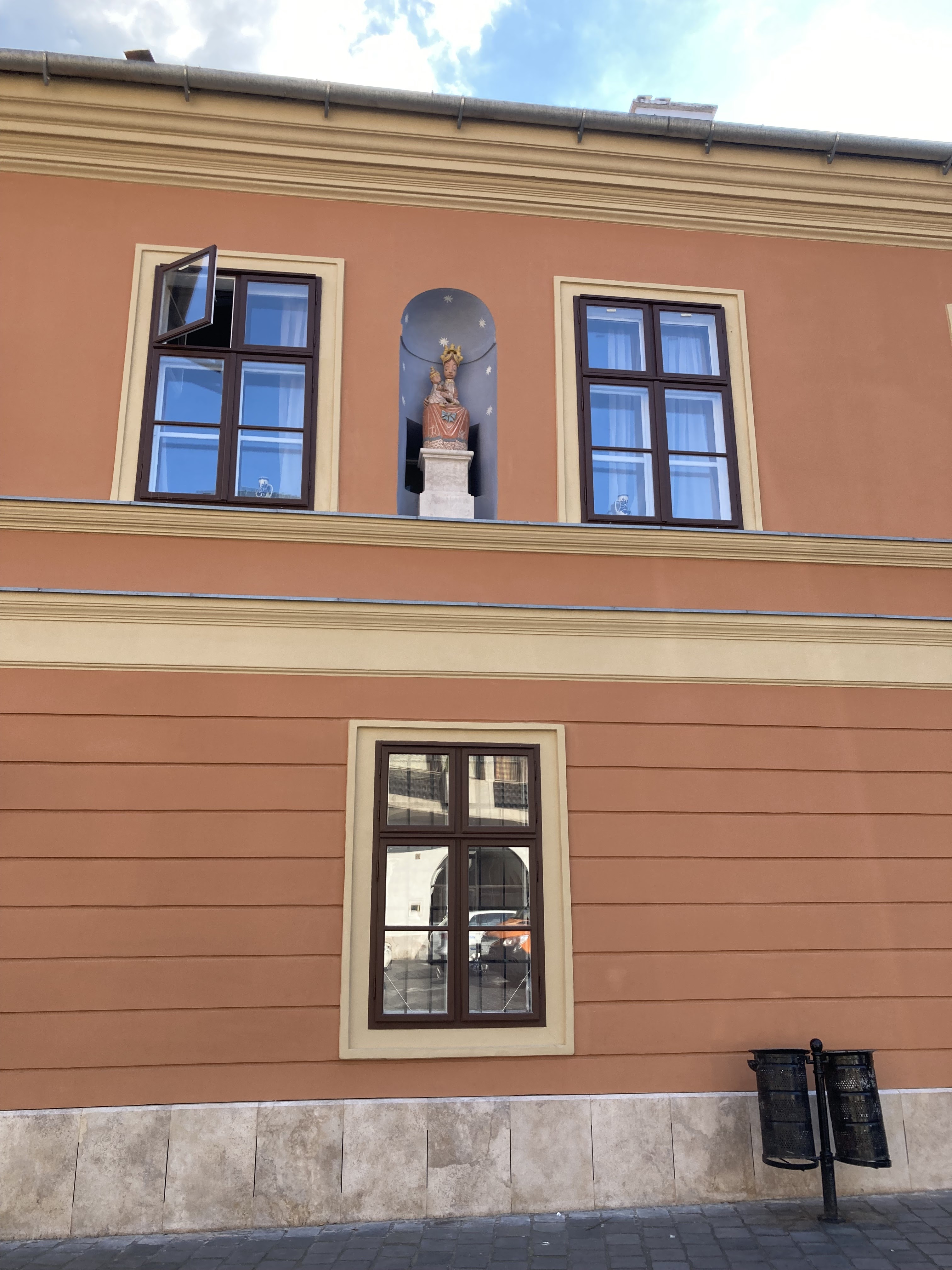
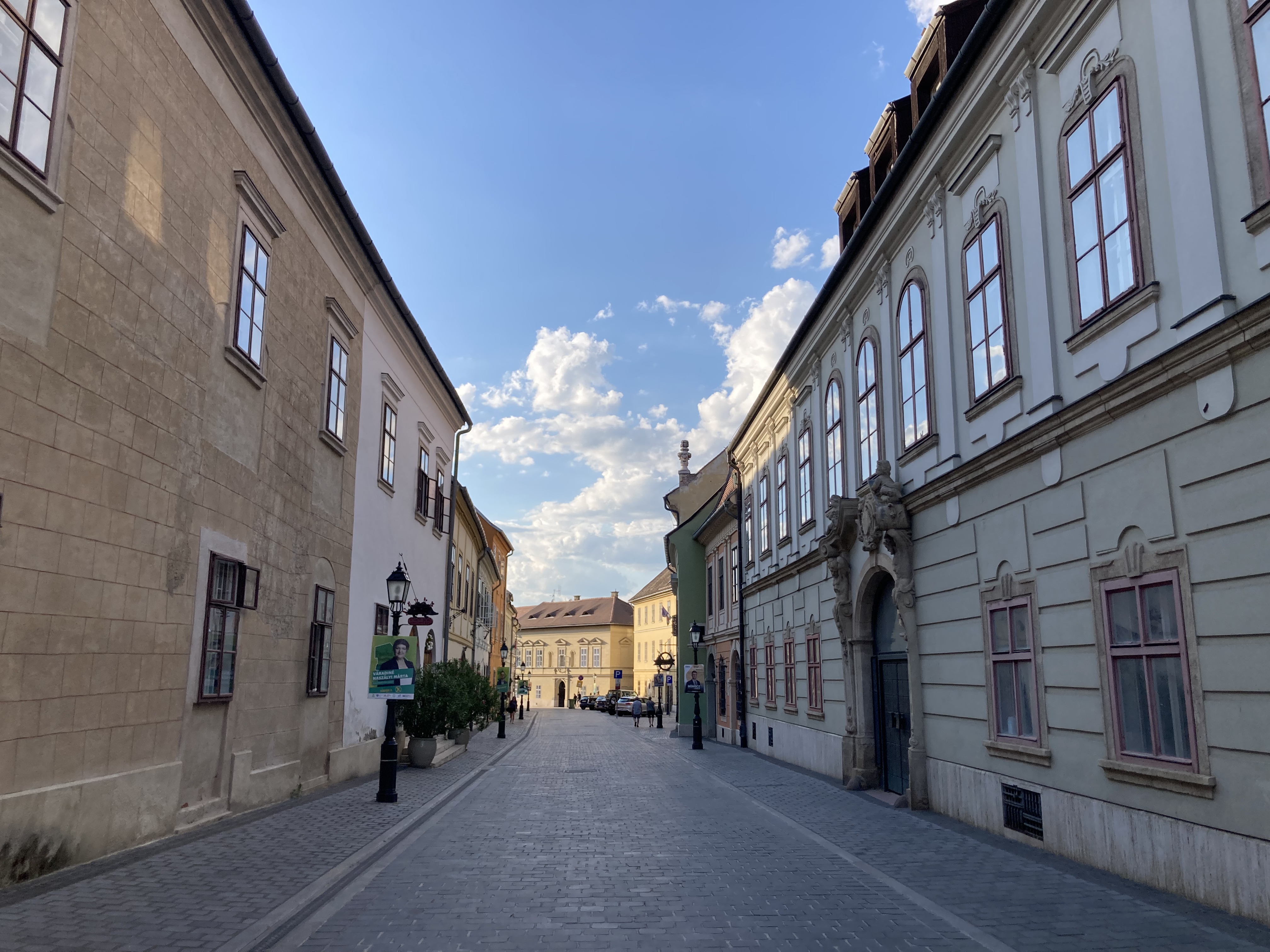
I had the pleasure of being spirited away on a business trip to spend much of the last week in and around the old town on the castle hill of Budapest. 

Hungary is a country that, to the European outsider, is encountered through a thin veil of fantasy. The Hungarians are Europeans, no doubt, but they retain a hint of the vast Eurasian steppe about them. Their language, and the aesthetic preferences rumoured in their art, crafts and architecture, speak of roots in an altogether different substrate to that of the peoples who surround them. 

The consequence is that Budapest, to the non-Hungarian, is a city that feels as though it ought to belong in a different plane of existence. It is a city with magic in the air - rumoured in the distance, or stowed away in secret attics, or hidden behind ornate doorways or at the end of high narrow alleyways. Never even really glimpsed except, if one is fortunate, at the extreme periphery of one's vision, like a flitting shadow. 

A feeling that there are things being said and done behind closed doors that one cannot dream of but suspects are filled with strange import and concealed meaning. A feeling that beyond upstairs windows are meetings and whisperings in rooms decorated with signs and symbols in gold leaf or etched in silver. Summonings and secrecy. Old books in old languages filled with old knowledge and paged by old fingers, read by ancient eyes. 

A feeling that one is on the border of something grand and mighty and distant - a shard of another reality that stabs into our own.

A feeling that it is a city of adventure - of cellars that lead to labyrinths and mazes, of wizards' studies, of collectors of rarities and obscurities, of pipe-smokers and calligraphers, of softly murmured rumour in coffee shops and over goulash or dishes of river fish, of antique shops selling merchandise of unknowable origin and vast heritage, of sidelong glances and whisperings in ears. A city defined by a public face which cannot fully conceal the private mind. 

Ultimately, the city-based campaign is one of great appeal. A city can contain worlds within it. Dungeons hidden beneath streets, of course, but also portals to other dimensions - not to mention conspiracies, plots, assassinations, subterfuge and secret war. What is especially noticeable about it is that it presumes that much of what passes for adventure is to a greater or lesser extent deliberately hidden. What goes on in terms of adventure must in some degree go on in a fashion concealed from polite or 'normal' society. A visit to Budapest was enough to kindle my appreciation for this kind of game, since as an outsider I was by definition required to approach the city in that vein - as a place whose real nature was partially disguised from me. I recommend a visit.

Thursday, 23 May 2024

Eddison-Tolkien-Zelazny: The Sweet Spot

I am currently engaged in something of a strange literary enterprise in that I am daily listening to an unabridged (and utterly fantastic, by the way) Audible audiobook of The Worm Ouroboros by ER Eddison on my way to and from work, but reading The Chronicles of Amber by Zelazny at night. (These are both re-reads after many years, although I don't know if I ever finished Ouroboros when I encountered it long ago.) 

It is hard to imagine two more stylistically different literary works, for all that they are in content oddly similar (both being, in the end, fun adolescent fantasy romps which unashamedly lionise an old fashioned, 'Boy's Own Adventure Story' aesthetic - and both, oddly enough, commencing with a short framing 'real world' narrative which has no bearing on the actual story). Ouroboros is written in a wonderfully self-conscious pastiche of early modern English in which there are absolutely no visible seams: the verisimilitude is total. Viz:

When the King was come into his high seat, with Corund and Corinius on his left and right in honour of their great deeds of arms, and La Fireez facing him in the high seat on the lower bench, the thralls made haste to set forth dishes of pickled grigs and oysters in the shell, and whilks, snails, and cockles fried in olive oil and swimming in red and white hippocras. And the feasters delayed not to fall to on these dainties, while the cupbearer bore round a mighty bowl of beaten gold filled with sparkling wine the hue of the yellow sapphire, and furnished with six golden ladles resting their handles in six half- moon shaped nicks in the rim of that great bowl. Each guest when the bowl was brought to him must brim his goblet with the ladle, and drink unto the glory of Witchland and the rulers thereof. 

Somewhat greenly looked Corinius on the Prince, and whispering Heming, Corund's son, in the ear, who sat next him, he said, "True it is that La Fireez is the showiest of men in all that belongeth to gear and costly array. Mark with what ridiculous excess he affecteth Demonland in the great store of jewels he flaunteth, and with what an apish insolence he sitteth at the board. Yet this lobcock liveth only by our sufferance, and I see he hath not forgot to bring with him to Witchland the price of our hand withheld from twisting of his neck." 

Now were borne round dishes of carp, pilchards, and lobsters, and thereafter store enow of meats: a fat kid roasted whole and garnished with peas on a spacious silver charger, kid pasties, plates of neats' tongues and sweetbreads, sucking rabbits in jellies, hedgehogs baked in their skins, hogs' haslets, carbonadoes, chitterlings, and dormouse pies. These and other luscious meats were borne round continually by thralls who moved silent on bare feet; and merry waxed the talk as the edge of hunger became blunted a little, and the cockles of men's hearts were warmed with wine. 

"What news in Witchland?" asked La Fireez. 

"I have heard nought newer," said the King, "than the slaying of Gaslark." And the King recounted the battle in the night, setting forth as in a frank and open honesty every particular of numbers, times, and comings and goings; save that none might have guessed from his tale that any of Demonland had part or interest in that battle. 

La Fireez said, "Strange it is that he should so attack you. An enemy might smell some cause behind it." 

"Our greatness," said Corinius, looking haughtily at him, "is a lamp whereat other moths than he have been burnt. I count it no strange matter at all." 

Prezmyra said, "Strange indeed, were it any but Gaslark. But sure with him no wild sudden fancy were too light but it should chariot him like thistle-down to storm heaven itself."

This can be contrasted with Zelazny's hardboiled prose, in which no matter the occasion or context everybody sounds like they hail from the Midwestern USA circa 1971. Here we find the main character, Corwin, having a conversation with a camp follower in a pseudo-Arthurian setting:

'Let's have another glass of wine.'
'It'll go to my head.'
'Good.'
I poured them.
'We are all going to die,' she said.
'Eventually.'
'I mean here, soon, fighting this thing.'
'Why do you say that?'
'It's too strong.'
'Then why stick around?'
'I've no place else to go. That's why I asked you about Cabra.'
'And why you came here tonight?'
'No. I came to see what you were like.'
'I am an athlete who is breaking training. Were you born around here?'
'Yes. In the wood.'
'Why'd you pick up with these guys?'
'Why not? It's better than getting pig shit on my heels every day.'

Nobody can question Zelazny's storytelling power, his pacing, or his skill for deploying dialogue, but this, my friends, is the precise opposite of verisimilitude: demigods and medieval camp followers would not talk like they hail from the late 20th century USA - and certainly wouldn't sound as though they had just stepped out of an afternoon TV mystery movie, as these two do. Don't get me wrong: I love the Amber books, but Zelazny was very much a storyteller first and a worldbuilder a far distant second. His settings never strike the reader as plausible worlds in their own right, but as mere backdrops for the plot. 

We can think of Zelazny and Eddison as being two poles on a spectrum in fantasy literature - the former strongly emphasising the telling of a good story at the expense of detail, and the latter lovingly and almost obsessively painting a picture of a fully realised and inhabited world. I like both; I have a hard time accepting that Eddison's is not by far the greater achievement, but it is hard to find a more entertaining series in the fantasy canon than the first five Amber books. 

One of the reasons why I think Tolkien still stands supreme in the genre is that his work strikes almost the perfect middle between these two extremes. He is a thousand times more accessible than Eddison (one can hardly imagine a Peter Jackson blockbuster version of The Worm Ouroboros) but a thousand times weightier than Zelazny. Hence, for example:

'Begone, foul dwimmerlaik, lord of carrion! Leave the dead in peace!' 

A cold voice answered: 'Come not between the Nazgul and his prey! Or he will not slay thee in thy turn! He will bear thee away to the houses of lamentation, beyond all darkness, where thy flesh shall be devoured, and thy shrivelled mind be left naked to the Lidless Eye.' 

A sword rang as it was drawn. 'Do what you will; but I will hinder it, if I may.' 

'Hinder me? Thou fool. No living man may hinder me!' 

Then Merry heard of all sounds in that hour the strangest. It seemed that Dernhelm laughed, and the clear voice was like the ring of steel. 'But no living man am I! You look upon a woman. Eowyn I am, Eomund’s daughter. You stand between me and my lord and kin. Begone, if you be not deathless! For living or dark undead, I will smite you, if you touch him.' The winged creature screamed at her, but the Ringwraith made no answer, and was silent, as if in sudden doubt.

Nobody could accuse these people as sounding like they are from 1970s Illinois, but at the same time the prose is perfectly digestible and understandable to a reasonably well-read adolescent - as most people reading this blog can probably attest. Tolkien presents with a totally coherent world, so real and so complete that it feels as though it exists, but in a way which still allows us to easily access it - there is no requirement, as there is with Eddison, to spend a while getting one's ear in before one can easily parse the ornate prose. 

What lessons lie here for the D&D DM? Only that every single RPG session I have ever been involved with has, more or less, followed the Zelaznyian mode in the way in which the participants have approached the subject of realism. I feel a sense of regret about this, while recognising the strong biases, incentives and preferences that lead things in that direction. I would love to one day be involved in a campaign in which people invested the time and energy in creating a setting and an experience of Eddisonian depth (if not of subject matter and substance) - but I would more than settle for a Tolkienian one. 

Monday, 20 May 2024

Make Animal Fantasy Great Again

I am a qualified fan of animal fantasy - I confess it. My tastes lean more towads the quasi-realistic Watership Down/Duncton Wood end of the spectrum, wherein the animals basically act like animals except for having human-level intelligence and being able to 'speak' an actual language; while I adored the Redwall books in particular as a child, as an adult the inconsistencies in size dynamics between the different animal kinds and their surroundings makes the events depicted impossible to really visualise. But the basic concept appeals wherever on that spectrum it appears.

It's a source of some regret to me that there is no animal fantasy OSR game or campaign setting, at least that I know of,* which does what I think animal fantasy really needs to do in the sense of creating a plausible-seeming depiction of anthropomorphic animals such as they do not simply come across as 'furries' or as human beings in funny suits, but rather as actual sentient animal species. Join me then while I dream up a list of central characteristics that a proper animal fantasy OSR game needs to have in order to merit the description of being truly Great.

First, it should be embedded in a real-world ecology and geography. What I mean by this is that animal fantasy is going to be inherently more interesting if it is based on the anthropomorphisation of animals from a particular biome - a fantasy England in which there are harvest mouse-people, badger-people, hedgehog-people, robin-people etc.; a fantasy Japan in which there are crane-people, fox-people and deer-people; a fantasy Botswana in which there are secretary bird-people, cheetah-people and eland-people, and so on and so forth. Too much animal fantasy is based on the same bog standard set of cutesy species from basically Western European environments, and too much of it feels divorced from a specific region or locality. 

Second, it should follow through on doing justice to the goal of creating plausible sentient animal civilisations. In particular, it should think clearly about the type of civilisation a race of intelligent predators, or a race of intelligent birds, or a race of intelligent herbivores, would produce. Animals definitionally are not human, so the kinds of societies which such an RPG depicts should not seem like human societies as such - their core assumptions should be different, and flow from the type of animal species depicted.

Third, it should be founded in fantasy - it should involve magic, and weird gods, and the other trappings of fantasy, because that's what the audience is entitled to expect. Fantasy without magic feels wrong. (This is another major failing of Redwall.)

Fourth, it should acknowledge the founding sin of all animal fantasy, which is that it makes no sense which animal species get anthropomorphised and which don't. One has to simply accept that there are going to be mouse-people (or whatever) but they are mostly surrounded by ordinary animals - spiders, butterflies, beetles, and so on which are the 'proper' size in the sense of being about as big to a mouse-person as they are to a human. One could make an interesting animal fantasy setting in which everything is its 'proper' size, but this becomes hard to make work logistically if different animal species find themselves interacting. 

The best approach structurally is I think to decide where in the world the setting is based (let's, despite my earlier comments, use the British Isles as a basic template) and then take somewhere between 5-10 'core' species that are going to get the anthropomorphism treatment: let's say rabbits, stoats and weasels, blackbirds, wrens, newts, badgers, and pheasants. And then one would need to sit down and think through carefully what type of societies, what type of religions, what type of magic systems, and so on, these creatures would create - whether in isolation from each other or in a more symbiotic form.

For instance, it seems to me that one could readily dream up a type of society in which the lower-classes are rabbits, living a relatively independent existence as subsistence farmers or serfs, but who owe a kind of fealty to an aristrocracy of stoats and weasels who get to periodically come and kill and eat sacrificial victims on the basis of being pseudo-protective demigods. (Something like this type of society was indeed depicted in The Sparrow, a book which does not get recommended enough in OSR circles.) Or you could dream up a society of blackbirds which forms a kind of dispersed empire of different pockets of forest scattered across a very wide territory - because, since birds can fly, they see no particular need to rule a contiguous physical space. Or a society of badgers who live underground in hugh cathedral-setts ruled over by 'dominant' sows. Or a society of pheasants who roam nomadically over vast ranges and place little to no value on each other's lives. Or a society of newts who create lake-cities and form together for orgiastic religious mating rituals and protect each other's spawn in underwater fortresses. And so on and so forth.

The greatest controversy of RPG animal-fantasy of the OSR stripe would probably be species-as-class. I can see the arguments on either side, but I suspect this may spark a culture war the likes of which we have not seen since the days of G+.

*There was long ago an attempt.