Showing posts with label rules cyclopedia. Show all posts

Thursday, 8 March 2012

D&D as Straight Man

How do you like your whimsy? I prefer mine leaning towards the slightly melancholic, surreal, sardonic, and cruel. But there is whimsy of a blunter and more prosaic kind in D&D. From the Rules Cyclopedia, page 261, in the "Room Contents" advice section:

Trick Monster: This applies to any variation of a listed monster, such as: A two-headed giant ogre, a carrion crawler that walks upright and has paralyzing tentacles for arms, a wild bore (a shaggy man who tells long, dreary stories), a quartering (half-sized halfling), a Mouth Harpy (who can't sing but plays the harmonica), an Ogre Jelly (looks like an ogre, but . . .), and so forth.

I came across this last night while stocking one of the levels of Sangmenzhang, and it raised a wry smile, but I have to say my kind of D&D doesn't really tolerate this kind of thing. I get the joke, I get that not everything has to be po-faced in any RPG, but still, it's an incredibly unsubtle way of crowbarring humour into a game.

I have two objections. The first is the simple one: every single RPG session I've ever been involved in, as player or GM, has more laughter in it than serious moments at a ration approaching 2:1. This is achieved without anything substantively "funny" in the rules, set-up, or content of the game. It's just because that's the way gaming is - funny things happen, and when they don't, funny things can be said about the things that are happening. So actually, I've never felt any need to insert pre-planned jokes or make any self-conscious attempt at humour in the setup of a game or session. It happens organically anyway.

The second is more philosophical, and is that jokes and puns are a kind of Brechtian alienating device which distance the players from the game world. As soon as a Mouth Harpy makes an appearance, suddenly you're not even remotely inside your character's head - your willing suspension of disbelief has been shattered and you've been wrenched out of the Secondary World which has been created. This is not really conducive to what I enjoy about gaming.

What this boils down to, I think, is that good humour is generally about what the Japanese call the tsukkomi and the boke, or what we call the straight-man and comic: you need a sensible springboard for the jokes to bounce off. For me, whatever the game is you're playing, the game's contents have to take on the role of straight-man - they have to be relatively serious on the face of it for the jokes to riff on. Seriousness of content is the necessary foil for all manner of jokes, sarcasm and piss-taking - and the overall level of humour in fact suffers without it. That is, overt humour built-in to the game world undermines it: to borrow again from theatrical comedy, there is no-one "feeding" the lines, because the lines are all stupid jokes in the first place. 

Friday, 22 January 2010

Wives Roleplaying

The wife and I will be moving back to the UK next week, on a mid-term permanent basis (i.e. for about a year). It's about time I concentrated on actually completing my PhD, and it'll be a good chance for her to learn English and improve her CV.

What this means is that for the first time in years I'll be able to have a regular face-to-face gaming group. Liverpool might not be a hub of RPG activity but I'm sure I can rustle up three or four people from somewhere to play. (If anybody reading this blog is around Liverpool, leave a comment!) Needless to say I'm quite excited about this and am already planning what game I want to run. Rules Cyclopedia, baby.

I might also try to get the wife involved. She hasn't expressed much interest, but then again she hadn't seen the Japanese edition of the Rules Cyclopedia yet.

Tuesday, 24 February 2009

The Nasnas of Syr Darya


[Apologies once again for the dreadful art.]

From the journal of Laxmi Ghuptra Dahl:

Before I arrived in Syr Darya I had of course heard of the strange appearance of its populace. After all, apart from the city's architectural beauty and the power of its magic, it is that for which the city is chiefly famed. But nevertheless on my arrival I was shocked by the throngs of deformed and ungainly half-men who hopped through its streets, and I could barely stand to enter the city from revulsion. Nothing in the tales of travellers had prepared me for the sight.

After several weeks in Syr Darya I had grown somewhat used to its wretched people, and I ventured out of my dwelling to find out why they had become this way. I went in search of one of the city's elders, an Ogre Magi by the name of Wahid Qasemi, who I had been told was favourably disposed to outsiders and something of an expert on his city's history.

The Ogre Magi are the only people living in Syr Darya who are whole (apart from some travellers and merchants). I asked him why it should be that those of his own race were unaffected by the affliction, while all of the human citizenry were stricken so.

"It is a long tale whose details I will spare you," he told me, "But it began some five centuries ago, when my people first came to this city. At that time we were wanderers from plague and war in the West, and we came to the mountains seeking fortune and employment as mercenary warriors. At that time the people of Syr Darya were handsome, fair-haired and tall, indeed a wondrous sight."

He paused and blew a great cloud of smoke from his hookah. "My ancestors found employ with the Rajah of Syr Darya, who used us in his many battles against rival states in the mountains - cities which are now long left to ruin. With our aid he laid all of his enemies low, and all of Sughd paid him homage. But even then his greed overtook him and he refused to offer us payment for our years of service.

"Now, my people is a learned one, and we had heard legends of a great demon living in these mountains, known as The Shikk. The Shikk can perform any task he is given, but he is both capricious and hungry, and he always demands a heavy toll for any boon he grants. My people were prepared to make any sacrifice, however, to exact revenge on the greedy Rajah. They summoned The Shikk and asked him for his aid in stealing Syr Darya away from the Rajah forever, and taking the city for their own.

"The Shikk granted their wish, and destroyed Syr Darya's armies while my ancestors stormed the palace. There they took the Rajah and his many wives and children and sliced them into pieces, spending three nights and three days in the process. Finally they were sated, and they looked out upon the beautiful city which they now intended to make their own.

"But The Shikk had taken a heavy toll indeed. The great demon believed that, since he had done at least half the work, he should also have half the prize. So he took the left side of every human being in the city for his own, leaving the people of Syr Darya forever cursed with but the right half of their bodies. My ancestors gained the city, but it has only ever been a pale imitation of what it once was."

Wahid Qasemi had been animated in the telling, particularly as he described the deaths of the old Rajah and his many wives and children. But now his voice became bitter and he said, "The people you see in the city today are the same as lived here five hundred years ago. Whether because of The Shikk's magic of some other reason we do not understand, the
nasnas are undying, and can never die. We Magi are the rulers of but half a city and will be forever more - until, perhaps, we one day find a way to take back from The Shikk what he took from us."

Nasnas

Armour Class: 5
Hit Dice: 4+1*
Move: 90'
Attacks: 1
Damage/Attack: By weapon +1 (usually halberd, sword, axe or spear)
No. Appearing: 1-20 (in mountains); 200-2000 (in city)
Save As: D5
Morale: 10
Treasure Type: S
Intelligence: 9
Alignment: Neutral
XP Value: 125
Type: Undead (rare)

Special Defenses:

Immunity to Normal Weapons: Nasnas are vulnerable only to silver or magical weapons.

Nasnas compose 90% of the citizenry of Syr Darya and females, children and non-combatants are present in the usual amounts. These statistics are for a typical member of the city guard.

Saturday, 14 February 2009

BECMI Bariaur Class


Prime Requisite: Strength
Other Requirements: Constitution of 9
Experience Bonus: +5% XP for Strength 13-15; +10% for Strength 16 or greater
Hit Dice: 1d8 per level up to 9th; +4 hp per level thereafter
Maximum Level: 16
Armour: Any, shields permitted
Weapons: Any
Special Abilities: Fighter Maneuvers; Fighter Combat Options; Charge Attack (see below)
Experience Levels: As Magic User
Saving Throws: Bariaur use the Fighter saving throw table

Bariaur are a hybrid of man and animal; their torso and arms are those of a human but the body is that of a large goat. The head is a mixture - the face human but horned like a ram in males and like a nanny goat in females.

Bariaur are generally lighthearted and are often considered shallow; they care for nothing much besides travel, drink, sex, and looking good. Incorrigible peacocks, their favourite pastime is decorating their horns, fur and clothing with elaborate, colourful schemes.

Bariaur are very strong fighters, but not intellectually oriented. They have no talent for magic. They have surprising dexterity for their ungainly-looking appearance, but still face difficulties in enclosed environments like dungeons.

Special Bariaur Characteristics:

Movement: Bariaur move much more quickly than members of other races. Their movement rate is 180' (60').

Charge Attack: A Bariaur can forgo the chance to make an ordinary attack and instead declare a charge. This allows him to move up to his running speed and make an attack with his horns. The charge attack does 1d8 damage, plus Strength bonus. However, on a successful hit the Bariaur must also make a saving throw vs. death ray/poison or lose 1d4 hit points himself.

Climbing: Bariaur are agile for their size, but climbing trees and sheer walls is generally impossible for them unless they have assistance of some kind.

Outdoor and Indoor Activities: Bariaur prefer the outdoors and gain a +1 bonus to their attack rolls under an open sky; conversely, they suffer a -1 penalty to their attack rolls indoors.

Sunday, 8 February 2009

Mollusc World: To BECM or not to BECM?

As I think I might have said before, for sentimental reasons 2nd edition AD&D will always be my favourite version of D&D, but I'd always make the case that the best is BECMI. ('Favourite' and 'best' don't always have to be the same thing, I'm sure you'd agree. My favourite TV series, for example, is Star Trek: The Next Generation, which is hardly the best ever made.) Why BECMI? Because it perfectly melds the make-it-up-yourself aspect of OD&D with a more comprehensive and sensible framework of rules - moreover a set of rules which work as one volume and don't become overly complicated or require you to memorise very much. No edition of (A)D&D ever managed anything like that.

So I think on the face of it I'd like to make my Mollusc World setting a BECMI/RC one. But this could cause a problem.

Viz: just how popular is BECMI these days? The so-called 'legacy gaming' trend tends to focus more on OD&D and 1st edition AD&D than anything else. As far as I can tell BECMI comes a distant third, only just in front of 2nd edition (the big loser in the 'old school renaissance'). Labyrinth Lord is partly to blame for this, in that it scratches the itch that Classic D&D used to. My suspicion is that the people who would have been using the Rules Cyclopedia to run games are now mostly relying on LL. (No bad thing in itself, but I've come to the decision that for aesthetic reasons if nothing else BECMI beats LL hands down.) And there is still, I think, an entirely misplaced prejudice and dislike of race-as-class at large in the D&D playing community.

Just how much interest there would be in Classic D&D products these days is questionable.

Tuesday, 21 October 2008

Yak Folk


I never was a big fan of D&D 3.x. But there were some gems (well hidden) in and amongst its sourcebooks. Here's one, kitted out for use with BECMI:

Yak Folk

In the high plateaus of Bhauta live the Yak Folk, a race of nomadic slave-owners whose utter indifference to other forms of life is easily mistaken for malice. They move around their mountain realm in clan groups numbering in the several dozen, herding both their yaks (who they view as their children) and their humans (who are seen as equal in status to all non-yak animals). Twice a year - once in spring when the snows begin to thaw, and again in autumn before the heavy snowfalls - they perform elaborate rituals before setting off to raid the valleys and foothills for more slaves. Life as one of their chattels is brutally tough, but the Yak Folk are generally sensible enough not to allow their slaves to die unnecessarily.

Yak Folk adults stand considerably larger than a man (6-7' for a female, up to 8' for a male), and they are covered in shaggy black fur. They are extremely vain, and enjoy elaborate, decorous clothing, especially dyed in yellows, reds and purples, and they usually adorn their horns with expensive silk tassels and scarves. The materials for clothing are often stolen on slave raids, where the Yak Folk take great care to select only the very best and most expensive looking goods.

Yak Folk are equally powerful in magic and combat. In a fight they wield short, heavy scimitars and kukri knives, and can also gore with their horns (although they view this vulgarity as a last resort). They prefer illusory spells which confuse and befuddle their opposition, and often employ such tactics to subdue an enemy; opponents are usually worth more alive as slaves than they are dead.

Armour Class: 3
Hit Dice: 5
Move: 120' (40')
Attacks: 2 scimitar/1 horns or 2 kukri/1 horns
Damage: d8+4/d8+4/2d6 or d4+4/d4+4/2d6
No. App: 3d4 (raid), 6d6 (clan group)
Save As: Cleric 8
Morale: 10
Treasure Type: E
Intelligence: 14
Alignment: Chaotic

Special Abilities:

Each Yak Folk encountered also functions as a magic user (Wokan) of level 4, except for one of their number, who will be a level 6 Wokan.

Once per day, three Yak Folk can perform a ritual to call 2d4 Lesser Djinni to their aid. The ritual takes two rounds, during which the Yak Folk cannot be disturbed. Any summoned Djinni serve for the length of the combat before returning to the elemental plane of air.

Wednesday, 10 September 2008

BECMI Planescape

One thing I've often thought about is making a BECMI D&D version of Planescape. It wouldn't require a heck of a lot of work at first glance; alignment is easily expanded on from the Law/Neutrality/Chaos three-way matrix, and things like hit dice and armour classes don't really change. The only major task would be reworking the races and classes - but as soon as I start to think about that, I realise that it in fact the whole thing is a heck of a lot of work.

It's also a bit intellectually dubious, really. I like race-as-class in BECMI because it's part of the humanocentric viewpoint encouraged by the designers. There might be dwarf clerics and elf thieves and halfling druids, but they are otherworldly, remote, and fantastical. The only dwarves, elves and halflings who humans regularly encounter are the occasional, and highly unusual, adventurer - who is always of a certain archetype because the others of his or her race just don't go adventuring.

Planescape isn't humanocentric, though; and moreover it is infinite. The BECMI view that dwarf clerics (or whatever) do exist but never adventure doesn't work with Planescape because in infinity anything is more or less possible. There will be one adventuring dwarf cleric somewhere given that there are an infinite amount of dwarven clerics. (The true possibilities of infinity are, I fear, never properly realised in Planescape. I'm going off on a tangent here that I'll probably expand upon in another entry, but in the multiverse, it should be possible to encounter literally anything that is possible; it is the one place in, I believe, all of roleplaying where the Infinite Monkey Theorem could be put into practice. See this old entry for more thoughts on such matters.) This is even truer with level caps: you're telling me that in an infinite multiverse there isn't a single dwarf who ever reached level 20?

Nevertheless, it seems like a fun exercise. What would tiefling, aasimar, bariaur, modron, genasi, githzerai and planar half-elf classes be like? What would their spell lists and saving throws be like? What about their abilities? And what about factions?

All thoughts I which I ruminate over in idle moments.

Tuesday, 24 June 2008

Elf Variants: III

I think I might rewrite the variants I've got so far, then bundle them up with some others and release them as a free .pdf. Brian has been posting a lot about Amagi Games recently, and I like the idea of free downloadable campaign ideas and game 'plugins'; the so-called webcomic model. It might be fun to try, and it beats just lobbing ideas out into the ether like I'm mostly doing with this blog at the moment.

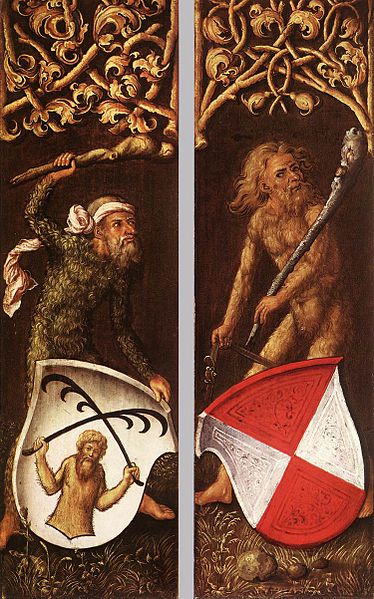
Anyway, a new variant: the Woodwose.


Elf (Woodwose)

In the deepest, darkest, thickest woodland of the temperate world live the people known as Woodwoses. Tall, thin, with fierce staring eyes and thick beards, their appearance is unmistakeable when they allow themselves to be seen. This, however, they rarely do. The most anybody is likely to see of one in its natural home is a brief rustle of ivy or a shadow moving in dappled sunlight - and then nothing.

Woodlands are lords and protectors of the forest. They are as aggressive in defending it from human woodcutters as they are goblinoid invaders: None are permitted to threaten their realm. When an intruder is discovered they strike from the shadows like ghosts with their magicks and then disperse.

Woodwoses rule the forest, but it is a rule of fear, not love. All life in the wood is considered to be theirs, be it tree or beast. They view it as their right to take what they need and bend all to their will; the animals and plants of the forest are nothing more than their chattels and slaves. This tyrannical rule is tempered by wisdom, however, for the Woodwoses are careful not to abuse their power to the point that it is taken from them by revolt. A kind of freedom exists for all creatures living in the forest - but only until a Woodwose has need of them.

Individually, Woodwoses are proud and quick to anger, with wills as hard as oak; only Dwarves surpass them in determination and strength of spirit. Though tall, they are physically frail, and they disdain physical combat - their power is in magic and manipulation of natural forces. Woodwose adventurers usually leave their homelands to search for greater knowledge and hence greater power, so that they can bring it back to their people and thus strengthen them against their enemies.

Elf (Woodwose)

Prime Requisite: Intelligence and Wisdom.
Other Requirements: Intelligence and Wisdom of 9 or greater.
Experience Bonus: 5% for an Intelligence and Wisdom of greater than 13; 10% for an Intelligence and Wisdom of greater than 15.
Hit Dice: d4 per level up to 12th level.
Maximum Level: 12
Armour: Only leather armour is permitted.
Weapons: Woodwoses may only use wooden or stone weapons - e.g. clubs, staffs and slings.
Special Abilities: Woodwoses have a 90% chance of not being spotted in woodland areas - this ability works in the same way as it does for Halflings. They have the innate ability to cast Speak With Animal or Speak With Plant three times per day.
Experience Levels: Woodwoses use the Magic-User experience table for purposes of advancement.
Saving Throws: Woodwoses use the Elf saving throw table.

Elf (Woodwose) Spell List

Woodwoses use the Magic User Spell/Level table, though they prepare their spells through meditation as Druids and Clerics do. They draw their spells from the following list:

Level 1
-Charm Person (M1)
-Shield (M1)
-Sleep (M1)
-Ventriloquism (M1)
-Detect Magic (M1)
-Read Magic (M1)
-Cause Light Wounds (C1)
-Resist Cold (C1)
-Faerie Fire (D1)
-Predict Weather (D1)
-Locate (D1)
-Magic Missile (M1)


Level 2
-Warp Wood (D2)
-Hold Person (C2)
-Know Alignment (C2)
-Silence 15' Radius (C2)
-Snake Charm (C2)
-Entangle (M2)
-ESP (M2)
-Invisibility (M2)
-Knock (M2)
-Phantasmal Force (M2)
-Web (M2)
-Mirror Image (M2)

Level 3
-Clairvoyance (M3)
-Dispel Magic (M3)
-Fly (M3)
-Haste (M3)
-Invisibility, 10' Radius (M3)
-Lightning Bolt (M3)
-Protection from Missiles (M3)
-Protection from Poison (D3)
-Call Lightning (D3)
-Growth of Animal (C3)
-Curse (C3)
-Speak With the Dead (C3)

Level 4
-Sticks to Snakes (C4)
-Cause Serious Wounds (C4)
-Animate Dead (C4)
-Plant Door (D4)
-Summon Animals (D4)
-Charm Monster (M4)
-Confusion (M4)
-Growth of Plants (M4)
-Wizard Eye (M4)
-Polymorph Self (M4)

Level 5
-Woodform (M5)
-Cloudkill (M5)
-Feeblemind (M5)
-Teleport (M5)
-Wall of Stone (M5)
-Control Winds (D5)
-Anti-Plant Shell (M5)
-Cause Critical Wounds (C5)
-Insect Plague (C5)
-Raise Dead (C5)

Level 6
-Create Normal Animals (C6)
-Find the Path (C6)
-Speak with Monsters (C6)
-Transport Through Plants (D6)
-Turn Wood (D6)
-Anti-Animal Shell (D6)

Monday, 23 June 2008

Elf Variants: II

I'll be editing the Curupira entry below to deal with some questions that cropped up, but let's push on and get another Elf variant out there into internet land. This time it's the Basque Faerie, the Basajaun.

Elf (Basajaun)

The Basajaunak inhabit hill and mountain heaths and forests. The most ancient of all peoples, they believe that they sprung from the earth itself, after it was struck by lightning. Legend has it that it was they who taught humankind the secret of farming, and they who taught the dwarves how to burrow and toil for silver. They see themselves as the older brothers of the other races, and try to help them when they can.

A Basajaun is taller and stronger than a human, with long, powerful arms and legs. Their men grow thick red beards, and their women wear their red hair long and loose. They live in small clan-groups of less than 100 - but each band is in contact with all the other bands in a wide area, allowing them to group together for mutual assistance in times of need.

They prize the simple life above all else: To them there is nothing of greater importance than freedom from care. Herding sheep, lying in beds of heather on warm summer days, and feeling the first autumn rain and wind on one's face; these are worth more than any treasure for a Basajaun. And yet their fraternal instinct towards their human, dwarf and halfling charges continually causes them to involve themselves in the world's affairs. This involvement can be as little as warning human shepherds about coming storms, or as much as joining together with local dwarves to fight off a goblin invasion.

Basajaunak identify most strongly with three animals: the wolf, the bear, and above all the lynx. These creatures share their rugged home, and are looked upon as kindred; Basajaunak cooperate with such beasts when hunting, and band together with them for mutual defence.

Basajaunak are powerful fighters, though they prefer to solve conflict through diplomacy. Their magic is simple, functional, and rarely used.

Elf (Basajaun)

Prime Requisite: Strength and Wisdom.
Other Requirements: Strength and Wisdom of 9 or greater.
Experience Bonus: 5% for a Strength and Wisdom of greater than 13; 10% for a Strength and Wisdom of greater than 15.
Hit Dice: d8 per level up to 12th level.
Maximum Level: 12
Armour: All armour and shields are permitted.
Weapons: All weapons permitted.
Special Abilities: Basajaunak have infravision to 120'. They begin the game with the standard Fighter abilities (Lance Attack and Set Spear vs. Charge at 1st level; Fighter Combat Options at 660,000 XP), and also with the ability to Speak With Bears, Wolves and Lynx at will.
Experience Levels: Basajaunak use the Dwarf experience table for purposes of advancement.
Saving Throws: Basajaunak use the Halfling saving throw table.

Elf (Basajaun) Spell List

Basajaunak prepare spells through meditation in a similar manner to druids and clerics. They gain spells as they advance in levels according to the Cleric spell/level table; however, beyond 8th level they gain no new spells (and thus cannot cast spells of higher than 4th level).

Level 1
-Detect Danger (D1)
-Remove Fear (C1)
-Sleep (M1)
-Shield (M1)
-Detect Evil (C1)
-Resist Cold (C1)

Level 2
-Resist Fire (C2)
-Speak With Animal (C2)
-Know Alignment (C2)
-Hold Person (C2)
-Produce Fire (D2)
-Knock (M2)

Level 3
-Call Lightning (D3)
-Growth of Animal (C3)
-Cure Blindness (C3)
-Cure Disease (C3)
-Protection From Evil, 10' Radius (M3)
-Haste (M3)

Level 4
-Charm Monster (M4)
-Summon Animals (D4)
-Speak With Plants (C4)
-Sticks to Snakes (C4)
-Confusion (M4)
-Ice Storm/Wall of Ice (M4)

Sunday, 22 June 2008

Doing Things With Elves (Double Entendre Optional) Part 1

So, here's the first of my Rules Cyclopedia Elf variants. It's based roughly on the Tupi mythological creature, the Curupira. For each variant, I'm not going to mention ordinary elves except in reference to mechanics - the implication being that the variant can completely replace elves in a given setting or game.

Elf (Curupira)

The Curupira are a race of humanoids who inhabit the thickest equatorial, tropical and semi-tropical forests. They are looked upon as a primitive ancestral remnant by those who are aware of them, but the majority of 'civilized' races know little, if anything, about them.

Their appearance is humanoid, with delicate features and pointed ears, although they are smaller and weaker than most humans. Their hair is almost always a bright flaming red, and their teeth and nails are green. Their most unusual feature is their feet, which face backwards. This makes them extremely difficult to track when they are in their forest home, and it gives them a loping gait which other humanoid races find disturbing and unnatural.

To other peoples, the Curupira are inscrutable. Their motivations are neither treasure nor power. Rather, their pleasure comes from the forest itself - the vibrancy of life around them, the thrill of the hunt, the noises and colours and smells. Like the forest, their character is mercurial and capricious: at times they can appear as implacable and as phlegmatic as a wall of trees; at others they can be warm and welcoming; and at others they are highly dangerous. These changes in mood do not have reasons or motivations which other humanoids can easily discern.

Curupira are strong with magic and make moderately good fighters, especially with missile weapons. They primarily use magic that allows them to manipulate their natural surroundings, and to beguile and confuse their enemies.

Elf (Curupira)

Prime Requisite: Wisdom and Dexterity.
Other Requirements: Dexterity, Wisdom and Intelligence of 9 or greater.
Experience Bonus: 5% for a Dexterity and Wisdom of greater than 13; 10% for a Dexterity and Wisdom of greater than 15.
Hit Dice: d6 per level up to 10th level.
Maximum Level: 10
Armour: Natural armours and shields.
Weapons: Spear, bow, sling, club, axe, javelin, bola, blowpipe.
Special Abilities: Infravision; Never surprised in wilderness areas; Impossible to track in wilderness areas; Bonus Skill (Stealth: Forest); +1 to hit when using missile weapons.
Experience Levels: As standard Elves. Upon reaching level 10 they gain fighter abilities as per standard Elves; note however that Curupira do not gain fighter abilities at first level.

Elf (Curupira) Spell List

Curupira progress in magical power as do standard Elves.

Level 1
-Detect Danger (D1)
-Faerie Fire (D1)
-Locate (D1)
-Purify Food and Water (C1)

Level 2
-Warp Wood (D2)
-Produce Fire (D2)
-Speak With Animals (C2)
-Snake Charm (C2)
-Entangle (M2)

Level 3
-Water Breathing (M3)
-Call Lightning (D3)
-Hold Animal (D3)
-Protection From Poison (D3)
-Growth of Animal (C3)
-Hold Person (M3)

Level 4
-Growth of Plants (M4)
-Hallucinatory Terrain (M4)
-Dimension Door (M4)
-Summon Animals (D4)
-Plant Door (D4)
-Speak With Plants (C4)
-Sticks to Snakes (C4)
-Neutralize Poison (C4)

Level 5
-Insect Plague (C5)
-Anti-Plant Shell (D5)
-Control Winds (D5)
-Hold Monster (M5)
-Woodform (M5)
-Teleport (M5)
-Wall of Stone (M5)
I'm not sure if, as it stands, the Curupira is overpowered or not, but my main concern is that it might step on the toes of the Druid too much. Any feedback would be appreciated.

Friday, 20 June 2008

On Elvishness

My 2nd edition Monstrous Manual rpg.net thread has reached 'E', and Elves.

As I wrote over there, I'm not into Elves. When it comes to demihuman races, it's Dwarves for me every day of the week and twice on Sunday. In fact, I usually try to gloss Elves over entirely when running games, so as to imply that they don't exist or are incredibly rare. It's always my hope that by doing so I can subtly persuade my players not to take on Elf characters. One of them usually does, though, and as I don't want to be one of those DMs who says "No such-and-such in this campaign!" I usually have to grin and bear it. No Orlando Bloom-like antics, though. I liked the LOTR films, but what they did with Legolas was one of the most ridiculous episodes of masturbatory nonsense that I think I've yet seen in a movie. The character was almost like Peter Jackson's very own Mary Sue.

But! I've been doing some thinking.
It seems unfair to dismiss the race if I'm not prepared to do my bit to make them interesting. I like Elves in Birthright and Dark Sun, after all; maybe all I need is a fresh perspective. Meanwhile, over at RPG Corner, Sirlarkins has been posting up some Rules Cyclopedia D&D versions of character classes from one of his favourite settings, Uresia. I love the simplicity of Rules Cyclopedia D&D and how easily modifiable the rules are, and Sirlarkins's recent posts have inspired me to play around a little bit with them myself. So I'm struck by the thought: Hey, why don't I come up with some 'Elf' variants for RC D&D, so as to spice them up a little bit? I can't think up a good reason why not.

So watch this space. I may post some of what I come up with over the next few days.