Thursday, 5 June 2014

An Example of the Yoon-Suin Gazetteer in Action

I thought it would be nice to show what my Yoon-Suin supplement (provisionally entitled the "Yoon-Suin Gazetteer") allows a DM to do. This is an example of how a campaign centred in the Yellow City could be brainstormed. There is no fluff or interpretation at all, here. I simply spent about half an hour following the process, rolling dice and noting down the results. Some of it will not make sense without the book in front of you; it's just a sample of what can be done in a very short space of time.

There is still leg-work for the individual DM to do after such a process, as will be apparent: joining up the dots and fleshing things out is something that takes a little extra time. What the book doesn't do is tell you what to do with the data that's generated. That's for you to use your imagination. 

So, the first thing to do is to draw up a social circle for the PCs. This involves generating a handful of social groups which the PCs know of and are known to, and a handful of NPCs they likewise know of and are known to. Not all of the information regarding them is known to the PCs, of course. And this is just a tiny fraction of what is out there in the Yellow City; this is a huge city, teeming with life. 

First, the social groups: 

A Noble House, called the Purple Family. [A Noble House is a mercantile, trading family, somewhere between a mafia clan and a legitimate commercial interest. They control all the trade in and out of the city together with the other Noble Houses, and are the only form of government, such as it is. All the members are slug-men.]  
There is a conflict within the Purple Family: the spouse of the matriarch and the teacher of the matriarch's children are in an adulterous relationship.
There is a rumour that somebody tried to poison one of the high-ups in the family, but accidentally killed a taster instead. The family want to know the culprit.
*
A Shrine, to a hawk-aspected demigod with food, males, and death as her spheres of influence. She demands sacrifices of invertebrates, and her holy colour is green.
The head sacrificer at the shrine has an incurable addiction to a certain type of opium.
There is a rumour that an important holy artefact has gone missing.
*
Another Shrine, to a crane-aspected demigod with famine as her sphere of influence. She demands sacrifices of mammals, and her holy colour is black.
A mad visionary has stolen something from the shrine.
There is a rumour that under the shrine there is a network of catacombs the members believe to be haunted.
*
A Philosophical Society, who practice sophistry.
One of the members, an important scion of a Noble House, has been driven mad by his ruminations.
There is a rumour that the society wants a former member, who has renounced its beliefs, assassinated. There is a further rumour that the society wants hallucinogens to further expand its theoretical insights.
*
An Exploring Guild, called the Society of Many Journeys. 
A magician patron is betraying them by passing secrets to a rival.
There is a rumour that the group have recently brought a strange, puissant artefact back from a journey - and powers in the city want it. 

Next, some individual NPCs contacts of the PCs. 
(The humans)
A cockroach butcher, over-friendly, called Pallab. He desires adventure.
An embezzler, called Rusheek, who is always accompanied by a small child. He has a rival.
A jeweller, with a haunted, desperate air, called Raakhi. She has a rival.
An assassin, with white pupils, called Mahek. She is jealous of the possession of another.

(Slug-men)
A scholar of automata, called Po Le, who is always accompanied by two slaves. He desires more knowledge.
A teacher, called Polaha Vo, who is especially slimy. He needs to pay off crippling debts.
A magician, called Malaba, who is a lover of the arts. He hates an enemy. 


As you will see, there are plenty of opportunities for adventures, missions, jobs, plots, and schemes there already.

Once the social circle has been established, the next stage is to develop further hooks. These are jobs or adventures that can be found out by the PCs simply by asking around the nearest opium den or tea house.

First, there are random connections.

A holy man, a small person called Edhas, needs to transport something to an assassin.
A cockroach clan chief, a grossly fat man called Mahantha, wants a dwarf refugee kidnapped.
A philosopher, Giriraj, who always walks on tip-toe, wants something stolen from Puli, an over-friendly beggar.


Then, there are simple random rumours. I'll just roll up 3. 

Russet mould has taken over a ghetto and is turning everyone in it into mould men.
A vampiric mist has made its home in a park in the grounds of a palace.
Golden wormlings have burrowed from somewhere into the basement of an archive and have been eating all the books and scrolls. 


This creates the raw material for a city-based campaign; as I said, it took roughly 30 minutes to generate it. It's now the job of the DM to start fleshing this out as appropriate. Clearly, there is no need to flesh out everything here. But as I hope you'll see, you can start off with the Yellow City chapter, roll some dice for less than an hour, and hey presto! there should be at least a dozen different hooks there for you to create into fully-fledged "rumours" to begin a Yellow City-based sandbox.

And it only scratches the surface of the different possibilities available.

Next, we turn to the surroundings of the Yellow City.


The map looks like arse; it will look better in the final version. The red city icons are the Yellow City proper; the black ruined icons are the Old Town - parts of the city which have been abandoned over the course of the aeons and gradually returned to the forest; they are home now to ghosts, exiles, outcasts, and mysterious magical features. The sea hexes are dotted with small islands - the Topaz Isles - which contain many small communities, monster lairs, etc.

There are three steps here. The first is to generate, and place on the map, some small communities which are found on the Topaz Isles. I generated four:

A Mine, which mines turqouise. It has 13 guards, a 2 HD leader, and 75 slaves, with 16 units of turqouise ore. The ferry, which is the only line of communication with the city, has sunk, leaving the mine isolated. Three significant NPCs were rolled up: the ferry captain; a disloyal, influential slave; and a brutal foreman. 
Another Mine, which mines tourmaline. It has 12 guards, a 2 HD leader, and 60 slaves, with 19 units of tourmaline ore. A gang of slaves are sneaking resources out to local smugglers. Three significant NPCs were rolled up: a brutal foreman, another brutal foreman, and the chief engineer. 
A Smugglers' Den. The smugglers are being actively sought after for retribution by a Noble House. It is a medium-sized network, with 60 members. In the den they have Treasure Type E, 14 units of opium, 15 units of tea, and 6 slaves.  
An Observatory. Important equipment has recently gone missing. There are 10 clay golems, 10 slaves, 10 guards, 11 astronomers, and 1 2 HD head guard, and Treasure Types K, L, N and O. 

Next some lairs. Again, I generated four.

Makara. [Stone statues resembling a humanoid crocodilian with a peacock's tail; they are found here and there in the Topaz Isles, sometimes submerged in the shallow seas, sometimes on land.] They are 8 in number. The makara are waiting for the return of an ancient artefact; one of them, obviously marked out as a leader, seems to be holding its hands out in waiting. Once the artefact is returned, the makara will serve the returner for one lunar month. Treasure: Lx5.
-The ancient artefact is a disc, 18 inches in diameter, of complexity 10. It is made of shell. It emits a shimmering sword of sheer force which can be wielded as per the Mordenkainen’s Sword spell, activatable once per day for d6 turns. 
Locathah. 150 in number, with a 5 HD leader, 12 3 HD guards. Treasure Type: A. The locathah are experts at capturing squid-men and have d3 of them captive on any given day.  
Sea naga. It lairs in a deep cave in a cliff face which curves back on itself in a spiral; the naga's home is in the middle. It has Treasure Type G. It is worshipped by a group of tamasic men (gibbon men, 16 in number, with Treasure Type B). 
Tamasic Men. 19 in number, axlotl men. They have uncovered an ancient artefact during their miserable attempts at mining.
-The ancient artefact is a star, of complexity 2. It is made of stone. It can be activated for prismatic spray 1/week.


These lairs and small communities are then placed on sea hexes as desired. In addition to the random generator tables which create these adventure locales, there are also 20 pre-made adventure locales of my own design which can also be placed here and there on the map.

Ancient Artefacts are generated randomly and have a system a little like that found in Gamma World 2nd edition; the greater the complexity, the harder the artefact is to operate and the more likely that something will go wrong when the PCs are trying to figure it out. 

Tamasic Men are men who have been re-incarnated in animal form due to their indolence and complacency in previous lives. 

Finally, I decide to generate a few ruins in the Old Town. Whenever PCs want to explore the Old Town they can do this and there is a system for randomly generating their discoveries as they go. But Old Town locations can also be pre-determined if the DM desires it. I thought I'd roll a couple up as additional adventure locales which the PCs can hear about.

Ruin 1 – A park. Old, overgrown, with crumbling walls. The main inhabitant is a ghost - a seductive baital [a type of demonic spirit which inhabits corpses]. There are also gloomwings lurking in the trees. 
Ruin 2 – A ziggurat, ancient and reclaimed by forest. The main inhabitants are cultists. It is a small cult – a 1st level holy man, 3 1st level holy man assistants, and 14 1 HD members. Treasure Type: C. The cult is despised and persecuted by a religious sect in the city proper. They are millenarian and cruel. 
Ruin 3 – A plaza. Old, overgrown, and crumbling. The main inhabitants are exiled revolutionaries. They are race warriors advocating genocide of slug-men. But they only pay lip-service to their beliefs. They actually have abandoned themselves to wanton hedonism. They are a small band of 11, with one 2 HD leader and Treasure Type: C. 
A Special Site - A high column. It is covered in spiders' webs; the spiders are poisonous (save versus death; success is 20 hp damage). The column is hollow and a secret door leads inside to a narrow chamber. Within is a trove of Treasure Type: I. It is guarded by two chinthe [guardian lion/dog spirits] who have been trapped there for aeons. 


As stated, some of this will not make total sense without the book in front of you; also, bear in mind this is one substantive chapter out of seven; there are five other geographical zones which have similar random-generation systems for campaign set-up brainstorming. Each is approximately 60 pages. There is also a bestiary with 50+ entries, rules on character generation, and Appendices A-Q, ranging from a random poison generator to fortune telling rules, to rules on magical tattoos. 

And it should be ready....soon

Wednesday, 21 May 2014

The Spear of Eternity

When I was about 10, a friend and I tried to write fantasy epics. I can't remember what his was about, but mine was called The Spear of Eternity. It clocks in at 61 pages and features a quest ranging over the continent of Snith to find the many parts of said spear, put it together, and use it to kill Keshin the Death Lord. The final chapter is split into two separate parts to build suspense - I was an absolute pathfinder in that respect when you consider the approach taken to the Harry Potter and Hunger Games films. I think of The Spear of Eternity as the great unpublished work of fiction of the 20th Century.

I don't want to give any more details away in case, at the time of my death, this lost masterpiece is uncovered and published to rampant and unbridled success, akin to Edwin Drood or The Love of the Last Tycoon. I wouldn't want to spoil that for my descendants. But I will give you a glimpse at some of the masterly interior illustrations.

This is called "The Chaos Mutants Attack Dwarves". Not sure why the dwarf on the left has his axe in his belt right in the middle of a battle. Frankly I think he deserves to be clubbed in the face with a massive morning star.

This is Rikki the Tigerman. In the first scene in which he appears, he bites the head off something that has "the body of a huge ogre and the head of an elephant" and then introduces himself as "An expert scout and fighter". Show off.


A zombie, fresh from battle. He looks friendly, but looks can be deceptive. Zombies are capable of whipping their claws around "in a hideous carousel of death". I have to admit there's no way that's my line; I must have cribbed it from somewhere. I'm not altogether sure I knew what a carousel was when I was 10.

A map of Snith. Not only is there a Forest of Destruction; there is also a Forest of Death. No Forest of Doom, though. To the West are the Howling Caves, the Scimitar Hills, and the Desert of Snakes; in the North the Icefinger Mountains; in the East, the Dark Lands. No prizes for guessing where the Death Lord lives.

If you are an agent or publisher who is keen to discuss terms, you can leave a comment in the blog post.


Tuesday, 20 May 2014

Covering Ourselves in Glory

Everybody is talking about the new D&D covers. My own opinion is that they're not what I want, but they're not as bad as they could have been, and I like that at least they've retreated from the awesome-adventurer-striking-an-awesome-pose school of RPG art. This is more the monsters, monsters, rahhh school of RPG art, and while I don't find that hugely compelling nor do I find it irritating. And I'm 32; I reckon if I was 12 I'd be all over monsters, monsters, rahhh.

But this makes me think about my favourite RPG book covers. What are the covers that stand out in my mind as being genuinely excellent? Because, let's face it, most RPG art is studiously mediocre. I'll narrow it down to a top 3.

1. The Keith Parkinson Rifts cover. I've never in my life played or owned Rifts, but I remember seeing this book in a shop somewhere when I was a kid and thinking it was among the greatest things I'd ever seen - to 9 year old me, it felt properly edgy and adult and even a wee bit scary. You shouldn't underestimate the power of genuine weirdness to entice young and impressionable minds.


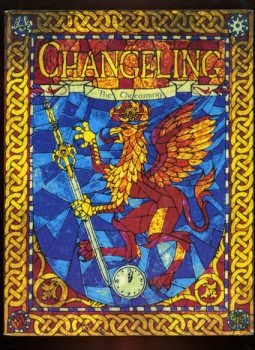
2. The Changeling: The Dreaming cover. The game itself is emo to-the-max, but this cover is like no other cover that there has ever been for a game before or since. Like it or not, it's different. It says: this is going to be something unique. And it gives almost nothing away. All you know is that it makes you curious to know what's inside.


3. The Planescape campaign setting cover. Again, like with Rifts, I can remember the first time I saw the cover to Planescape - it was in, of all places, Tel Aviv, in a game shop I had wandered into. I remember just thinking, "What's that all about?" The Lady of Pain logo looked almost like some Pacific Island idol or Mayan bas-relief, but then what's underneath is, again, like nothing you've ever seen on the cover of an RPG before or since. I think of all RPG covers out there, this may be one of the absolute bravest, because it says almost nothing and has almost no real content: it's for all intents-and-purposes a weird street in a weird city with people walking along it. If that. But it has a feel; the feel pulls you in. You have to wonder who commissioned it - who said, "Yes, that will be exciting and make people want to play it." The painting has no earthly business being the cover of a flagship AD&D boxed set. It's not awesome-adventurer-striking-an-awesome-pose school; it's not monsters, monsters, rahh school; it's not let's-go-adventuring-AD&D-first-edition school; it's.... trippy and vague and ephemeral and you're not sure what's going on school. And in its own way, that gave it a wow factor beyond dragons and beholders and people with big swords.


Monday, 19 May 2014

Generative Hexcrawling

Following on from JDJarvis's interesting recent post on exploration, I've been thinking today about what I'm going to call Generative Hexcrawling - or, to put it more bluntly, creating a rudimentary system to make simple exploration or searching useful and interesting. In particular, I'm trying here to make a system that can be used when the PCs engage in exploring a wide area looking for interesting stuff - particularly in an Indiana Jones, "Let's search for weird ancient ruins and their contents deep in the jungle/desert/mountains" type affairs.

So here goes. The basic concept is based around the Exploring Day. The Exploring Day is broken into two segments, morning and afternoon, although you could divide it into more segments as appropriate.

In two segments, a certain area can be explored. I'm going to suggest 1 hex on the basis of a 1 mile hex-map, although this will depend on the geography. (Exploring 1 square mile of jungle versus one square mile of desert is a vastly different proposition.)

Each segment spent exploring an area, the DM rolls 4d6. If the first d6 results in a 1, there is an encounter. If the second d6 results in a 1, a minor site is discovered. If the third d6 results in a 1, an inhabited ruin is discovered. If the fourth d6 results in a 1, the party gets lost and ends up exiting the hex at a randomly determined edge. These can obviously be tweaked or modified as desired.

An 'encounter' result is a typical random encounter (although you could introduce elements like "somebody breaks a leg", "somebody gets bitten by a poisonous spider", etc.). A 'site' result is a small location, possibly with treasure or a Gamma World style MYSTICAL ANCIENT ARTIFACTTM, possibly with a monster. An 'inhabited ruin' is a sizeable complex inhabited by a significant being or population (and probably mapped out using something like the fast and dirty AFF2 dungeon map generator).

You would then need random tables for encounters, sites, MYSTICAL ANCIENT ARTIFACTSTM, and inhabited ruins, with sub-tables for more details such as treasure types and magical features. I won't do this properly at this stage, but for illustration's sake, I'll give some d6 tables, assuming an area of jungle is being explored:

Encounter
1. Carnivorous apes
2. Giant beetle
3. Giant centipede
4. NPC explorers
5. Tyrannosaur
6. Yuan-ti

Site
1. Monolith
2. Cave
3. Shrine
4. Abandoned village
5. Tower
6. Cairn

Inhabited Ruin
1. Cultists
2. Dragon
3. Degenerate tribe
4. Oozes
5. Hook horrors
6. Manscorpions

Once two segments have been spent exploring a hex, it is 'exhausted' and does not reveal any more secrets, although encounters will still occur in it.

Rather than exploring, if the PCs have no rations, they can spend a segment foraging for a day's worth of food (thus a day spent foraging allows two days of further exploration). During this time, encounters can occur, though not discoveries of sites or ruins.

Each hex successfully exhausted gives a 100 XP bonus to each PC.

Sunday, 18 May 2014

Three Wilderness Thoughts

Regular followers of the blog will know I can't stop picking at the theme of improving D&D wilderness play. (See posts passim hereherehere, and here. A lot of interesting discussion along similar lines takes place on this old Hill Cantons post, and this old Nine and Thirty Kingdoms one.) Three thoughts occurred to me along these lines while spending an outdoors-y weekend.

1. I'm becoming keener on what I'm starting to call the extended wilderness encounter, which begins not when the two parties necessarily see each other, but when one of them realises the other exists. This could be on sight (for instance, well concealed bandits waiting for a passing group of horsemen) but it could equally be a distance of miles. Take, for instance, the photo I took on Saturday:


You didn't have to be Aragorn to notice that a horse had walked by and it had been most-likely wearing a horse-shoe and hence carrying a rider. And you would have had to have been more-or-less blind to miss it. God knows where the horse and rider were at the point I noticed its tracks (I wasn't about to follow them) but it was likely miles away. So what business do we have rolling up encounter distances in the wilderness of d4x10 yards or whatever?

2. We're very wedded to a human view of the universe even in the context of a fantasy game. During summer if you're hiking around the Northumberland countryside you can't move for pheasants. They've all been set loose by game-keepers on local country estates so they can fatten up ready to be shot - 30 million of the poor bastards nationally each year, it seems. 

I've been comings across pheasants constantly in all my time hiking this area of the country, but the question has never occurred to me before: what kind of creatures would storm giant game-keepers release every year to hunt? I'm caught up in thinking of the wilderness from a human perspective - human use, and human scale. Horizons need to be expanded. 

3. A big element of making wilderness adventure exciting has to revolve around accurately representing how tough it can be out there. The other day I was watching a Natural World documentary about the Scottish Highlands; the narrator quite blithely stated that lots of deer die in the Western Highlands during spring because they've been rained on so much over the winter that they are critically weakened and die of exposure. And that's deer, who you'd think would be reasonably well equipped to deal with the elements. Imagine being a medieval person travelling through that sort of environment. There's a reason our ancestors didn't get about much. 

Thursday, 15 May 2014

Housekeeping

I've been informed that the link to my "Let's Read the AD&D 2nd Edition Monstrous Manual" mega-PDF is broken. The file is now available on the Internet Archive, which is a bit slow, but should be more reliable. The link is here: https://archive.org/download/ReadMonstrousManual/Read_Monstrous_Manual.PDF

Tuesday, 13 May 2014

How I Roll, or, What Is the Point of Stats in D&D?

On G+, Courtney C was posting his reasons for disliking the mechanism some DMs use of rolling under a Stat to determine success at a miscellaneous task. As time goes on I also dislike that mechanism more and more, though perhaps for different reasons. They're as follows:

1. Most tasks don't really boil down to a single Stat. Think, for instance, of climbing a sheer wall. Is that DEX because it requires agility, STR because climbing requires you to support your own body weight, CON because it requires you to be fit, or INT or WIS because it requires you to think about where handholds are and apply climbing know-how? Roll-under-a-Stat, then, seems a little reductive.

2. It puts emphasis on thinking about Stats, which isn't as bad as obsessing over skills, but still can be restrictive ("I won't bother attempting difficult task Y because my character's Stat X is crap").

3. I think I would find myself using it as a lazy shorthand to stop me thinking carefully about PC actions in the game: "Oh, you want to negotiate with the guards? Roll CHA."

I prefer nowadays a method which I think is more intuitive and more humanist (!). That method is as follows:

  • Player says their PC might do something
  • DM considers the situation in general (including the Stats of the PC) and assigns a target number for success between 1 and 6
  • DM tells the PC what this number is
  • PC decides whether to go ahead or not and has a small amount of negotiation

Let's use an example: Bob the Builder is a PC and he wants to get some item of treasure which lies at the other side of a moat that is filled with killer crocodiles. There are vines hanging down from trees which overhang the moat. Bob's owner decides he's going to try to swing, Tarzan-like, across the moat on one of these vines. The DM thinks for a bit: intrinsically, the task is relatively difficult but not immensely so - we've all played on rope swings as kids. Bob the Builder has a STR of 15, a DEX of 9, and a CON of 12, so the DM reasons he's in pretty good shape. He says, "You can do that if you get a 3 or more on a d6. Otherwise you fall into the moat. Want to go ahead?" The player can then say yes or no. He can also, if he thinks the number is egregious or the DM is overlooking something, negotiate. Let's imagine the DM forgets that Bob the Builder has a STR of 15 and puts the target number at 4. The player howls in outrage: "But Bob has a STR of 15!" The DM relents and makes it 3, and so forth.

Now, this is necessarily somewhat arbitrary, but there's an antidote to that.

So, then, what's the point in Stats, exactly? In the noisms school of D&D, there are three reasons for their existence:

A. Stats provide flavour and a role playing guide. They stop PCs just being another PC. Why does this guy have STR 6? Is he just a scrawny weakling or does he have some debilitating disease? Why does he have DEX 4? Is he blind? etc.

B. Stats help you decide which class to be if you're rolling 3d6 in order and seeing what happens. 

C. Stats are something to take into consideration when checking for success. To refer back to the example above, Bob's STR, DEX, CON etc. are relevant considerations. They're just not the only ones.

Sunday, 11 May 2014

Shameless Behaviour, Tarragon, and Yoon-Suin

Nate interviewed me about Yoon-Suin on A Gaming Podcast About Nothing. I know I said I wasn't going to post about the podcast on this blog more than once; I lied. 


It's an attempt to explain what the whole Yoon-Suin thing is all about - in a concise 30 minute conversation. The conversation also ranges over random encounter tables, the philosophy of randomness, and tarragon.  

Wednesday, 7 May 2014

On Reaching Into the Subconscious Mind

Patrick asks whether the mind can be a kind of random generator. I know what he means. All DMs do it, or something like it, when they're creating NPCs or events on the fly. You pause for a moment and something comes to you; God knows from where - it springs into your mind from the depths of your brain and sometimes the results are surprising.

One thing I sometimes do for fun is sit in front of my computer, try to completely blank my mind, and then just start writing sentences - channelling my subconcious directly onto the keyboard. I'm going to try it now:

"There is a man lying on the floor and there is a keyboard and a monkey in the room."

But you see there the problem: I just blanked my mind and started typing. But the word 'keyboard' came to me, evidently because I had just written it in the previous sentence. Keyboards were present in my unconscious mind. And when I tried to come up with something 'at random', keyboards are part of what came out. Oddly, when I wrote the sentence, the image of a musical keyboard - a Casio keyboard - flashed into my brain, rather than a computer one. The unconscious works in strange ways.

You see my point, though, which is that your brain can produce unexpected, surprising, and interesting results when you free-associate, or when you try deliberately to void your mind of all influences and just give yourself free reign to blaaaaaaaah. But these results are not necessarily as unexpected as you might think: the things that are in your brain are there for a reason, because they've been taken in and processed. This means they're always imminent, in the background. You're not coming up with things at random - you're reaching into your mind and pulling something out. You may be reaching blind, but it's not quite the same thing.

In the same way, the NPCs and situations that you come up with on the fly may be spontaneous and surprising and unexpected, but I bet if you really thought about it you would find similarities with people (real or fictional) that are known to you or at least seen, or situations that you have been in or heard about or read about.

Now, you might say the same thing about random tables that you, yourself, have created. If you've written up a d100 table, let's say, then everything in it has come from your mind. So when you roll a d100 and consult that table, you're not really getting totally unexpected results, because you know what's in the table, and after all everything there is from your mind, so what's the difference?

I think the difference is that the result on the d100 table is not contingent on recent input. When reaching into your subconcious mind on the fly to pull out an NPC, let's say, you are probably going to be - unintentionally - generating an NPC on your mind who is influenced by what has happened in the last 10 seconds, last 10 minutes, last 10 days. It might not be immediately apparent what that influence is; it might only be at the level of a Casio keyboard because the word keyboard cropped up a while earlier. But there will be something. On a d100 table, on the other hand, the results will be disconnected from recent input and will therefore have more of a capacity to be genuinely weird and surprising, genuinely dislocated from the situation, and thus genuinely more potent and with more potential for being interesting.

Sunday, 4 May 2014

Thoughts on Yoda and The Great Sin


On G+ the world and his wife are talking about "Star Wars Day", which is apparently a thing that people do. Don't worry if you can't guess why it's May the 4th. It took ages for me to work it out too.

So I thought I'd write about Star Wars. Specifically, Yoda. I hate the prequels to Star Wars in the sort of mild way that I hate, say, rice pudding; if faced with the prospect of watching one I will probably pull a 'yuck' face, but I don't froth at the mouth the way some Star Wars fans do. I honestly think that the prequels, for me, were like Star Wars antibodies. Once they'd been introduced to my system I became able to see the entire franchise for what it really is: two really good films, an enjoyable kids film, and three shit ones. Hitherto I was a huge fan; afterwards I maintain a cordial relationship. It's like an amicable divorce. In the same way that you might not mind the thought of getting back into bed with your ex wife or husband but it would come wrapped up in too much bullshit to be worth it, I wouldn't mind being a fan again except for the fact that it would mean accepting notions like General Grievous and Count Dooku are good names for baddies or somebody thought that "I don't like sand. It's coarse and irritating and it gets everywhere. Everything here is soft and smooth," is something that an actual human being would use as a chat-up line, let alone one that would work.

But in some way I do still have a bit of bile and vitriol left for George Lucas when it comes to Yoda. Yoda in The Empire Strikes Back was such a great character. I say it unashamedly: the scenes with Yoda in that film are some of my favourite scenes in cinema. The combination of Irvin Kershner's unfussy, calm directing, Mark Hamill's understated acting, John Williams' gorgeous score, and Frank Oz's puppetry is more or less perfect. It's easy to be sniffy about the pseudo-Buddhist nonsense that Yoda is spouting, but the character and his situation have so much charm that you just don't care.

In the prequels, George Lucas takes Empire's good-natured, humble, peace-loving, grammatically-confused SF version of Kermit the Frog and transforms him into a vicious, mean-spirited, aggressive little prick with a god complex. Worse than that, though, he commits what I often think of as The Great Sin of genre fiction: giving the audience what they want.

In Empire the presentation of Yoda's power is perfectly judged. When you watch it for the first time, you are first shown a slightly annoying, but amusing, clown character, who then transforms into a wise old teacher. You gradually get the sense that this little fellow is more than he seems, but you still aren't quite sure about him - until the moment when he shows Luke what using the force is really all about by moving the X-Wing. In common with everything else in the film, it's executed brilliantly: from the way the score builds and swells, to Mark Hamill's reaction, to Yoda's killer closing line. But, for a moment of great grandeur and climax, it's also nicely understated. All Yoda has done is move a starship. He hasn't killed anyone, blown anything up, or done anything fancy-dan. He's helped out his young student and given him a valuable lesson. That's all.

Watching that scene, of course, the audience is given the awareness that, wow, Yoda must be an immensely powerful badass. But it's done so well that you don't need to be shown anything more. The message comes across perfectly. Yoda must be a mighty warrior. And Kershner has the taste, the class, to leave it at that. Let the audience imagine what they want. He's given a hint, knowing - crucially - that the power of suggestion will be more powerful than anything he could actually have put on the screen. The audience wants more, but Kershner knows that actually their imaginations will be more satisfactory than anything he can deliver.

But of course, Star Wars fans being what they are, they want to see more: they want to see what Yoda can do. And in Attack of the Clones (easily the worst of the prequels), George Lucas gives every 25-year-old Star Wars fan what they'd only previous dared to imagine: Yoda having a fight with lightsabers. In an act of sheer, barefaced fan service, we see the full shebang - Yoda getting out his lightsaber, shooting lightning bolts, and throwing boulders around. And it's fun...for a second. Until you realise that there is something awfully tawdry about the whole affair. Yoda was a calm, wise, peaceful little puppet in Empire, and he had a certain message - that you should try to transcend violence. That aggression and anger lead you down the path of ruin. Yet here he is, throwing his weight around in the most unseemly fashion. The fight with Count Dooku is like the moment you get a blowie off the hitherto untouchable school good girl: it's nice and everything, but at the same time you can't help but feel as if something important has been sadly diminished. Something that was pure in your mind has become forever sullied.

In giving the audience a view of Yoda's full power, the magic of what had hitherto only been hinted at and imagined completely dissipates. He falls from being a great and powerful being of myth into a silly little dancing green ninja with a shiny sword. And we all lose something as a result.