Showing posts with label new troy. Show all posts

Tuesday, 15 March 2016

Witches and Warlocks

Those who worship Satan gain certain powers because their master is the prince of the world. While witches and warlocks can never enter heaven, they can walk freely between other realms, and are indeed the only beings that can do this. The mightiest of Faerie Nobles cannot enter the world of men without sacrifice and undergoing restraints both physical and temporal. Yet witches and warlocks can go back and forth from Faerie to New Troy to Muspel and suffer no hindrance in doing so.


Thanks to the granting of the devil's power, witches and warlocks also use magic, which comes from Faerie, and can communicate with the spirits of the evil and unbaptised dead, who exist in Muspel. Through it, they can even exert influence over nature itself, bending the will of beasts and plants to their own. 


Witch or Warlock

HD: d6+4, AC 6, #ATT 1, DMG By weapon +2 (typically staff)

Roll: 1 - Young woman; 2 - Young male; 3 - Middle-aged woman; 4 - Middle-aged man; 5 - Old woman; 6 - Old man

Powers by number of HD (cumulative):

5/6 - can walk between Faerie and New Troy, or New Troy in Muspel, if alone for one hour; can cast animal friendshipbarkskin, entangle, faerie fire, pass without traceshillelagh, obscurement, warp wood, call lightning, cure/cause disease, plant growth, neutralise poison/poison, summon insects, tree, all once per day; charm personcall woodland beings, animal summoning I, hallucinatory forest, dispel magic, speak with dead all once per week; and speak with animals and invisibility to animals at will
7/8 - can cast charm personanimal summoning I, hallucinatory forest, dispel magic, animal growth, commune with nature, sticks to snakes, all once per day; and animal summoning II, control winds, insect plague, pass plant, weather summoning, transport via plants, animate dead, all once per week
9/10 - can cast animal summoning Ihallucinatory forestdispel magicanimal growthcommune with naturesticks to snakes, animal summoning IIcontrol windsinsect plaguepass plantweather summoningtransport via plants, all once per day; and animal summoning III, feeblemind, turn wood, wall of thorns, control weather, creeping doom, finger of death, raise the dead, all once per week

Other:


Dice Lair Familiars* (roll d3) Unique Power
1 A small, ordinary and pleasant-looking
cottage
Wildcat Can detach own hand,
which acts independently
and can cast spells; has 1/4
of witch's total HD 
2 A house in the forest made from
many thousands of dead flowers woven
together
Rat Can bite to poison; save vs
death
3 A hut surrounded by petrified frogs,
bats, birds, toys, etc. hanging from
branches
Owl Can hypnotise with eyes 1/day;
save vs paralysis
4 Within a bulbous gall on a tree which
somehow requires entrants to imagine
they are small enough to enter
Rook Can sing a beautiful song which
attracts the unwary 1/day; save
vs magic or be compelled to
discover song's source 
5 In a set of caves under a boulder which
is entered through an impossibly thin
crack which requires entrants to imagine
they are thin enough to enter
Lizard Can pause time for 10 seconds
1/week
6 A hut in a huge bird's nest is a high tree
in the forest
Adder Can feign death 1/week
7 A hut made from lily pads floating on
a pond
Sparrowhawk Can use words to compel others
(suggestion 1/day)
8 A hut constructed within the hollow of
a blasted oak
Spider Can fly 1/week
9 Balancing on top of a small tower of
boulders, standing one on top of another
in an impossible seeming way 
Stag beetle Can disguise perfectly as a
person seen and heard once
10 In a wind- or water-mill which seems
to turn backwards
Fox Can cast clairaudience 
and clairvoyance 1/day

*Familiars are as the normal animals, but contain the witch or warlock's consciousness and can cast one of his/her spells once per day.


Saturday, 12 March 2016

More Game World Building Reaction Tables

Following on from this recent post, I got to thinking a little more about how reaction tables can build the setting and serve as sources of greater interaction, not to mention contribute to achieving a certain mood.

Here's a sample. This is part of a table for New Troy, my pseudo-English folklore setting. One of the conceits of New Troy is that in certain parts of the map (particularly forests) PCs can accidentally stray into, or out of, the Faerie realm (and Faeries can do likewise into the 'real' world of the PCs). They will frequently do this without even knowing it. In such places encounters with animals in particular will have special significance.

This is a set of 'reactions' for encounters in Faerie with the most mundane creature I could think of - a slow worm. (For those of you in North America who can't be bothered to click the link, this is a small limbless lizard.) Ordinarily slow worms are so small and unobtrusive that humans simply don't really 'encounter' them. But that's ordinary slow worms. In Faerie things are different.

I've just provided one set of results for each reaction type; in reality there will likely be 3 or 4:

Friendly
Neutral
Cautious
Aggressive
Attack
The Tail of the Worm
A slow worm’s detached tail will bring luck for its saviour. (The PCs come across a badger, fox or other predator attacking a slow worm. If they chase the predator away, the slow worm leaves its detached tail behind. This is a lucky charm if carried, allowing the wearer to avoid a failed save vs death once each lunar month.)
A Plea for Aid
A small, lithe woman dressed in brown leather and with yellow irises asks for aid; she is being hunted by the three wildcat familiars of a witch who lives deep in the forest and wants her for her potions. If the PCs agree to help and kill the witch, the next morning they will be visited again by the woman, who transforms into a slow worm and will lead them to a trove of gold buried beneath a tree (300 gp).
 The Blinding Creeper
In the old tongue, men knew of the slow worm as the “blinding creeper”, because its scales are so dazzling in sunlight. On a sunny day, on an exposed rock on a heath, the sun may catch on the blinding creeper as it dashes for its burrow. (Randomly select a PC, who must successfully save versus poison or be blinded for a day.)
The Maternal Serpent
Occasionally a voice is heard in the forest, calling out for help, giggling, crying, or singing. Its source cannot be found, but it leads a traveller away from his path and strands him in the forest. This is the doing of a mother slow worm, protecting her brood by distracting threats. (For each turn the PCs spend following the sound, there is a 1 in 6 chance they become lost.)
Born of the Earth
Sometimes travellers  climbing on a steep slope, or passing through a ravine or by a rock face, are hit by falling rocks. This is the work of a slow-worm, threatened by their presence. (1d4 damage to each PC; save versus paralysation to avoid).

The idea, here, is that you would roll for a random encounter as normal, and the entry "slow worm" would direct you to its entry, where you then roll the reaction dice, As you can see from the above table, this then provides you with potentially three different things:

-The location of the encounter (on a steep slope or passing by a rock face in the case of an "attack" reaction; on an open rocky heath for a "cautious" one, etc.)
-An actual event of some kind
-Complications (getting lost in the forest for an "aggressive" reaction; possibly encountering a witch for a "neutral" reaction, etc.)

More information can also be packed into this very easily. For example, consider such a table for a standard D&D humanoid monster such as "orcs". An "attack" result might consist of "20 orc slave raiders searching for new blood". A "friendly" one might consist of "a single lost orc who obsequiously begs to be brought under the party's protection". So you get the number of creatures encountered included in the reaction table result. Other information that can be packed into the reaction dice in this way include distance - "attack" might mean that the monster is right on top of the PCs, whereas "neutral" might mean it is very far away - or even the surprise roll, with "attack", in the case of a predator, signifying surprise of the PCs, and "friendly" being the opposite.

This does require quite a bit of work, but it's worth it given the nature of the results, and it's part of the fun of creating the thing.

Wednesday, 9 March 2016

Reaction Tables Which Create the World

So let's think a little about how to use reaction dice to make animal encounters interesting.

BECMI has the following reaction dice table:

2-3 Attack
4-6 Aggressive (roll again -4 next round)
7-9 Cautious (roll again next round)
10-11 Neutral (roll again +4 next round
12 Friendly

This works nice as a quick and dirty method but it could be elaborated on, particularly if you want to make interesting encounters with animals that are magical but not normally predatory on humans. It also occurs to me that you can actually communicate something about the totemic nature of animal species through the reaction dice table, or even change it on an encounter-by-encounter basis.

So for the sake of continuity let's think about shags. (Phwoar.) I like this idea of shags as being a kind of elemental spirit of the shore: a sort of sprite which is produced from the collision between land, wind and sea. A beast of stone and salty water and gale force winds.

Shags are never going to attack the PCs, nor really be "aggressive" towards them as you'd normally understand it. So if you have "shag" in an encounter table, you need to have the reaction dice mean something different if "attack" or "aggressive" come up. And you may as well do it for the other results too (because what exactly does it mean for a shag to be friendly? (Nice and slow, if you want to innuendo done for you)). For example:

Attack result: roll a d6 and consult the following:

1 - The shags summon a minor earth, water or air elemental (3 HD) to protect them
2 - The shags cause a wave to swamp the shoreline, causing PCs to fall over on a failed save versus paralyzation, which results in d3 hp damage in bruises, cracked bones/skulls
3 - The shags are the servants of a coastal warlock who collects flotsam and jetsam and lives in a nearby cave. He comes to attack the PCs and will arrive in d6 turns, clambering over the rocks with alarming speed.
4 - The shags croak aggressively and alert the other seabirds nearby, which bombard the PCs with their dung (PCs stink for the rest of the week unless they get a thorough bath, losing all surprise rolls automatically)
5 - The shags use their power over the earth to cause rocks to fall from the nearby cliff face: roll a d6 for each PC; on a roll of 1 her or she is hit for 3d6 damage
6 - The shags flee into the water and, through their magical power, cause the PCs to want to pursue; each must successfully save vs. magic or chase after them into the deep and cold sea

You get the idea - some of these may be a bit too tough.

Hopefully this communicates something of what I mean. The PCs encounter a group of shags at the bottom of a sea cliff. They get an "attack" result on the reaction dice and the shags summon a minor air elemental. They are revealed to have this power through the reaction table; the DM didn't predetermine this - he just created the potential for it to happen and the dice instantiate it. Maybe all shags have this ability or maybe it is just these ones, and the DM has the chance to think some more about his world. Similarly, the '3' result introduces some new opportunity to the adventure - probably the list could do with more such results - again deepening the DM (and PCs') sense of a living world.

There's no reason why you have to stop at animals with this, of course. Think of what you could do with, say, orcs. A list of potential 'friendly' results might be:

1 - The orcs offer money in return for the PCs attacking the nearby lair of a troll
2 - One of the orcs is a half-orc who bears a weird resemblance to a family member of one of the PCs
3 - The orcs are escapee slaves from a local mage and throw themselves at the mercy of the PCs
4 - The orcs are from a certain tribe who try as much as possible to dress, talk and act like humans, and want to 'ape' the PCs in precise detail...

&c. &c. The game world gets fleshed out simply through the PCs meeting things.

Tuesday, 8 March 2016

The Voice of the Earth


I like how this programme (The Last Seabird Summer?) presents an encounter with a seabird in an intelligent and thoughtful way. You get a sense of what it must be like to be a shag - living in a "slum hell-hole", scampering about the rocks, freely spraying shit wherever you feel like. (Look at the shag's face as it does that. Isn't there a look approaching pride on its face? Isn't it almost triumphant about the complete liberty it has to shit where it pleases?)

Our ancestors must have spent a lot of time thinking about animals, because their relationships with them were so intimate. And that doesn't just mean domestic animals - it includes creatures like the shag, which until fairly recently people living on the coasts of Northern Britain would gather to make into stew. It doesn't surprise me in the least that folk tales in any culture you care to name are almost obsessed with animals which can turn into humans and vice versa, animals which can talk, animals which are magical, and so forth. Imbuing animals with totemic significance is completely natural if you spend any time whatsoever interacting with them in their wild environment. It's only a small step from there to imbuing them with supernatural powers: a shag becomes not just a sea bird, but "the voice of the earth" - some elemental being produced from the collision between land and sea.

Animals are an undervalued resource in fantasy RPGs. They tend to appear on random encounter tables to cause trouble, or in lairs as "giant [x]". All the attention is diverted towards mythological creatures - the monstrous. There is something more interesting to me in the subtleties of animals presented not as monsters but as spirits of nature with significance and power - which, if the players think about hard enough, may be in some small way understood.

Monday, 7 March 2016

Random Encounters with Rooks

Rooks. Pale-faced, sword-beaked swaggerers, bundles of contradiction, cloaked raggedly in black feathers that gleam with luxuriant purple, and possessing eyes that are cruel but wise. At times they signify foreboding and foreshadow death. At others, they bring succor and protection of a kind.


The Solitary Rook in Winter

A rook encountered alone in winter time is almost certainly the servant of a witch. The witch lives within the distance of one hex at a suitable location, and is now aware of the presence of the PCs unless one of them is carrying a branch from a Rowan tree. She will seek to: 1 - Enchant them to act as slaves; 2 - Enchant them to perform a task; 3 - Sacrifice them to the devil.


A Storytelling of Rooks

Rooks gather in the evenings in their dozens, hundreds or thousands - often close to a church or other holy site - to converse about the happenings of the day. Standing amidst them, surrounded by their cries in the gloaming light of the dying evening, a cleric or child can discern something of their discourse. Select a lair, adventure locale, or rumour the PCs have not yet discovered. This is what the listener hears about.


A Mother Rook with Young

A mother rook with her brood is a portent of disaster - and rebirth. The next time the first PC to spot the birds (determine at random) has to roll a saving throw, he or she fails automatically. If the result is death, a tree grows where the PC is buried within one month. It bears three apples, each of which restores all lost hit points if eaten.


Rooks Flying in the Wind

Rooks flying on a windy day, celebrating the skill and strength and speed in their wings, summon storms which reinvigorate the weary. Within d6x10 minutes the storm begins. It lasts for d3 hours; during this time travel is impossible without fatigue and sickness. After the storm has ended, the clouds dissipate and the PCs lose existing levels of fatigue; spell-casters recover spent spells.

Sunday, 18 October 2015

Underworld Fortresses

This is a prototype for New Troy. It is an underworld location. As with Yoon-Suin, I am taking a tool-kit approach: there will be pieces of blank dungeon maps which the DM can position and fill-in as he or she likes. Each piece or template can then have its nature randomly generated.

For some reason blogger isn't displaying the table correctly when I preview it. You get the idea.

Great Fortress

Eldjotnar and hrimthursar rule the deepest parts of the underworld in their great fortresses of stone. Their struggles are unending. In summer the eldjotnar reign in flames and heat and the hrimthursar hide in isolated places. In winter the frost and cold of the hrimthursar has dominion and the eldjotnars’ power diminishes to nothing. In between there is constant war. Each stronghold changes hands, back and forth, with the passing of the seasons – the only constancy being the thickness and strength of the great stone walls, and the temporary nature of the allegiance of the thralls, which shifts like a sapling in the wind.

A Great Fortress is ruled by d3 giants (eldjotnar in summer; hrimthursar in winter; roll to determine in spring/autumn), who may be lovers, family members, comrades, or rivals. There are 1d100 loyal niflungar or rjufendr per giant. The fortress also has a population of thralls (in d3 groups), whose allegiance changes depending on who controls it.    

Use a Great Fortress template to plot out its layout, or create your own.


Dice
Thralls (1d3)
Summer/Winter Event
Spring/Autumn Event
1
Landvaettir (1d30x3)
The giants are reinforcing their fortress and the thralls are extra-vigilant (never surprised)
The rulers have all been killed in battle, leaving the fortress in anarchy
2
Lindworms (1d12)
The giants are away at war or hunting
The fortress has struck by an earthquake, flooding areas with lava
3
Dvergar (1d30x3)
A false sense of security prevails and the thralls are complacent (always surprised)
Large sections of the fortress have been reduced to rubble
4
Berzerkers (1d30x3)
A group of captives have arrived from a raid on the upper world
The fortress has been taken over by a dragon in its weakness
5
Trolls (1d12)
The fortress is plagued by a shadow walker
One of the groups of thralls is plotting rebellion
6
Hamingja (1d30x3)
A great feast is being held
The fortress has been flooded by melting ice
7
Saehrimnir (1d12)
The giants are plotting an attack on the upper world
The fortress is under siege by the opposite side
8
Ettins (1d30x3)
The fortress is at peace and rich in treasure (roll twice when determining treasure)
Enemy patrols in the area are seeking to employ spies or assassins
9
Thurse (1d12)
One of the giants has come under the sway of a Dis, who is now the real ruler
The fortress is divided equally between eldjotnar and hrimthursar
10
Roll again, double population
A group of einherjar have come from the glorious afterlife to do battle
There is civil war amongst the rulers (roll again if only one ruler)


Treasure Types: A, L, M, N, O

Sunday, 16 August 2015

Sons and Daughters of Muspel


Muspel is home to an infinite variety of malevolent spirits. Here are some.

Eldjotnar, The fire giants of legend, rulers of Muspel in summer. Their flesh is black like coal, their hair red, and their temperament violent. They exude heat, and their aim is to create a fire so large in the bowels of the world that it will wreak its final destruction. HD 15, AC 0, #ATT 1, DMG 2d10+10, Move 180. Spell-like abilities: Eldjotnar never suffer any damage from fire or heat-based attacks. They cause 1d6 damage per round through their body heat to anybody within a 10' radius.

Hrimthursar. The frost giants who wrest control of Muspel from the Eldjotnar in winter. Their flesh is white, their hair pale blue, and their temperament as cold as their nature suggests. They exude cold, and their aim is to bring glacial ice rolling up from beneath the surface of the world to cover all creation. HD 15, AC 0, #ATT 1, DMG 210+10, Move 180. Hrimthursar never suffer any damage from ice or cold-based attacks. They cause 1d6 damage per round through the cold they exude to anybody within a 10' radius.

Niflungar. Diminutive humanoid creatures who dwell in the misty places of the underworld and are at their strongest during autumn and winter. They hoard treasures in the darkness and are avaricious and grasping. HD 1 (1+1 in autumn; 2 in winter), AC 6, #ATT 1, DMG d6, Move 120. Spell like abilities: Pass without Trace 3/day, Wall of Fog 3/day (treat the size of the fog as 4 yards cubed; niflungar can cooperate to create fog of exponentially increasing size, i.e. 8 yards cubed by two niflungar, 16 yards cubed by 3 niflungar, etc.).

Rjufendr. Clawed creatures who exist to tear flesh asunder. One swipe of a forearm can slice a man open from nape to chops. HD 1 (1+1 in spring; 2 in summer) AC 6, #ATT 1, DMG Special, Move 150. When a rjufendr successfully 'hits' in combat, it does d6 damage; if the score is 5 or 6, the target must roll to save vs. death. Failure means instant death; success means a limb is lost (roll a d4 to determine) and the target is automatically reduced to 0 hit points and unconsciousness.

Fenrir's Brood. The lupine spawn of the god of wolves. Black, snarling, canine brutes with grasping human fingers and warped hunched spines. HD 1+1, AC 7, #ATT 1, DMG 1d6 (bite) or as weapon, Move 150. Spell like abilities: Can go Berserk 1/day, gaining an extra attack for the next 3 rounds but falling unconscious straight after.

Landvaettir. The spirits of the wicked or feckless dead; pathetic cloaked ethereal figures who are bent to the will of whichever powers of Muspel may desire to control them. HD 1, AC 8, #ATT 1, DMG as weapon, Move 120. Spell like abilities: Can touch to Bestow Curse 1/day. Harmed only by silver or magical weapons.

Gullinbursti's Brood. Golden-maned descendants of a boar demigod who was forged from fire. They appear as large tusked boar-headed men or women who glow with radiant yellow. HD 3+1, AC 5, #ATT 2, DMG as weapon +2, Move 120. Spell like abilities: Constantly case Continual Light and can channel their light into an attack akin to a Colour Spray 1/day,

Marmennill and Margygur. Loathsome half-fish people who live in the pitch-dark lakes of the underworld and have lost their sight accordingly. They can foresee the future (as an augury spell with no time restrictions) and will use this power in return for: 1 - A certain item on that level of Muspel; 2 - Sacrifice of a treasure worth 200 gp or more; 3 - Sacrifice of a life. HD 1+1, AC 7, #ATT 1, DMG as weapon (usually spear), Move (Sw) 150. Spell like abilities: Augury 3/day, Detect Invisibility at will, Fish Summoning I 1/week.

Lindworm. Wingless, bipedal, serpentine dragons which live in the depths of the underworld and serve whichever giants are its rulers - shifting their allegiance as swiftly and easily as the wind changes direction. Their bites and breath are the vilest poison, and they love trickery. HD 6+6, AC 3, #ATT 1, DMG 1d8+2/poison, Move 150. Spell like abilities: Stinking Cloud 1/day, Suggestion 1/day, Fools Gold 1/week, Ventriloquism 3/day, Audible Glamer 1/day, Putrefy Food and Drink at will. Their bite kills automatically on a failed save vs. death; success limits the effect to that of a Ray of Enfeeblement.

Audumbla's Drool. Beings created from the spoor of the cattle demigod. Horned, twisted, semisolid yearners for souls of their own. HD 1, AC 7, #ATT 1, DMG 1d6, Move 120. Suffer no damage from bludgeoning weapons, and only 1 hp damage from piercing weapons. Can steal the soul from a body if it remains in physical contact for 6 rounds; the body becomes a lifeless husk and the soul becomes the drool-being's possession.

Wednesday, 12 August 2015

New Troy: The Nature of Muspel

Work on New Troy also continues. For a while I've been thinking about how best to conceptualise Muspel. You'll recall that the basic geography of New Troy (i.e., the "real world") is replicated in the mythic otherworld (Faerie) and the mythic underworld (Muspel). But while Faerie is a kind of looking-glass wilderness area reflecting New Troy (see posts here and here), Muspel is - as you would expect - the "dungeon". It will therefore mirror New Troy in a more abstract sense: the similarities may not be immediately striking but there will be ways of comprehending the geography of Muspel by considering where things are located in New Troy itself.

What is the nature of Muspel itself? Here, I steal from, and bastardise, Norse mythology. Sometimes when you descend to Muspel it is a realm of fire, ruled by fire giants (eldjötnar), their fire drake servants, and "sons of Muspel". And sometimes when you descend to Muspel it is really Nifl, a realm of ice, ruled by frost giants and their niflungar slaves. This is because there is a constant struggle between the two sides, with neither side ever gaining a complete advantage, but coming to dominance depending on the seasons. While the tunnels and caverns remain the same, everything else is in flux. The only thing that remains the same is that the nature of the creatures living there is malevolent and depraved.

The other factor to take into consideration when entering Muspel is that time there moves slowly; each hour spent there is 1d100 hours in the "real world". This means that seasons last for only the briefest of periods down there in the darkness; life is a constant struggle of rebellion, warfare, dominance, and then rebellion again. Whenever the PCs venture into the underworld, they find themselves in the centre of conflict.

Christian Kessler, who is going to be doing the graphic design/layout, has come up with some nice ideas for the way things work in Muspel, which I won't go into too much detail on yet. I will post some examples of sons of Muspel and niflungar from the bestiary in the coming days, though.

Wednesday, 28 January 2015

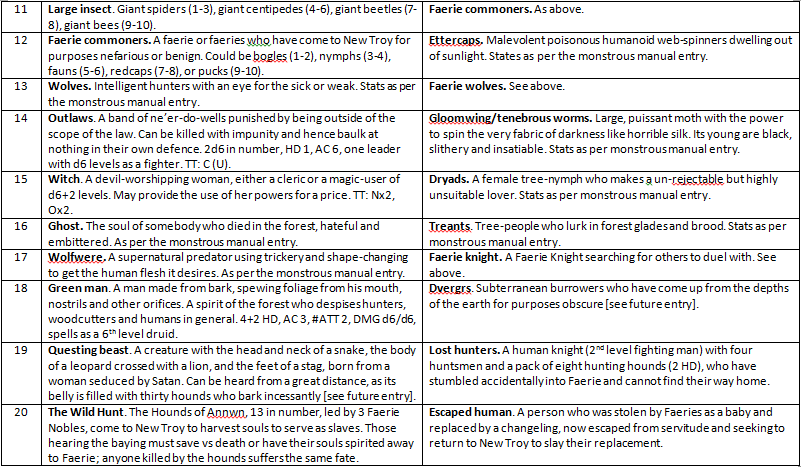
Random Encounters in New Troy: The Forest of Broceliande

This is a random encounter table for the Forest of Broceliande. All random encounter tables for New Troy have two columns, with some rough correlation between results for New Troy and Faerie; occasionally Faeries are encountered in New Troy, and humans are encountered in Faerie. The basic principle is that Faerie is generally where high adventure happens, but there is always going to be slippage.

I've only included stats were necessary; I intend to expand on methods for creating "generic faerie commoners", the Questing Beast, and the role of the Dvergrs in future entries.


Tuesday, 20 January 2015

Hexmapping in New Troy: Example (Hex 0101)

Each 1-mile hex on the New Troy map has a mirror-image in Faerie, yet the Faerie equivalent is 6 miles. What this chiefly means is that each hex in New Troy has one interesting location, whereas each Faerie hex has at least three - one or all of which are warped refractions of the New Troy counterpart. Let's produce an example.


Hex 0101, right up in the top left. A mixture of hills and meadow, some woodland. It contains the hill pond, an isolated pool nestled among hilltops with deep, dark water inhabited by murky green loaches. Long ago 33 bastard children were drowned in the pool by a Lord of Kinkernadon who was warned by a witch that a child of the devil would cause his death. These loaches have drawn up something of the sorrow and pain of those children, and they communicate the children's spirits' desire for revenge on the Lord of Kinkernadon's descendants. They will grant a limited wish in return for the body of such a descendant being delivered into the pool.

In Faerie, the pool is home to Mournful Nel, a Faerie resembling an old woman, who sits naked on the bank dangling her legs in the water and singing sad songs. She is forever unhappy, though she does not know why; anyone who can provide her with a brief moment or two of solace she will provide with three boons: remove curse, cure blindness, and cure disease, which she will bestow any time they are needed within a year and a day.

In Faerie, there are two other locations in the hex:

The rock doves' nest. Two pucks, a couple, who transformed themselves into rock doves but have forgotten how to turn themselves back again. They need a Faerie Noble to return them to their original forms, but are terrified of the consequences of this and need representatives to act as supplicants on their behalf.

The crack in the earth. A crevasse in woodland inhabited by a band of brocks, man-sized talking badgers. They are bad tempered but not necessarily aggressive; young ones may be tempted into adventuring, and make excellent tunnellers. They are fierce rivals of a pack of Hounds of Annwn living in another nearby hex. (Brock: 3 HD, AC 6, #ATT 1, DMG d6 (does double damage on a successful to hit roll of 18+), Move 150).

Monday, 19 January 2015

Faerie Commoners


Faerie commoners are the chief inhabitants of Faerie. They are subdivided into many different types, but a method of unique 'generic' faerie generation will also be provided. Some examples of common sub-types are as follows:

Bogle: A malicious being which enjoys tormenting or vexing humankind with tricks and curses. Diminutive and wrinkled. HD 1+1, AC 6, #ATT 1, DMG 1d4, Move 120. Spell-like abilities: Putrefy Food and Drink 3/day, Invisibility 3/day, Sanctuary 1/day, Pass Without Trace at will, Curse 1/week, Dancing Lights 3/day, Fools Gold 1/week, Faerie Fire 3/day, Push 3/day.

Boggart: A genius loci, guardian of a certain obscure location, who will always try to scare away or deter visitors with visions, plagues, and so forth. Usually ugly, with long arms, though may take on any appearance. HD 2, AC 5, #ATT 2, DMG d3/d3, Move 120. Spell-like abilities: Fear 1/day, Insect Plague 1/week, Trip 1/day, Scare 3/day, Audible Glamer 3/day, Spectral Force 1/day.

Nymph: A beautiful nature spirit, male or female, which seduces human beings for love and veneration. Requires complete devotion but offers only flightiness, cuckoldry and heartbreak in return. HD 1, AC 8, #ATT 1, DMG d3, Move 120. Spell-like abilities: Charm Person 1/day (permanent effect, only broken by a Limited Wish or Wish spell), Pass Without Trace at will, Obscurement 1/day, Call Woodland Beings 1/week.


Faun: Fun-loving half-goat which may guide the lost or lead them to destruction on a whim - but only after enjoying feasts and fucking beforehand. Roll a d6 or toss a coin to determine whether the Fauns are in a helpful or malevolent mood. HD 2+2, AC 5, #ATT 2, DMG d6/d6 (headbutt and weapon), Move 150. Spell-like abilities: Suggestion 3/day, Charm Person 1/day, Animal Summoning I 1/day, Otto's Irresistible Dance 3/day.

Redcap: Murderous sadists who dye their caps in the blood of those they maim or kill. They are said to be impossible to outrun, and appear as wizened old men, often armed with a pike. HD 2+1, AC 6, #ATT 1, DMG d8, Move 180. Spell-like abilities: Jump at will, Darkness, 15' Radius 3/day.


Knocker: Mean-spirited thieves and murderers who visit mines, workshops and other sites of industry to steal items and arrange "accidents". Small, brown, and hateful. HD 1/2, AC 6, #ATT 1, DMG d3, Move 120. Spell-like abilities: Invisibility 3/day, Pass Wall at will, Darkness, 15' Radius 3/day, Stone Shape 1/day, Conjure Earth Elemental 1/week (requires 6 knockers acting in unison), Earthquake 1/week (requires 3 knockers acting in unison)


Morgen: Siren-like beings who lure men to their deaths in deep lakes and ponds with their beauty and powers of persuasion. HD 1, AC 7, #ATT 1, DMG d6, Move 180 (swim). Spell-like abilities: Suggestion 1/day, Raise/Lower Water (as 7th level cleric) 1/day.


Pwca/Puck: Shapechangers who may be helpful or not depending on the day, location of the moon, temperature, direction of the wind, and so forth - but may be more likely to be benevolent if given a gift which is a genuine sacrifice. Can transform into a hare, stag, horse, dog, goat, boar or bear, with stats as appropriate, at will: the animal always has jet black fur. HD 3, AC 5, #ATT 1, DMG d6, Move 120. (Stats refer to human form: in animal form the animal stats apply, except for the HD.) Spell-like abilities: Push 3/day, Blink 3/day, Polymorph Other 1/day, Cure Disease 1/day, Cure Blindness 1/day, Purefy Food & Drink at will, Neutralize Poison at will, Confusion 1/day, Darkness 15' Radius 3/day, Light 3/day.

Cailleach: Hag-like instantiation of winter. Carries a stave and has the power to bend the weather and geography to her will. HD 7+7, AC 2, #ATT 1, DMG d8+8, Move 120. Spell-like abilities: Control Weather 1/week, Earthquake 1/week, Stone Tell at will, Weather Summoning 1/week, Stone Shape at will, Call Lightning 1/day, Cone of Cold 1/day, Wall of Ice 1/day, Wind Walk 1/day, Ice Storm 1/day, Move Earth 1/week.


Woodwose: A bearded, forest "wild man" with fierce eyes, all wiry muscle and sinew. They rule the deep forests with fear, and force all the beasts that live in them to do their will as chattels. HD 4, AC 5, #ATT 2, DMG d6/d6, Move 120. Spell-like abilities: Pass Without Trace 3/day, Conjure Animals 1/week, Animal Summoning III 1/ day, Call Woodland Beings 1/day, Wall of Thorns 1/day, Pass Plant 1/day, Barkskin 1/day, Plant Growth 1/day, Sticks to Snakes 1/day, Animal Growth 1/day,


Sunday, 18 January 2015

Faerie Nobles


Faeries Nobles are the rulers of a Faerie sidhe. They are beings of great power and even greater caprice.

Faerie Noble

HD 7-12 (d6+6)
AC As armour +4
# ATT 2
DMG As weapon +4

Faerie Nobles always have one magical weapon, and three items of magical jewellery, randomly determined.

All Faerie Nobles can cast a geas or quest, and a limited wish, one each per week.

All Faerie Nobles can choose at any time to reveal their full power, acting as a fear spell.

All Faerie Nobles have an additional d6+3 thrice-daily spells, d3+3 daily spells, ad d3 weekly spells. These are generated randomly using the following table:


Like all Faeries, Faerie Nobles change their appearance according to the season, growing pale and flint-eyed in winter, or youthful and green in spring. In winter any reaction dice rolled for a Faerie Noble is at -2; in autumn, -1; in summer +1; and in spring +2.

[Art by Roger Garland]

Saturday, 10 January 2015

The Fetch

It is said that sometimes the nobles of a Faerie shee decide to send a double of a human inhabitant of New Troy to replace the original. It is not known to what purpose they do this, but it is believed that, every so often, a 'real' person is spirited away somewhere and replaced by such a wraith, or fetch. The fetch is like the original in every way, completely identical, with all of his or her knowledge, character traits, and flaws. Underneath it is a cipher, and a malevolent one at that, but even close family members will be unable to tell there is anything amiss.

Everybody in New Troy knows, therefore, that if one sees one's double or twin - only ever when one is alone; only ever when it is dusk or early morning; only ever in some isolated spot where no cry for help will be heard - it can only mean that this is a fetch and shortly one will lose the life one had, and be replaced by this malicious being. It will soon be living as you did, amongst your friends and loved ones, and all you know of your fate, whatever it is, is that you will never see them again. 

Thursday, 8 January 2015

Faerie Knights


Those straying into Faerie may well come across a Faerie Knight, and likewise Faerie Knights Errant may sometimes appear in New Troy in pursuit of some quest or lost love. They are often associated with a colour - black, red or green - and hence a season. They are powerful figures and often appear with the aim of testing the resolve of the humans they encounter.

Faerie Knight

HD 5/7
AC 2
Move 120/40 (as steed)
#ATT 2
DMG By weapon +2
*Like all Faerie nobles, Faerie Knights can bestow a geas (once a month), and can also reveal their full might, causing fear (once a day).
*Every Faerie Knight also has the ability to cast one of the following spells once a day (roll a d10):
Haste/Slow
Chant
Charm Person
Ray of Enfeeblement 
Obscurement
Invisibility
Forget
Mirror Image
Silence 15' Radius
Hold Person
*Faerie Knights always have a steed - a war horse with 3 HD and a 2 attacks doing d3/d6 damage.


Faerie Knights tend to have a specific colour. Roll a d8 to determine this: 1 - red, 2 - orange, 3- yellow, 4- purple, 5 - black, 6 - white, 7 - green, 8 -  blue

Depending on their colour, Faerie Knights are more powerful during a certain season, during which they have two extra HD and can use an extra kind of spell once per day. This applies both in Faerie and in New Troy.

Red and orange knights are most powerful in summer.
Yellow and purple knights are most powerful in autumn.
Black and white knights are most powerful in winter.
Green and blue knights are most powerful in spring. 

Faerie Knights encountered in New Troy are Knights Errant, with a specific quest. Roll a d4 to determine this:

1 - Finding a human they have fallen in love with; 2 - Duelling all comers; 3 - Searching for something; 4 - Testing the resolve of humans

Sub-tables provide further detail:

Finding a human love: the knight is searching for a human who came to Faerie and became his lover, but then returned to New Troy. Typically they will ask for information or the PCs' aid in locating the lost love and/or winning her back.

1. The knight's lost love is a relative of one of the PCs.
2. The knight's lost love is now married - to an important NPC in New Troy.
3. The knight's lost love is a witch who plans to use him for her own ends.
4. The knight's lost love is a peasant living in a small village somewhere; she has already given birth to their child, who is a faerie.
5. The knight's lost love is the daughter of a rich noble who is expecting to marry her off to a 'good match'.
6. The knight's lost love has died and is now a ghost. 

Duelling all comers: the knight is occupying a certain spot for a period of time (often a year and a day) and challenging all passing warriors to duel him. He will always pull a killing blow so that the target is reduced to 1 hp, and will of course expect the same courtesy. If he is victorious he may demand his opponent give him any possession, or perform any task, in the form of a geas. If defeated he can be asked for a single boon.

Searching for something: the knight has been given a quest by a lover, king, relative, etc. Those aiding him will be rewarded with a boon.

1. An honest man.
2. The roots of a mountain.
3. A bond that never breaks.
4. A child not born of a woman.
5. Something no faerie has ever seen before.
6. A pure heart.

Testing the resolve of humans: the knight has been sent to test mankind with strange and capricious-sounding challenges. If anyone passes the test, the knight will become his or her servant for a year and a day.

1. Guessing the knight's true name.
2. Allowing the knight to sever a hand or foot, or remove an eye or ear (randomly determined).
3. Gain a kiss from a hag.
4. Pluck the beard of a giant.
5. Find the treasure at the end of a rainbow.
6. Discover the dreams of a dragon.


[Art by Julek Heller]

Tuesday, 6 January 2015

Restatement of New Troy

Last year my main resolution regarding the blog was to do something more creative with it, as I'd felt it had turned into basically a forum for pointless rants. Like most resolutions it didn't last beyond January (although I notice I did post about it as late as April). Let's resurrect it.

The project I was working on was called New Troy, and you can find the original posts here. It's like a cross between the Lyonesse books, The Wizard Knight, The Matter of Britain, The Ill-Made Knight, The Chronicles of Narnia, the tale of Urashima Taro, and work of that nature. To summarise:

The working title for the new campaign setting is New Troy. This is purely because I've always liked the completely made-up notion from the Middle Ages that Britain was founded by refugees from the fall of Troy. This is a reality in which that, or something like it, happened. But it was long ago, and nobody really knows much about it at all - or what Troy is or was.

In New Troy, there are two other worlds, called Faerie and Muspel. (There is a third, called Elysium, but it remains inaccessible except to the dead.) Faerie is the realm of elves, changelings, and other beings that are by turns capricious, curious, benevolent or cruel. There, time moves more quickly than it does in New Troy, and nothing is ever quite what it seems.

Muspel is the underworld, the realm of evil spirits, giants, and devils. Sometimes it is like fire; other times like ice. There, time moves more slowly than it does in New Troy, and everything is what it seems: malevolent and depraved. But also full of treasure.

There are times, and places, where the boundaries between New Troy and the world of Faerie and the world of Muspel become blurred. For Faerie, these tend to be ever-shifting: a gate may exist on a certain hilltop for a hundred years before suddenly moving elsewhere or closing, while another may be found behind a waterfall for one day every decade. For Muspel, they tend to be fixed, eternal: caves, chasms, natural arches.

Faerie and Muspel are where adventure happens in New Troy. Muspel is the mythic underworld [while] Faerie is the mythic otherworld, the wilderness equivalent to the megadungeon. A world of trees, hills, rivers and rain, but where the normal laws of reality do not apply, and are bent, warped or broken. It may even be more dangerous than Muspel, because it resembles the real world so closely that you may not even realise you are in it. But it is not the real world: There are other things there. 

There are three core mechanical conceits:

1) Geography. New Troy, Faerie and Muspel all use reflections/refractions of the same map, because they are reflections or refractions of each other. So New Troy has its own 1-mile hex map. Faerie has a reflection of it, where geographical features are mirrored, although different, and the hexes are somehow 6 miles. Muspel is simply a megadungeon whose geography is measured in yards, but in a way which represents the geography of New Troy and Faerie.

2) Time. Time moves much more quickly, though randomly, in New Troy: just as you go through the wardrobe and spend what seems like years in Narnia only to return minutes later, the same could end up happening to PCs venturing into Faerie. The mechanism for this is to divide time spent in Faerie by d100, which explodes downwards to d1000, d10000, and so on, to discover how long passes in New Troy while the PCs are away. In Muspel, the opposite is true: time spent there is multiplied by d100. There is a Series of Unfortunate Events table while the PCs roll on to discover what happened while they were in the underworld.

3) Seasons. Seasons matter, both in Faerie and Muspel. In Faerie, each season means different animals, different faerie beings, and so forth - all acting in different ways. The way things work in summer is markedly different to how it works in winter. Moreover, there is no way to predict what season it is in Faerie based on what season it is in New Troy, because time is different. In Muspel, on the other hand, the character of the dungeon changes according to what the season is in New Troy: in winter the underworld is one of ice; in summer it is one of fire; in spring and autumn, it is a little of both.

I'll be going into some more detail on this in coming posts. I may flake on this commitment, but you're used to that.


Tuesday, 8 April 2014

Mapping New Troy and Faerie

[This is a continuation of a project detailed in previous posts here.]

This is the basic map of New Troy, explained in brief in this post. Those readers following these posts will remember that this is an area 15x10 miles, with the hexes 1 mile in size.


Entering one of the gates, marked on this map by a star, takes you to Faerie, which has the following map. Here, the hexes are 6 miles in size.


The geographical features here are fundamentally the same, but at the same time, different. They are, in essence, a looking glass version of those in New Troy - except in every respect more dangerous, more unusual, more vibrant, just more

Four things have changed. The settlements have been renamed as 'Shees' and are Faerie 'kingdoms'. Thripsey Shee is so named as a tribute to its namesake in the Lyonesse books; Trinovant Shee is a play on 'New Troy'. 

The caves in the North East of the area, which on the mundane New Troy map are the gate to Muspel, in Faerie are the home of the dvergar - much more akin to the Dökkálfar of old Germanic/Norse myth than D&D "dwarves". 

I'm going to start keying in the hexes for New Troy and Faerie in coming posts.