Monday, 14 March 2022

The Deep and Wondrous Complexity of the World

One of my addictions - perhaps the most profound and difficult to break - is going on forays through wikipedia, beginning on the entry for something I'm interested in (in this case, the Chechen language) and then following links to whatever catches my eye, so as to end up on, say, the ancient kingdom of Colchis.

These expeditions across time and space never fail to reinforce just how complicated human history is - how many layers upon layers of politics, ethnicity, language and culture we have laid across the surface of the world.

Take Colchis, for example. Thought to be "the earliest Georgian formation", it was perhaps populated by "early Kartvelian tribes", but there are also many Abkhaz, Scythian, Anatolian, Iranian, and Greek place names, and wikipedia tells us that "any of these groups could have constituted the ruling class". One of its major settlements, Discourias (modern Sukhumi, in Abkhazia/Georgia), was founded by Greek settlers in the 6th century BC; "the city and its surroundings were remarkable from the number of languages spoken in its bazaars" (between 70 and 300), and it was a major centre of commerce between the Greeks and the ancient Colchian tribes (for which, naturally, there is a separate entry on wikipedia). 
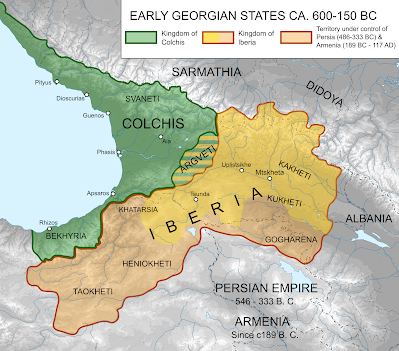

Reading the history of Discourias itself reinforces the point. It was a major supporter of Mithridates VI of Pontus in his struggle against the Roman Republic; it eventually became part of the Roman Empire but was demolished so as to avoid its capture by Sasanians. It was then restored by the Byzantines but sacked by the Arabs in the 8th century AD, before ultimately being restored again by the Kings of Abkhazia and then flourishing during the Georgian Golden Age as a major centre of trade with Genoa. Occupied by the Ottomans, changing hands between Abkhazians and Mingrelians, and it was then stormed during the Russian conquest of the Caucasus in 1810. During the 20th century it saw war, revolution and ethnic cleansing; its 2003 census lists Abkhazians, Armenians, Estonians, Georgians, Greeks, Russians and Ukrainians among its population.

A cursory knowledge of the history of the world reveals it to be of such complexity, variety and interest that no fantasy setting could ever be its match in richness or fascination. One is also reminded when reading it of Voltaire's maxim that "History is only the patter of silken slippers descending the stairs to the thunder of hobnailed boots coming up from below". Empires rise and fall, each leaving behind them yet more intriguing detritus for us to pick through. 

Friday, 11 March 2022

Russian Inspiration

It goes without saying that Russia's invasion of Ukraine violates international law, not to mention morality, and I feel desperately sorry for everybody swept up in these events. But there is brewing in the West a bizarre kind of performative Russophobic theatre (not to mention a LARPish belligerent frenzy) that only serves to demonstrate that human beings are as irrational in our purportedly rationalistic modernity as we have ever been. We are really just where we were in 1914, smashing up shops owned by people with German-sounding names, renaming 'German Shepherds' Alsatians, and gathering together to boo at posters of the Kaiser. 

Orchestras firing conductors or opera singers for failing to be sufficiently publicly anti-Putin is itself like something out of the McCarthy era; banning innocent Russian teenagers from playing ice hockey or 20-year old concert pianists from performing or Russian cat breeders from participating in competitions simply by dint of being Russian is even worse; but what can one say about Cardiff Symphony Orchestra's decision to stop playing Tchaikovsky, London Science Museum closing an exhibit about the Trans-Siberian Railway, or somebody at a university finding it appropriate to try to cancel Dostoevsky? It would be charitable to call it simple bigotry. It's a bandwagon of pig ignorance and lunacy. 

The real world isn't "four legs good, two legs bad". The real world isn't one in which subjecting everything Russian to a Two Minutes Hate causes the Ukrainian war effort to be psychically bolstered. The real world isn't Twitter.

The real world is one inhabited by people with different cultures but a shared humanity: every culture sheds light on the human experience in a different and valuable way, and the exclusion of high art from the world on its being rooted in the wrong culture is philistinism of the most pernicious kind. High art is a bridge between cultures, allowing us to see our humanity in new ways, and it is doubly important during time of conflict to remember this.

In defence of that principle, and as a tweak to the nose of the Cardiff Symphony Orchestra in particular, some inspiration from Russian high art for RPGs:

Stravinsky:

It begins and ends, in many ways, with The Firebird - an evil wizard who keeps his soul in an egg, a summonable magic bird that inflicts its foes with an 'infernal dance'; how more D&D could you get?


But you could just as well do with The Rite of Spring, which is the ballet equivalent of a Clark Ashton Smith or Lord Dunsany story, all naked cultist dancers and human sacrifice in the time-before-time:


And then there's his Chant de Rossignol, which is one of the finest pieces of orientalist art ever produced - like listening to the symphonic equivalent of the Jin Ping Mei; it was a huge inspiration for Yoon-Suin:


Rachmaninoff

Do you like brooding orchestral pieces that are not only called The Isle of the Dead, but which sound like people approaching a literal Isle of the (Un)dead in order to explore it?


Or how about the Vespers, if you're in the mood for other-worldly grandeur and awe in the genuine sense of the word?


Mussorgsky

Night on the Bald Mountain, anyone? Whether as animated by Disney or otherwise? I mean, it's quite literally about a witches' sabbath:


And then there's the orchestral Pictures at an Exhibition, featuring reflections on the themes of 'The Gnome', 'The Old Castle', 'The Tomb', the 'Hut on Hen's Legs', and 'The Great Gate of Kiev':


Borodin:

Prince Igor fighting off the barbarian hordes?


In the Steppes of Central Asia, which conjures a distant and wondrous landscape better than any piece of music I know?


But if classical music isn't your thing, of course, perhaps some paintings:

Surikov


Shishkin


Kozhin


Kustodiev


Repin


And I suppose if you really wanted to, you could go out and invest in Mythic Russia.

Monday, 7 March 2022

The MegaProject: Foxes and Hedgehogs

People come in one of two types. There are people who have the inclination to focus on getting really good at one activity in a very meaningful way. And there are people whose interests are comparatively broad but shallow. Specialists and generalists. And it's hard for one to become the other and vice versa.

By my nature I am a generalist. I know a bit about a lot of things. I'm the kind of person to read a single volume history of the Crimean War and then skip to one on the Cambodian Genocide, rather than to 'deep dive' into all of mankind's knowledge about one subject area. I've never found anything, either in my professional life or my leisure time, that could occupy my attention for long enough to become an obsession. My attention flits between many interests. And I have always been jealous of the kind of person who can plow one furrow so deeply that they can sow within it gold. 

To steal from Isaiah Berlin, and to do damage to his concept, we are either foxes or hedgehogs. We know many things, or we know one big thing. This is also true of our creative lives. Jack Vance, Michael Moorcock and Gene Wolfe were foxes, in that they wrote many different works that were ostensibly unrelated, or only loosely so, and in many genres (although, as with any writer, if you get to know their respective oeuvres well enough, you can begin to think of them as each having a single, hedgehoggish theme). JRR Tolkien and Lois McMaster Bujold were/are hedgehogs, writing about basically one thing - one great story - in vast depth throughout the course of their lives. 

Being a fox, my natural tendency as a DM is therefore to want to run many different campaigns in many different settings, rather than run a single campaign in a single world over the course of decades. But I am very envious of those who can achieve the latter. I would very much love to create a megaproject of my own.

What is a megaproject? Some examples that spring to mind:

  • Mapping and keying an entire world (Iron Man version: doing it at the scale of 1 mile per hex)
  • Slowly and painstakingly drawing a megadungeon map on a 30m roll of drawing paper
  • Creating many modules constructing a vast 'implied' campaign setting from the ground up
  • Detailing the contents of one city, a la City State of the Invincible Overlord, down to the very last single inhabitant
  • Tekumel

The people who can really pull off megaprojects are rare and special indeed. If you possess that gift - don't waste it.

Monday, 28 February 2022

The Tournament of the Gods, First Round (5) - Galeb Duhr and Giant Bombardier Beetle

As spiders who wait unmoving and noiseless the Gods are in perfect stillness as Sleep approaches their glade. No suppressed chuckle from the Droll Knave; not the merest hiccup from the Skurtch; not even the faintest drip of salt water from the belly of the Trident-Bearer betrays them. Sleep is blind, but Sleep can hear so well that he can even detect the motions of thought itself. The Gods must wait unthinking for him to pass, as stones on a hillside sit dumbly through the winter. 

He creeps. His feet pad softly on dewy grass. He sniffs. This way and that. As though swaying his head from side to side like a coursing hound in search of scent. Merely to look on him is to be taken; the Gods hold their eyes shut tightly. Not a cough. Not a wheeze. Not a blink nor a breath. They wait until he circles about their glade, and feel the sun's rays grow warm; by the time he has passed, the light of morning is beginning to gleam through closed eyelids. 

Finally the sounds of his movement recede and it is Lap-Laz who speaks first. "Well, brothers and sisters! He is gone. Do we continue?" He drinks from his apricot brandy and dispels anxiety with a belch. "There are many yet to join battle."

Relieved, the Gods crowd once more around the purple. One already stands at the left of the blanket: tall, slender, with long grey feathered wings and tail iridescent and gleaming in the morning sun. Cacomantis, the yellow-footed, black-billed Cuckoo King, whose soft voice has yet to call out in the dawn's games. Now is his time: he unfurls a wing on the blanket and then withdraws it to reveal six giant iridescent green beetles arranged in a line upon the cloth. "These are mine," he declares. "I welcome a challenge."

The Gods murmur their appreciation; Sleep is forgotten. "I will challenge!" calls out the sonorous voice of Hexaich, the River Mother, her hippopotamus head reared in pride, her dozen breasts leaking milk down her belly. She casts three pebbles onto the blanket; they all bounce once, then twice, then come to a rest. Each, as though rousing itself from sleep, sprouts first arms, then legs, and then a grimacing maw beneath tired and mournful eyes. Galeb duhr, resentful of being wakened, and sorrowful at their own vast age. They fixes their misery upon their foes.

Their foes strike first. The beetles lurch forward, spasmodic but fast, and fling themselves upon the rock-men. Mandibles slice and crush, tearing off hunks of rubble; one of the galeb duhr is cracked and gravely weakened, while another loses many fragments of stone-flesh, spraying like grey tears across the purple. The Gods applaud at the resumption of violence - "That's the way!" yells the Skurtch. "Straight at it!" - and Lap-Laz cannot help himself from blurting out, "An upset is on the cards!" 

But the galeb duhr's misery now turns to anger. Stone fists pound and swing, cracking carapace like thin clay; it shatters in shards of glimmering green. Beetle bodies jerk and flap amidst ichorous ruin - four are dead, and one of the remainder is sorely wounded. In an instant the battle seems won and lost. Hexaich throws her head back and squeezes jets of milk from her udders in the excitement of impending victory; it squirts in great gushes across the crowd and they cackle and shriek in delighted drunken disgust. For a moment all is chaos of laughter and shouting as they roll and caper on the grass in exaggerated horror; the fight is briefly forgotten until the Elder Sister, her face flushed, her eyes sparkling and stern, cries out "Silence! Children! The fight is not yet over! Remember decorum!" 

And certainly it is not. The beetles have earned their name as bombardiers. Both those left alive turn and with deafening blasts spew stinging clouds of steaming, acrid bile at their foes. Each is seared and scarred by the burning sprays, and one is sent reeling, stunned, to slump down to its backside like a sullen, confounded toddler. Hope are raised afresh that the underdog will triumph - Lap-Laz, now carried about by the Droll Knave by piggyback, pours apricot brandy down his gullet and calls out, "Six legs good!" while others among the Gods begin to drum an impromptu rhythm on tree trunks, gourds and bowls to accompany his yells.

But there the contest brutally ends itself before the chant can really gain its momentum. Wounded as they are, the galeb duhr are not to be deterred from visiting their melancholy on their foes. They rend the two last beetles apart and the fight is over.

Cacomantis has been watching affairs aloof. He wipes a drop of milk from his left wingtip with the right, and sniffs. "That was poorly executed. I apologise they offered so little."

Hexaich shrugs. "Life is strong. Unlife is stronger." 

Saturday, 26 February 2022

"He Was Killed in the Very First Month"

By coincidence, I happened to be reading Boys in Zinc during the days in which war engulfed Ukraine. So titled because of the Soviet practice of sending dead soldiers home from Afghanistan in sealed zinc coffins, the book is a vast collection of records of oral interviews Svetlana Alexievich conducted with soldiers, wives, mothers, doctors and nurses about their experiences of war. Its poignancy is made almost aching at the thought of what the families of soldiers on both sides are experiencing as we speak.

From an interview with 'a wife':

There's a big photograph of him hanging on the wall. "Get papa down for me," my daughter asks. "I'm going to play with papa." She surrounds the photograph with her toys and talks to him. I'm putting her to bed at night and she asks: "Which part of papa did they shoot at? Why did they choose our papa?" I take her to kindergarten. In the evening, when I have to take her home, she bawls, "I won't leave until papa comes to get me. Where's my papa?" I don't know how to answer her. How can I explain? I'm only twenty-one myself.

By 'a mother':

They brought him back ten days later. For all those ten days I'd dreamed that I'd lost something and I couldn't find it. For all those ten days the kettle wailed in the kitchen. I put it on to make tea and it sang in different voices. I like houseplants: I have lots of them on the windowsills, on the wardrobe, on the bookshelves. Every morning when I watered them, I dropped the pots. They slid out of my hands and broke. The air was filled with the smell of damp earth. 

Three cars stopped in front of the building: two army jeeps and an ambulance. I guessed immediately that they were coming to us, to our home. I went to the door myself and opened it. "Don't tell me! Don't tell me anything! I hate you! Just give me my son's body. I'll bury him my way. Alone..."

And another:

On 4 March I had a dream. A big field, with white flashes all over it. Something exploded, and there were long white streamers of smoke. My Sasha was running, running like mad, tearing along...He had nowhere to hide. A flash on one side, then on the other. I was running after him, trying to catch up with him. I wanted to be in the front, with him behind me. Once, when he was little, we got caught in a thunderstorm out in the country. I covered him with by body and he scrambled about underneath me, like a little mouse: "Mama, save me!" But now I couldn't catch up with him. He was so tall and his strides were so very, very long. I was running as hard as I could. I thought my heart would burst. But I couldn't catch up with him...

The front door banged and my husband came in. My daughter and I were sitting on the sofa. He walked straight across the room to us in his shoes and coat and hat. He'd never done that before. He was always so particular, because he'd been in the army all his life. He had to have discipline in everything. He walked over and went down on his knees in front of us. "Girls, something terrible has happened." 

Then I noticed there were other people in the hallway. A nurse came in, and a military commissar, teachers from my school, friends of my husband.

"Sashenka! My little boy!" 

It was three years ago. And we still can't open the suitcase with Sasha's things in it. They brought it with the coffin. I think they smell of Sasha.

From a doctor:

The way a man dies isn't anything like in the movies. A man doesn't die like a Stalinist hero - a bullet hits him in the head, he throws up his arms and falls. In reality what happens is this: a bullet hits him in he head, his brains go flying out, and he runs after them - he can run half a kilometre, trying to catch them. It's crazy, way over the top. He runs until physiological death sets in. It would be easier to shoot him that to watch him lying there and listen to him sobbing or begging for death as a release. That's if he has any strength left. Another man can be lying there, and the fear creeps up on him. His heart falters. He shouts and calls for you. You check him and calm him down...But his brain is just waiting for the moment when the man relaxes...Before you can even leave the bed the boy's gone. And he was there just a moment ago.

From a soldier: 

What did I learn there? That good never wins. There's always just as much evil in the world. Man is terrifying. But nature is beautiful.

And, finally, from another:

What is love? I was there at the birth when my wife had our daughter. At moments like that you need the person you're closest to beside you to hold your hand. Now I'd force every male bastard to stand beside a woman's head when she's giving birth, when her legs are splayed out and she's covered in blood and shit. Take a look, you sons of bitches, at the way a child comes into the world. Yet you kill so simply. Killing is easy....A woman isn't like a door you can just walk in and out of.... I've seen. I know now that children are born bright and radiant. They're angels.

Monday, 14 February 2022

Last Chance to Submit

There are about 24 hours left in which to send me submissions for the first volume of In the Hall of the Third Blue Wizard. I'll not be reading or looking at anything submitted after midnight UK time on the 15th of February.

You can follow the Kickstarter here. I would expect launch at some point in late March or early April.

I've been extremely impressed with the quality and quantity of submissions and will have my work cut out choosing what to include. If you have sent me something and I haven't replied yet, please don't read anything into it - I've been inundated!

Friday, 11 February 2022

A Philosophical Typology of Elves

Bland modern fantasy elves tend to be depicted merely as living for a bit longer than humans and being a bit sexier. The history of the genre gives us many other, more interesting, archetypes. Let's see if we can catalogue them. 

Tolkien imagined that, granted near-immortality, elves would spend most of their time writing poetry, singing, creating wondrous art, honing their talents, and so on. Let's call this the optimistic elf. It is based on the view that people will set their sights on lofty goals when freed from the burden of time and the pressure to earn a living.

Moorcock satirised the optimistic elf with his decadent variant. This figure appears again and again in his fiction (and his intellectual descendants); the paradigmatic iteration is the Vadhagh of the Corum stories, who are so interested in the contents of their own navels that they fail to notice the world has turned, the barbarians are quite literally at the gates, and their precious cultural achievements will do nothing to protect them from impending doom.

Zelazny's Amberites can be thought of as megalomaniac elves. Given demigod-like power, they deploy it not in the name of art or song, but toward the aim of amassing yet more, and at the expense of their rivals. Their might makes them intolerant of equals; each must strive to be the greatest. 

In M. John Harrison's A Storm of Wings, the Reborn Men of the ancient Earth go slowly mad, whether because of the passage of time itself, or because they have found themselves in a distant future they are not equipped to understand. They are senile elves.

HG Wells' Eloi are dissolute, passive, unintelligent and apathetic; leisure and ease have rendered them both bored and boring, like humanoid cattle. Predating Tolkien, his Eloi feel like their mirror-universe twins - let's call them this archetype the pessimistic elf.

Leonard Nimoy's depiction of Spock is one which I hardly need to describe to you in writing. He was a Vulcan elf.

I'm sure I'm overlooking or forgetting things, but I'm not sure if I have ever encountered what I will call the dark triad elf. (Except perhaps for the drow.) Given a near-infinite lifespan and/or near-infinite leisure, might one become so self-absorbed and so caught up in the pursuit of pleasure - not to mention so psychologically distanced from the generations of short-lived humans living, growing old and dying before one's eyes - as to become narcissistic, even psychopathic? 

Thursday, 10 February 2022

The Influence of Roguelike Visuals

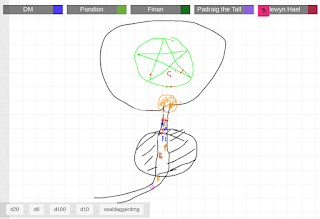
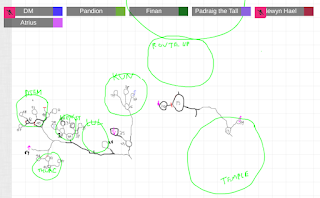
A player in my regular online game posted some examples of my maps:


The one at the top is a zoomed-in combat map. The one at the bottom is level 2 of the megadungeon they're exploring. 

Roll20 has all kind of fancy functions, but I'm too old now to be bothered how to learn. I would rather just scrawl things on the screen with the rudimentary drawing function. It does what it needs to. And it also, I think, spurs the players to use their imaginations rather than getting caught up in what they can see.

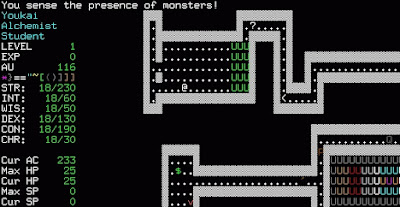
I never really thought of it this way before just now, but looking at these maps of mine with fresh eyes, it seems evident to me that my aesthetic experience of playing and running D&D is very strongly influenced by having wasted vast swathes of my teenage years playing *band games and other roguelikes, squinting at maps like this:


Shorn of box office visuals (or any visuals at all, really), the brain has to make up for it by doing a lot of imaginative legwork. This is the genius of ASCII-based roguelike games, of course: by providing an initially alienating aesthetic, they end up becoming more immersive than the most cutting edge PS5 offering, because you get caught up in a world that is as much, if not more, a product of your own imagination as the designer's. (The additional stimulation to the brain is also partly, I think, what makes them so addictive.) 

The phenomenology of the visualisation of events in an RPG is fascinating to me. When a DM describes to four players a room in a dungeon, each of the five participants will build an image in his or her mind. Usually, this works tolerably well - well enough for everyone to have the same rough idea of where and what everything is. Yet we will never be able to tell how close their independent visualisations are to each other's, or to that of the DM. Every player in every RPG session ever played has created their own independent representation of a particular reality in their own mind, and it is one that can never fully be revealed to anybody but themselves. This is, you know, deep, man. 

Saturday, 5 February 2022

Reflections on the Great Orc Debate: Expressionism versus Naturalism and Interesting Orc Types

My previous post provoked largely reasonable debate, proving how old fashioned dialectics can get us to the heart of the matter. I thought it would be interesting to summarise the points on which I think agreement was reached, and where the truth probably lies. People almost never take the effort to take stock after internet debates; let's give it a shot.

  • There is certainly a problem that arises when people adopt a vision of the orc as 'noble savage'. The is far too close to real-world historical conceptions of people living in particular societies, and leads to clear insensitivities.
  • It was probably extremely ill-advised in the first place to have adopted the word 'race' to refer to orcs, elves, dwarves, humans, and the like. And however ill-advised that may have been, it is even more so nowadays when the word has become almost unbearably fraught. 
  • If somebody you're gaming with says something in the game makes them feel uncomfortable, you're probably an arsehole if you keep doing it. As I said back in 2009, almost all gaming advice can be reduced to the simple maxim: Don't be a dickhead.
  • Orcs work really well as a representative of the worst human tendencies (on which more below) - aggression, cruelty, resentment, and so on. Watering that down by trying to make them sympathetic ironically seems to have the result of making it feel 'wrong' to stereotype them as evil, leading to weird discomfort with what is a core element of traditional D&D (killing evil humanoids and/or taking their stuff). 
  • Almost nobody likes racists or wants to be one, so debates should be had in good faith.

What I think this boils down to, to reframe the main point of my previous post, was that if one is to use 'orcs' at all, it is better to do so expressionistically rather than naturalistically. In other words, orcs (like all monsters in general, really) are best thought of as representations or evocations of mood and emotion rather than natural species with genes and psychologies and histories of their own. They're like fairy tale goblins, devils or evil spirits - and not like Klingons. 

Some interesting orc types would therefore be:

  • The pig-faced militarist, embodiment of belligerence and tyrannical discipline, like a hypertrophied perversion of ancient Sparta
  • The aggressor, glorying in violence and self-aggrandisement and worshipping nothing but the principle of might makes right - an embodiment of what people really seem to mean when they talk about 'toxic masculinity' (and in the same sense that Nazism seemed to embody a distortion and glorification of the most negative of male traits, unmoored from any of the positive ones and freed from traditional morality by Nietzschean nihilism) 
  • The dehumaniser, representative of how cruelty develops from conceiving of human life, and certain individual human beings, as lacking in intrinsic value, and therefore fair game for whatever torments one wishes to inflict upon them; these orcs would look upon humans as lacking any inner life or moral worth, and hence as mere playthings (or worse)
  • The resentor. Human beings know love, they know kindness, they know friendship, they know art. The orc does not understand those things, except insofar as it grasps that it will never have them. It embodies spite: it will make us suffer because it can never be what we are.

Add your own.

Tuesday, 1 February 2022

Racism and Orcs

The latest edition of the Quillette Podcast contains some interesting thoughts and observations about wokeness in D&D, and is worth listening to. The starting point for the conversation is a recent Wired article on 'genetic determinism' in fantasy, with particular reference to orcs. Apparently, some people think there is something 'problematic' (though I'm not sure that particular word appears in the article) about D&D orcs. The logic of the argument is rather hard to follow, but it seems to boil down to unease about the 'racial essentialism' of portraying orcs as indelibly evil (or, for that matter, elves as being into poetry, or dwarves as being into mining). There is felt to be something wrong with this. It's unfathomable to me that anybody could think that imagining there are such things as orcs and imagining they have intrinsically negative characteristics would lead anybody to imagine that the same could be true of human 'races'. But that genuinely does appear to be the implausible argument that is being made: if there are orcs in D&D, and they are evil, people might play D&D and come to believe that human 'races' might be evil, and thereby become racist. Does that sound even remotely realistic to you? 

I've long ago lost interest in the idea of orcs as an adversary monster, along with most of the trappings of high fantasy in general. They're old hat. But the concept of evil entities bent on the violent destruction of humanity clearly has a resonance with us. Calling it 'genetic determinism' is so self-evidently a category error that I find it difficult to process the notion that anybody could be making that argument seriously - but then I force myself to remember there are people in the world who worry about things like whether dragons are physically capable of flying. Nerds can have a really difficult time with expressionism. 

Orcs don't have genes. They are mythical, fairy tale beings, with a different essence altogether. They're not a 'race', or a 'species'. They're spirits, demons, monsters. This isn't racism. It is quite literally the stuff of which fantasies, myths and legends are made. Why would you want them to be otherwise? 

The other problem, of course, is that even taking the argument on its merits, it makes no sense. Animals which belong to different species are different from one another. It isn't 'genetically essentialist' to say that lions are live in prides whereas leopards are solitary, that crows are more intelligent than wrens, or that ants are social insects whereas spiders generally aren't. It's just fact. So even if one does want to think of fantasy 'races' in the reductive, pseudo-scientific, materialist sort of way that the author of the Wired article clearly does, the problem just isn't a problem in the first place. You're not talking about different types of human. You're talking about different species.

Being charitable, I have no doubt the people who worry about this kind of thing are acting in good faith. Who likes racism? But the idea that one needs to excise orcs from the game, or radically rethink them, because their existence and the fact they are evil might lead people to be racist in the real world is so strange, so melodramatic, so reflective of a complete lack of understanding of basic human psychology, that it beggars belief it would find any credence whatsoever in the world beyond the fever dreams of the most stereotypically, self-parodically woke. It's profoundly odd.